NVIDIA: 45°C liquid cooling cuts data center water use to near zero
NVIDIA says its Rubin generation is the first fully liquid-cooled AI infrastructure. The DSX reference design removes evaporative cooling and aims to bring facility water consumption close to zero.
A closed loop instead of cooling towers
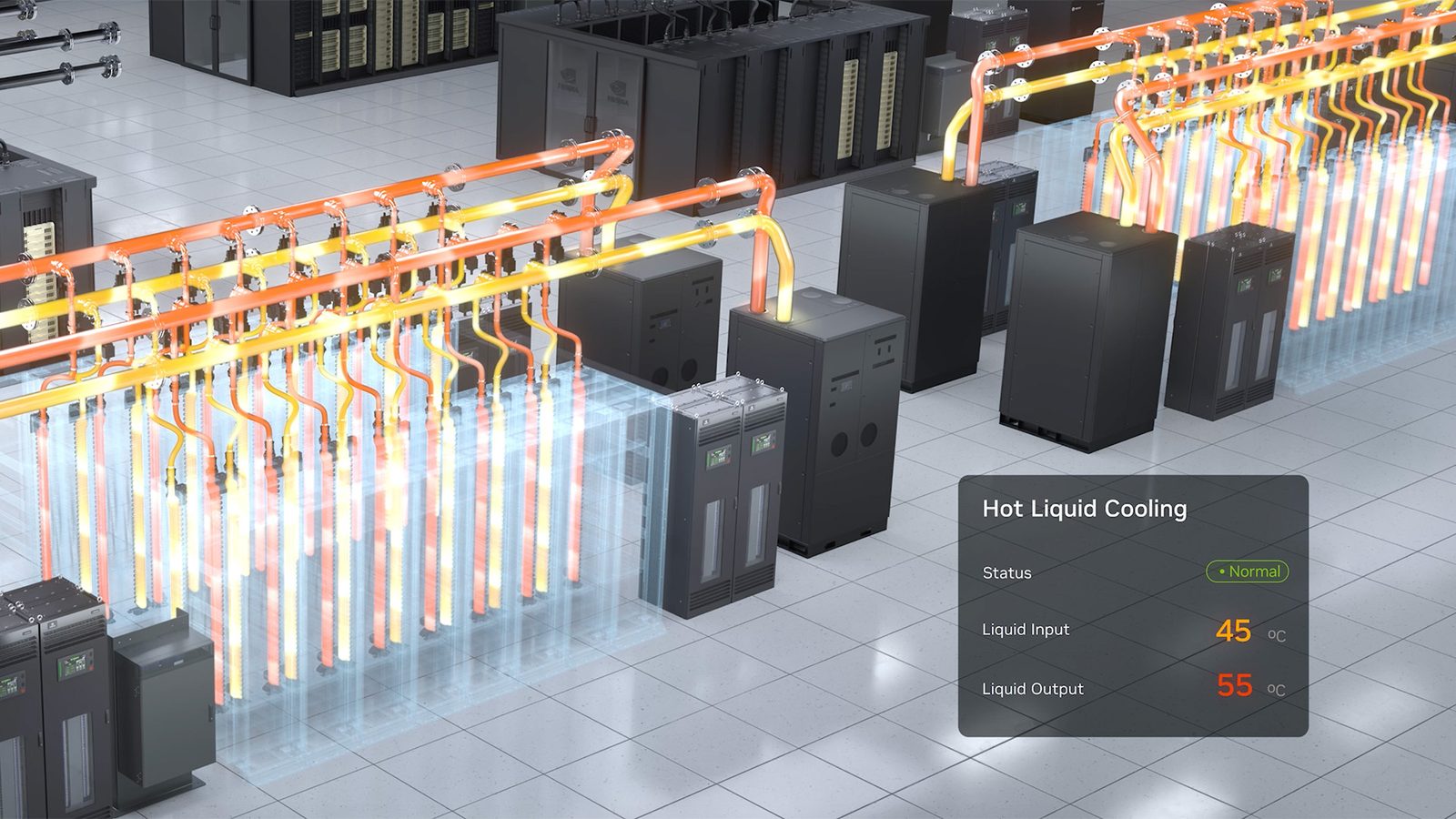
NVIDIA has detailed the thermal architecture behind the Rubin generation of its AI infrastructure, which the company describes as the first to be cooled 100% by liquid: every chip and every networking component sits inside a closed loop, with no fans anywhere in the system. The approach is documented in the NVIDIA DSX AI factory reference design.
Ali Heydari, director of data center cooling and infrastructure at NVIDIA, said the DSX design has zero water consumption and that most of the power and water usage has been eliminated. With dry-cooler-based designs, he added, the system runs closed-loop with no evaporative water cooling — except for roughly 1% of the year, when chillers may be needed in some climates.
In favourable geographies, NVIDIA says the 45-degree architecture reduces facility cooling water consumption from about 2.6 million gallons per megawatt per year — typical for cooling-tower-based systems — to near zero, a reduction of up to 100%.
Why warmer coolant saves energy
Cooling has historically accounted for as much as 40% of a data center's electricity consumption, according to McKinsey data cited by NVIDIA. Industry estimates suggest that raising chiller plant temperatures by just one degree can cut cooling energy costs by around 4%. At hyperscale, NVIDIA calculates that a 50-megawatt facility can save more than $4 million annually in cooling-related energy and water costs after switching to liquid-cooled infrastructure.
The coolant is 75% water and 25% propylene glycol, circulated through cold plates mounted directly on the processors. It enters at up to 45°C and leaves at roughly 55°C; NVIDIA says performance does not degrade, because the cold plates keep device temperatures within validated operating limits. Since nothing in the server depends on cool air, warm summer ambient temperatures are acceptable and heat can be rejected through outdoor dry coolers for most of the year.
A different machine — and a new industry default
Richard Whitmore, president and CEO of Motivair, the advanced cooling division of Schneider Electric, said the transition became unavoidable once power density passed the point where air cooling was no longer viable: “Once the watts per chip crossed a certain level, liquid cooling became mandatory.”
Fully liquid-cooled servers also change the physical layout. Sealed front panels replace perforated bezels, fan noise that can reach 85 decibels disappears, and rack density rises: NVIDIA says a system that previously occupied six rack units now fits in two. The company also points to waste-heat recovery, where residual heat could warm nearby commercial or residential buildings, while noting that geography still matters — a data center in the Scottish Highlands and one in Phoenix, Arizona, face very different conditions.
SiTech — AI-powered web development
We build fast, modern websites and bring AI into real business workflows. Have a project or a question? We'd love to help.