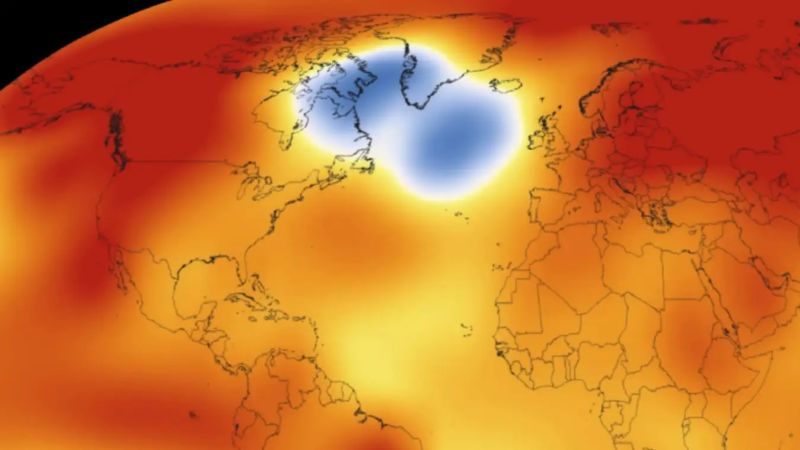
A 'cold blob' in the Atlantic could be a sign of AMOC shutdown
A patch of the North Atlantic south of Greenland has been cooling while the rest of the ocean warms. A new study links the anomaly to a weakening AMOC, one of the most alarming climate tipping points.
A patch of the North Atlantic south of Greenland and Iceland has been getting colder while the rest of the ocean warms — a phenomenon scientists call the "cold blob" or "warming hole". A new study, covered by CNN on 12 June, concludes that the anomaly is a signal of a weakening ocean circulation rather than a local weather effect, and that the finding points to one of the most alarming climate tipping points.
Nearly one degree of cooling since 1900
The cold blob has cooled by almost 1°C (1.8°F) since 1900. Scientists have long debated two explanations: heat loss from the ocean surface caused by changes in winds and clouds, or the weakening of the Atlantic Meridional Overturning Circulation (AMOC) — the vast conveyor belt that carries warm water from the tropics to the Northern Hemisphere, where it cools, sinks and flows back south.
The study's authors combined ocean heat measurements from instruments and satellites with climate models. They found that cooling occurs not only at the surface but also deep in the ocean, where winds and clouds have a much weaker influence. "It is changing ocean heat transport," said Stefan Rahmstorf, a study author and professor of physics and oceans at Potsdam University in Germany.
Why a shutdown would matter
Research suggests the AMOC is weakening as global warming melts ice and pushes more freshwater into the ocean, disturbing the balance of heat and salinity that drives it. Some scientists warn the system is approaching a tipping point, potentially as early as this century. A shutdown would be a global catastrophe: accelerated sea-level rise on the US East Coast, a deep winter freeze in Europe, and a shift in the African monsoon that would drive prolonged droughts.
Not the final word
Independent researchers quoted by CNN said the study strengthens the case but does not settle it. René van Westen of Utrecht University noted that earlier work showed a cold blob can be produced by atmospheric conditions alone, while adding that consistent results across different datasets make the conclusions more robust. David Thornally of University College London cautioned that sparse real-world data means the datasets are "best viewed as good approximations rather than perfect representations of reality", and Jonathan Baker of the UK Met Office said the paper adds evidence for an AMOC contribution "rather than definitively settling the question".
SiTech — AI-powered web development
We build fast, modern websites and bring AI into real business workflows. Have a project or a question? We'd love to help.