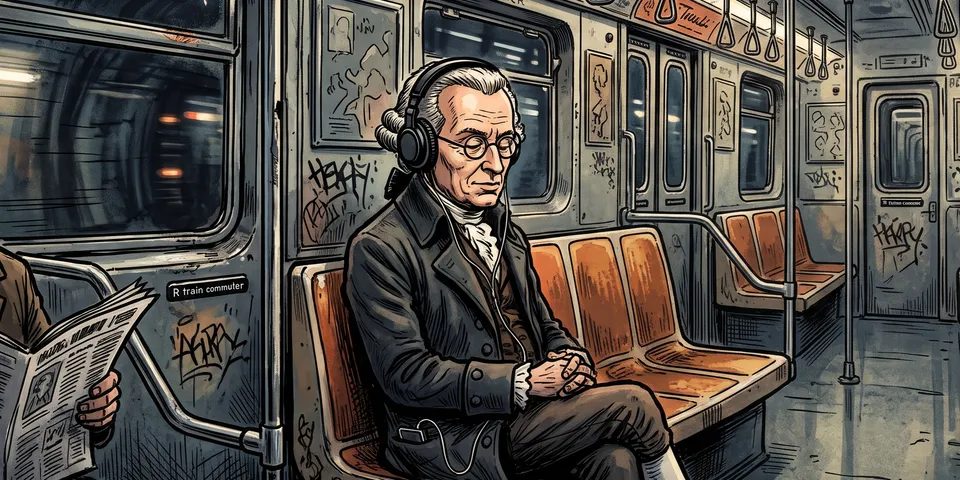
A Kantian Critique of Justin Bieber's “Sorry”
An essay published on decodingvibes.com reads Justin Bieber's 2015 song through Kantian ethics and argues that its central question — is it too late to say sorry? — is not a moral question at all.
An essay published on decodingvibes.com analyses Justin Bieber's 2015 song “Sorry” through the prism of Kantian ethics and its central question: is it too late to say sorry?
For the author, Suranjan Das, the thesis is paradoxically simple: through a Kantian lens this is not a moral question at all. The answer sits inside the question — yes, it is too late, but not for any reason connected to the nature of time. The form of the question itself shows that the song fundamentally misunderstands what an apology is.
A question that contains its own answer
Bieber is not asking “What do I owe to the person I have wronged?” He is asking whether saying sorry is still worth anything.
The hypothetical imperative: apology as a means
If an apology becomes a means towards an end, it is a hypothetical imperative: you expect to gain forgiveness by using it. A moral obligation, by contrast, does not depend on whether the desired consequence remains available — which is precisely why the question of lateness reveals that the value of the apology is being measured by what it can accomplish.
He claims “I made those mistakes maybe once or twice” and then admits “maybe a couple of hundred times”, so he cannot claim ignorance of having wronged someone. Yet the song does not dwell there: “So let me redeem myself tonight”, “I just need one more shot at second chances”. The concern shifts immediately from the harm done to the consequences suffered by the wrongdoer — and moral redemption is not the restoration of one's preferences.
Testing the maxim
Later, Bieber clarifies that he is “missing more than just your body”, which is the real reason the apology is offered. He is not confronting the wrong he committed but the loss of something he desired. The categorical imperative requires treating another person as an end in itself rather than as a means to satisfy one's desires. That yields an obvious control question: would the apology still be rendered if Bieber knew for certain there is no second chance and no redemption?
The following verses strengthen the suspicion. “I'll take every single piece of the blame if you want me to” is morally revealing, because responsibility for a wrong cannot depend on the victim's request. And “there is no innocent one in this game for two” treats wrongdoing as a contest in which the other party's guilt diminishes one's own — though another person's misconduct cannot alter the maxim by which one acted.
Finally, “can we both say the words and forget this?” shows the objective is closure rather than moral acknowledgment. Moral worth cannot be established by declaring the purity of one's motives; the maxim must be examined. If the maxim is “When I have wronged someone and fear losing them, I will apologise in the hope of regaining them”, the apology stays hypothetical and, more importantly, fundamentally self-interested.
The conclusion: the song's central question ironically reveals the very moral failure it seems to try to repair. “Is it too late?” translates to “is an apology still capable of getting what I want?” Once an apology is evaluated by whether it can secure forgiveness and reconciliation, it ceases to be an action grounded in duty.
SiTech — AI-powered web development
We build fast, modern websites and bring AI into real business workflows. Have a project or a question? We'd love to help.