Georgia Tech's SWANS network lets implants talk through body tissue
Researchers at Georgia Tech built SWANS, a system that sends signals between medical implants through body tissue instead of radio waves, extending battery life more than 15 times and reaching 30 centimeters across the body.
Most medical implants, from pacemakers to insulin pumps, work in isolation. Engineers at Georgia Tech built a networking system that lets them coordinate through body tissue instead of antennas and radio waves. The research appears in the journal Science.
Why radio does not fit the body
Communicating implants today mostly rely on Bluetooth Low Energy or near-field communication (NFC), and both fit the body badly, says co-author Alex Abramson, a Georgia Tech engineer. Active Bluetooth parts can cut an implant's battery life by up to 90 percent, and radio links struggle once a signal must cross more than a centimeter of tissue. Radio also needs antennas, which pushes devices to at least five millimeters wide.
A network modeled on the nervous system
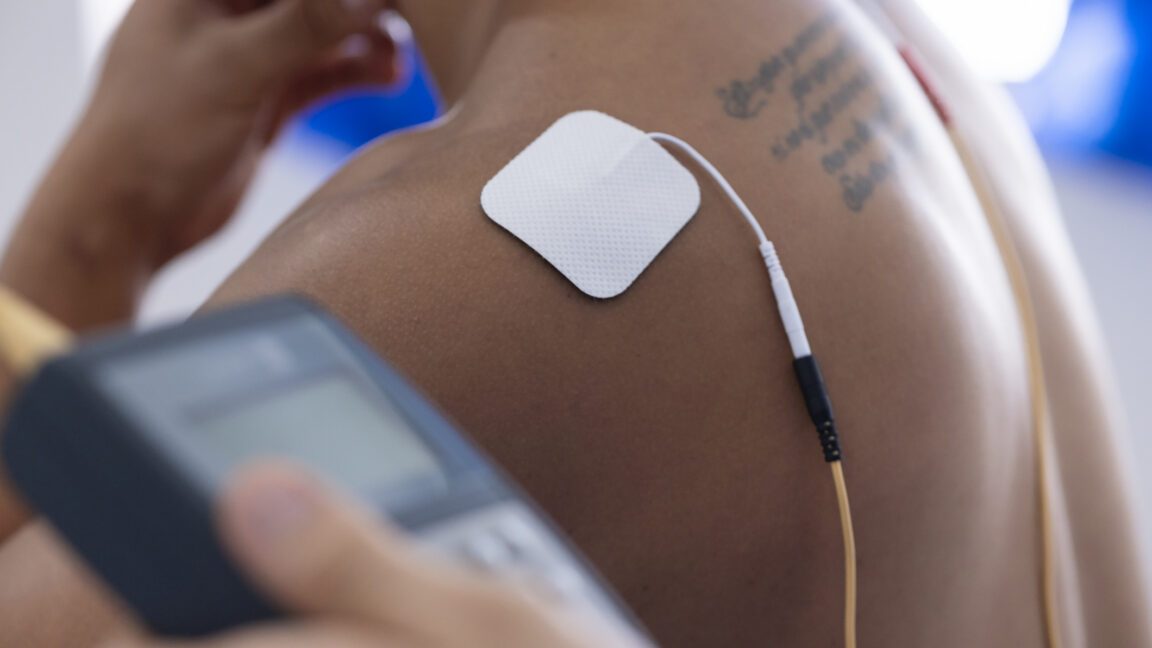
The team's alternative is SWANS, the Smart Wireless Autonomous Networking System. It uses ionic conduction, the mechanism neurons rely on when they shuttle sodium and potassium ions across their membranes, but its signals travel through ordinary tissue rather than nerves. A wearable hub holds the intelligence and the power and emits pulses of up to 12 volts. A patch of stainless-steel microneedles carries those pulses past the skin's poorly conductive outer layer, and syringe-injectable implants do the work inside the body.
Every implant in range picks up a pulse, but only the intended one reacts, "a bit like people in a crowded room who turn around only when they hear their own name," Abramson said. A resistor and a capacitor tune each switch to answer only specific combinations of pulse strength and length.
Tests in tissue and live animals
Because the implants are passive, they draw almost no power while listening, extending battery life more than 15 times compared with Bluetooth and NFC. A complete implant with its battery measures 3 by 1.1 by 17 millimeters and fits through a 6-gauge needle. In pork belly, a single 10-volt pulse produced a detectable voltage gradient more than 30 centimeters across the tissue and 14 centimeters deep.
In live rats, signals reached implants under the skin, in the abdominal cavity and in the stomach. Strain sensors on the animals' front legs triggered a pulse that reached an implant on the corresponding hind leg and made it twitch, and a relay passed a signal on only when a temperature sensor registered a fever above 40° C. A two-month study found scar tissue around the implants, but raising the voltage within safe limits kept communication going without stimulating untargeted nerves.
What SWANS cannot do
SWANS cannot carry much data, and it is not meant to: it passes key information between parts of the body, and has not yet been tested in large animals or humans. Abramson argues its value is that the protocol is agnostic to the sensor or actuator, so it could one day link drug delivery pumps and neurostimulators that today work separately.
SiTech — AI-powered web development
We build fast, modern websites and bring AI into real business workflows. Have a project or a question? We'd love to help.