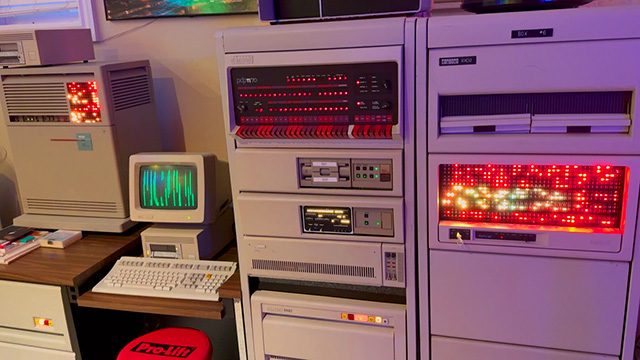
A restored PDP-11/83 serves this page on 2.11BSD Unix
A restored PDP-11/83 minicomputer running 2.11BSD serves pdp1173.com itself and publishes a live system panel — from a Mentec M11 CPU and two Q-bus chassis down to a plain-text snapshot of 21 processes.
The page at pdp1173.com is titled “PDP-11/83 — Live System Overview”, and it is what the title says: a restored 16-bit minicomputer that serves the site itself and reports its own activity while doing it. The machine runs 2.11BSD, the PDP-11 port of UNIX, and the live panel at the top of the page is fed by a text snapshot that the server asks the machine for.
The hardware
The CPU is a Mentec M11, a single-board PDP-11-compatible processor with memory on the same board. It replaced the original M8190 processor and two separate memory boards. The system spans two Q-bus chassis linked by an M9404/M9405 pair, with 22-bit memory management and drivers written to be SPL-aware.
Storage and media ride on a mix of DEC and Emulex controllers: an RQDX3 for MFM disks and the dual RX50 floppies, an Emulex UC07 that bridges SCSI disk and tape onto the Q-bus, an RLV12 for a pair of RL02 drives, and a KDA50 pair presenting an RA82 and two RA92 drives through MSCP. A TKZ50 tape unit on the UC07 holds backups, while a DEQNA Ethernet controller with the BSD if_qe driver and an M3104 serial multiplexer tie the system to the network and to terminals.
What the live panel reports
The site serves a plain-text snapshot at /cgi-bin/webtop. A snapshot fetched while this article was being written showed the host “minerva” up for one day and four hours, 21 tasks with one running and 20 sleeping, 4,088 KB of physical memory of which 1,730 KB were in use, 8,359 KB of swap, and a load average around 0.39. The process list included init, cron, syslogd, sendmail, ntpd, eight getty processes, httpd under the www user and the webtop process that answered the request.
Keeping 1980s hardware online
The page caches its shared snapshot for five seconds and pauses updates while the browser tab is hidden; a front-end cache cuts repeated homepage requests. The system boots from MSCP disks, keeps an RL02 drive as an alternate boot path, rotates backups onto TKZ50 tape, images the RL02 media periodically and preserves source, site assets and restore instructions in Git. The animated front panel is a browser-side simulation of a PDP-11/70 operator panel credited to Paul Nankervis and James Hagerman; the numbers beside it come from the machine itself.
SiTech — AI-powered web development
We build fast, modern websites and bring AI into real business workflows. Have a project or a question? We'd love to help.