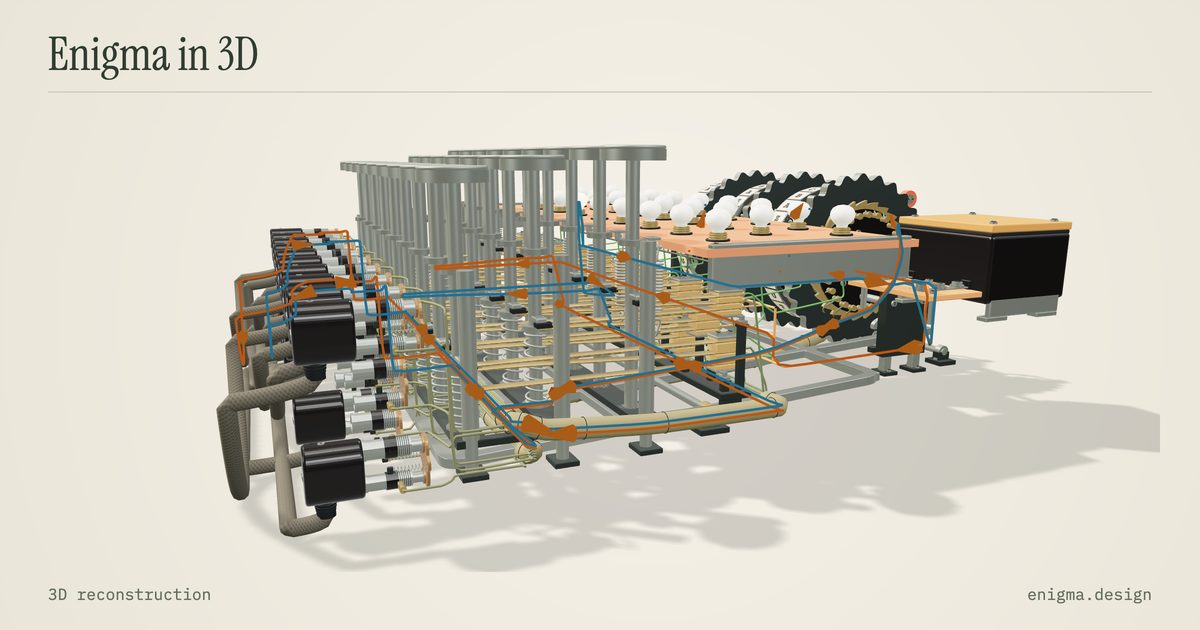
A working 3D model of the Enigma machine, playable in the browser
The site enigma.design renders the German cipher machine in interactive 3D: type on your keyboard, watch the current cross the plugboard and the rotors, and follow how Allied cryptanalysts learned to break it.
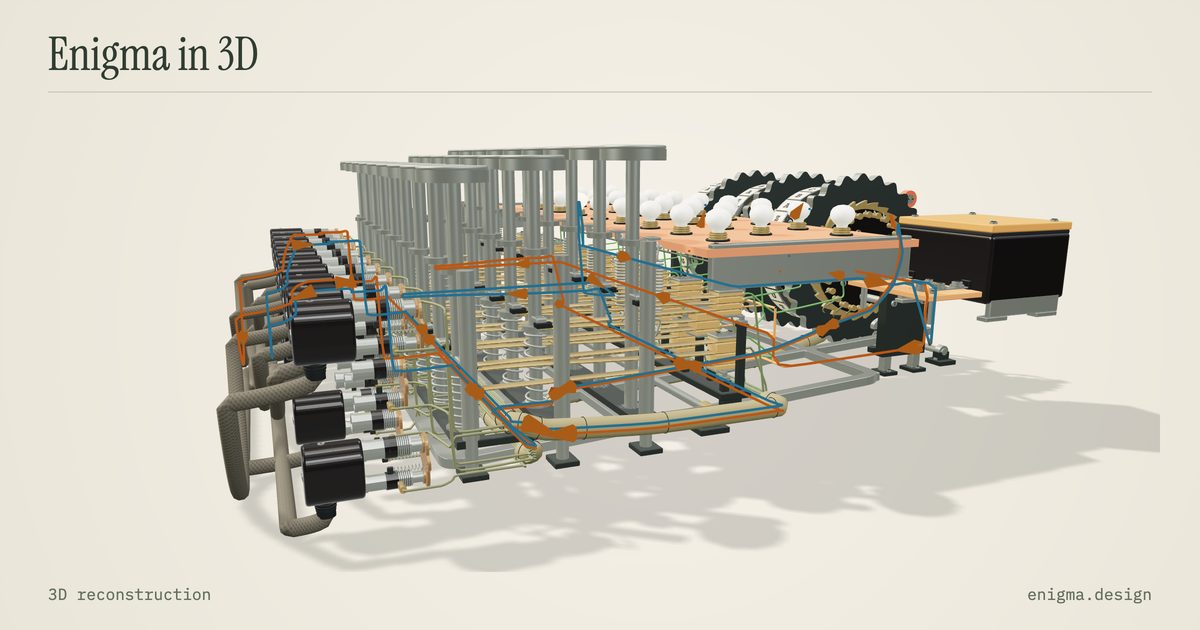
enigma.design hosts a working 3D reconstruction of the Enigma machine that runs entirely in the browser. Typing on your keyboard presses the keys of the rendered machine, the current travels through the rotors and the plugboard, and the matching lamp lights up. Sixteen short lessons and a 33-event chronology run alongside the model.
What the model shows
The collection covers several variants, from the 1923 Handelsmaschine to the naval M3. You can spin the machine, inspect a rotor from the inside and follow the circuit step by step. A guided demo walks through the first encrypted telegram: the letters light up, an operator taps them in Morse and the radio carries the signal, since Enigma itself never transmits.
Rotors, plugboard and the electrical path
The plugboard swaps pairs of letters as the current enters the rotors and again as it leaves them, so a single cable changes the whole route. The ring setting shifts the alphabet ring around the wired core, while the reflector stays still and turns the current back. Every keypress moves the right-hand rotor, and when the notch arrives the next wheel steps with it; one lesson covers the double step.
A daily key sheet gave the operator four things: the rotor order (Walzenlage), the ring settings (Ringstellung), the starting positions (Grundstellung) and the plugboard connections (Steckerverbindungen). Operators began with six cables and later used ten. Army and Air Force units chose three rotors from five, the Navy from eight; adding rotors IV and V raised the orders from six to sixty.
Why the history still matters
On 23 February 1918 the German engineer Arthur Scherbius filed a patent for an electrical cipher machine whose rotating wired wheels changed the electrical path with every turn. Enigma I entered Army service on 1 June 1930 and added the plugboard at the front. In December 1932 the Polish cryptanalyst Marian Rejewski reconstructed the military machine's internal permutations from mathematics, intercepted messages and intelligence from France; with Jerzy Rozycki and Henryk Zygalski he devised ways to recover its changing keys. In July 1939 Poland shared those methods with British and French colleagues; by September Bletchley Park was Britain's codebreaking centre.
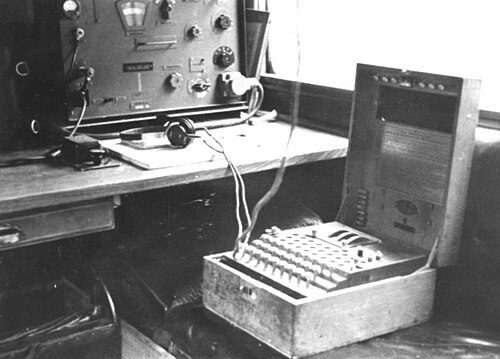
The site is explicit about where reconstruction begins: no specimen of some machines survives, so case, dimensions and wire routes are rebuilt and the demos use a synthetic cipher.
SiTech — AI-powered web development
We build fast, modern websites and bring AI into real business workflows. Have a project or a question? We'd love to help.