AI isn't outthinking mathematicians, it's out-remembering them
A new analysis argues that part of AI's mathematical advantage comes not from superior reasoning but from escaping the tight limits of human working memory.
When an AI system solves a hard mathematical problem, the usual explanation is that it has become more intelligent. A new analysis by David Piffer argues that part of that success has a far more prosaic cause: human working memory is severely limited, while a model's symbolic workspace is not.
Memory as a hidden limit on mathematics
Working memory is the mental system that holds and manipulates information over short periods. Solving an equation means remembering what each variable stands for and which operations have already been carried out. Human capacity is remarkably restricted: multiplying two three-digit numbers in your head is hard not because the operations are complicated, but because partial results must be preserved. Paper does not make anyone smarter, yet it expands effective working memory.
What the research shows
The role of memory in mathematics is not merely theoretical. Alloway and Passolunghi (2011) found that working-memory measures made a distinct contribution to children's mathematical performance rather than simply reproducing the link with general verbal ability. In a six-year longitudinal study, Alloway and Alloway (2010) found that working-memory performance at age five predicted literacy and numeracy six years later even after IQ was included. Blankenship and colleagues (2015) and a meta-analysis by Friso-van den Bos and colleagues (2013) reported similar effects. The author warns against exaggeration: memory and intelligence overlap substantially, and statistical controls cannot perfectly separate them.
The context window as a gigantic notebook
A modern model can process an enormous sequence of tokens at once — the problem statement, definitions, intermediate calculations and its own earlier reasoning. The context window is not identical to human working memory; it is better understood as a gigantic external notebook with an imperfect search system. The model's reasoning is often externalised: the text is part of the mechanism, not merely a report of a finished thought. The author therefore calls it "augmented symbolic working memory".
Von Neumann or Einstein
Mathematics benefits from this more than other fields, because almost every assumption, definition, objective and proved result can be written down and stays stable. In informal reasoning — a social question, say — the decisive information may never have been observed and concepts are unstable, so a larger notebook does not solve the underlying problem. Mathematics also provides strong feedback: a solution can be substituted back or checked numerically.
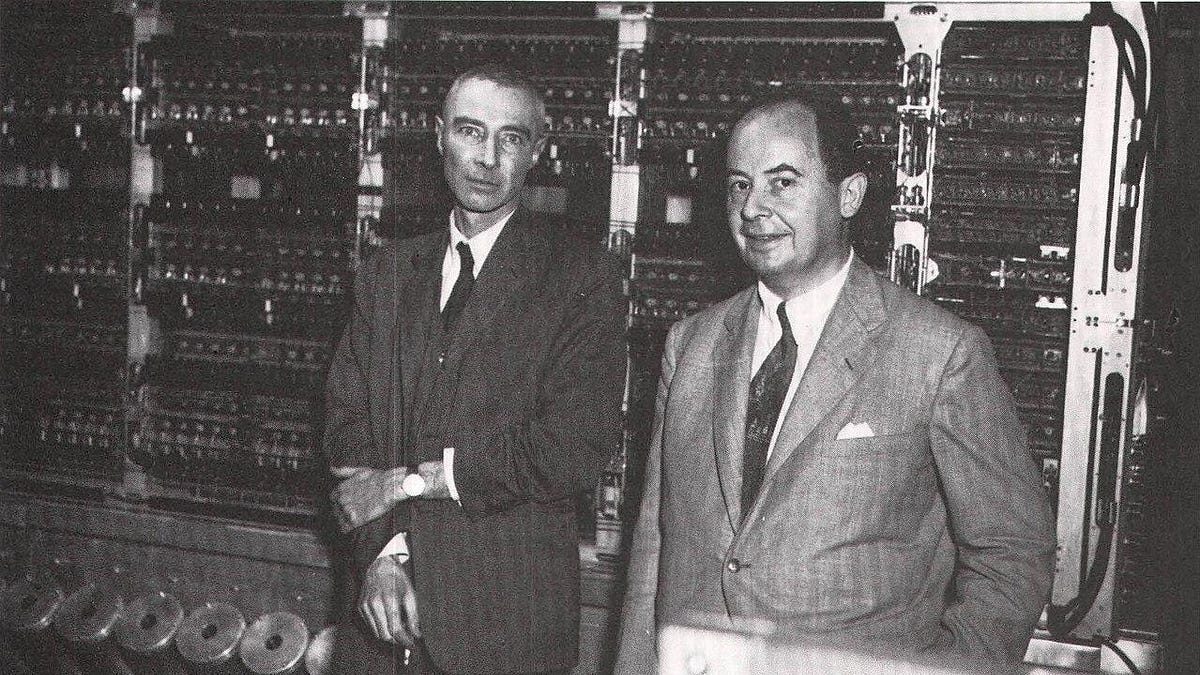
The author concludes that present-day AI resembles a machine-amplified version of von Neumann's speed and breadth more than Einsteinian depth. The physicist Eugene Wigner, who knew both, called von Neumann's mind the quicker and Einstein's the deeper. The next threshold, on this view, will be reached when AI can recognise that a problem has been framed incorrectly and invent a fundamentally better way of understanding it.
SiTech — AI-powered web development
We build fast, modern websites and bring AI into real business workflows. Have a project or a question? We'd love to help.