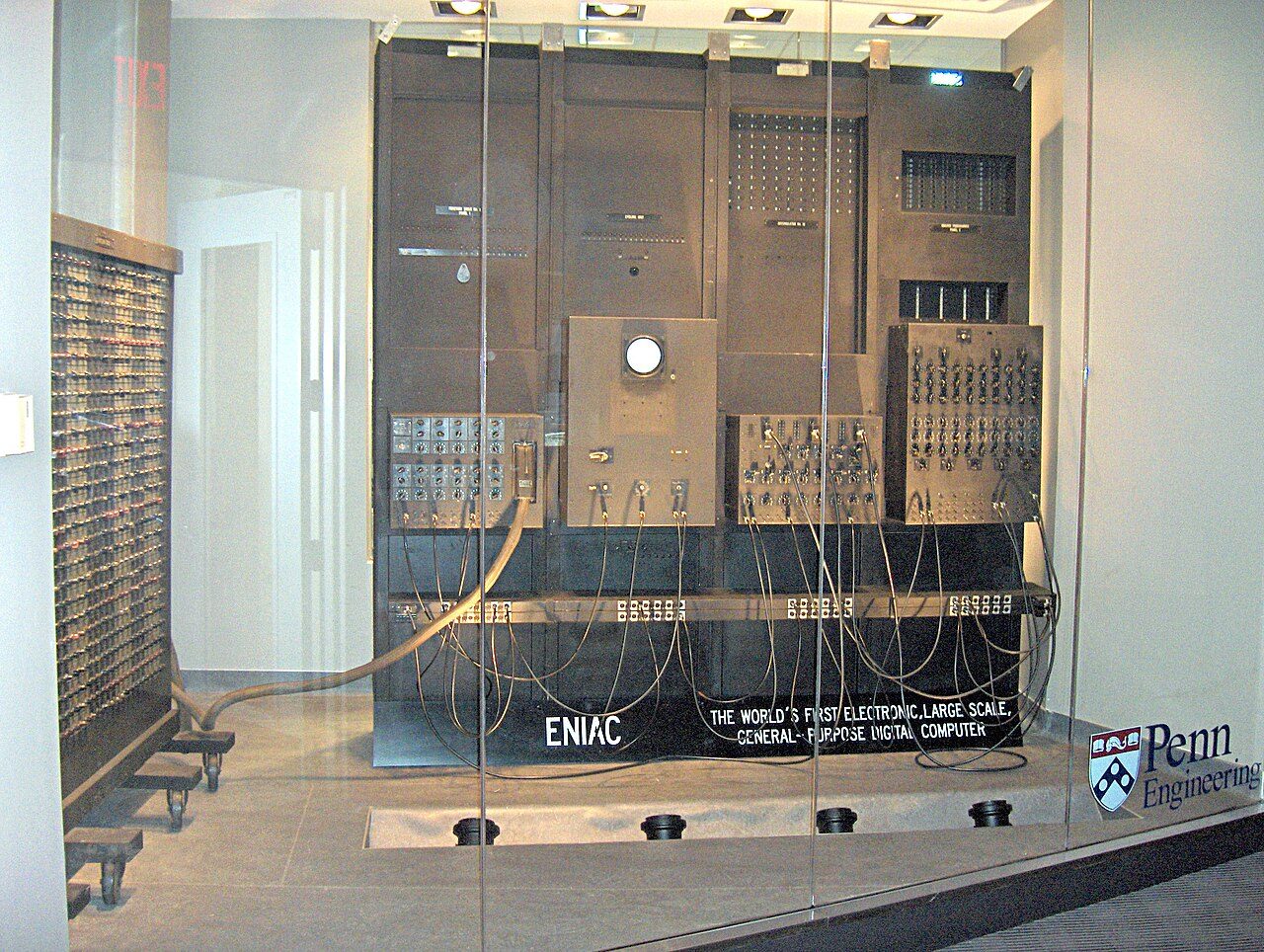
Alan Kay: ENIAC Had No BIOS, and Its Programs Were Wired by Hand
Asked on Quora whether the ENIAC had a BIOS, computing pioneer Alan Kay said the machine had nothing of the kind: its programs were wired into plugboards and switches, and the word BIOS only appeared decades later, in 1975 and 1981.
Asked on Quora whether the ENIAC had a BIOS, computing pioneer Alan Kay gave a direct answer: he is pretty sure the machine had neither a BIOS nor anything analogous to one. In the same reply he sides with those who do not consider ENIAC a stored-program computer, noting that a few tricks along those lines existed but, in his view, not enough to qualify.
Why there was nothing to boot
ENIAC, the Electronic Numerical Integrator and Computer, was completed in 1945 and introduced publicly at the University of Pennsylvania in February 1946. It was designed by John Mauchly and J. Presper Eckert to compute artillery firing tables for the U.S. Army. Programs were not kept in memory: a problem was set up through plugboard wiring and switches, and three portable function tables carried 1,200 ten-way switches each. Preparing a new problem took days, and the machine had to be rewired rather than rebooted.
Cold starts with toggle switches
The second half of Kay's answer tests the definition of a BIOS. He asks whether the "Basic IO" program must live in firmware to qualify, and notes that the letter of the law says yes, while he leans toward the spirit, which does not require a ROM. Well into the 1960s, he recalls, many computers were started cold with no code at all: an operator keyed a few instructions in with toggles or other switches, and those instructions read in a paper tape holding more code. That was the case for most of the early DEC machines. The CDC 6600 of roughly 1964-1965 had a panel of switches for initial cold starts, which he calls much more convenient than toggles.
When the word BIOS appeared
Turning to Wikipedia, Kay notes that the first officially named BIOS arrived in 1975 with the CP/M operating system, while the modern sense of the term dates to about 1981 and the IBM PC. Both were ROM based. Commenters on the answer add that the CP/M BIOS was itself loaded from the boot disk, and that some machines kept a small boot loader or a debug monitor in ROM.
Why the distinction matters
The short answer points to a wider shift: ENIAC's generation worked at the level of hardware, and the stored-program idea arrived later. John von Neumann's 1945 draft report on the EDVAC and the EDSAC built at Cambridge mark that transition. ENIAC gained a primitive read-only stored-program mechanism in 1948 using its function tables, but by 1955 it had been retired in favour of EDVAC-class machines. A BIOS, in this reading, is a layer of the 1970s and 1980s, not of the first computers.
SiTech — AI-powered web development
We build fast, modern websites and bring AI into real business workflows. Have a project or a question? We'd love to help.