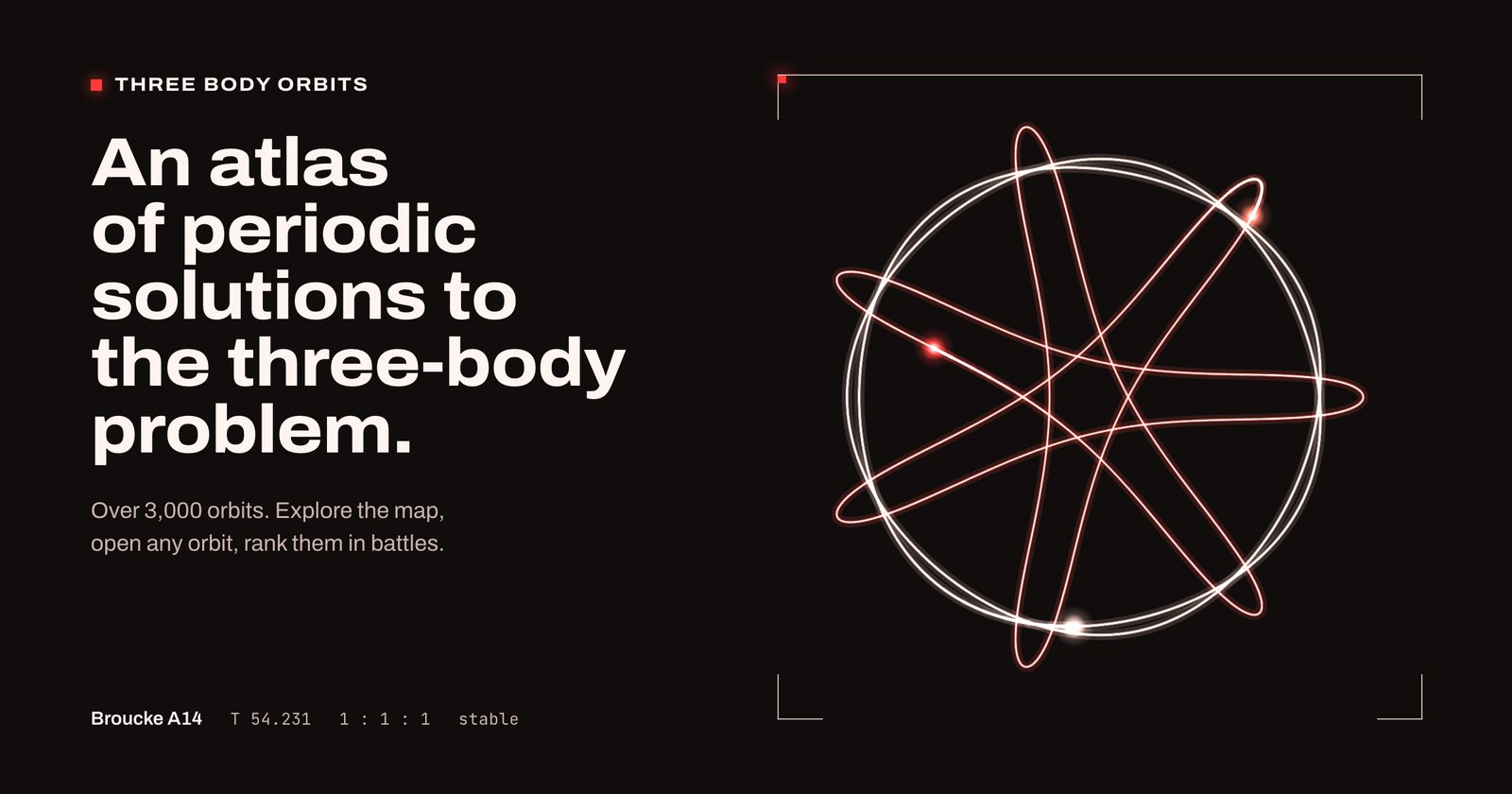
An atlas of 3,928 periodic solutions to the three-body problem
A new site, Three Body Orbits, gathers 3,928 periodic solutions of the three-body problem into one browsable atlas: orbits run live in the browser, and each is traced back to the paper that found it.
The three-body problem has no general solution in closed form, but it has thousands of periodic ones: arrangements in which three masses fall around each other and return, after exactly one period, to the positions and velocities they started from. A new website, Three Body Orbits, gathers 3,928 of those solutions into a single browsable atlas.
A map, not a list
The atlas is organised as a map rather than a catalogue. Orbits that look alike are placed next to each other, so related solutions cluster into islands, and each island — a family — has its own page. Zoomed out, the visualisation reads as a constellation of known solution space; zoomed in, individual orbits run live in the browser, playing one period at a time. Visitors can nudge an orbit off its track to watch it drift, rate it, and enter it into ranking battles against other orbits.
Forty families, one paper each
The 3,928 orbits are grouped into 40 families: sequences that share a shape and a topology but differ in how many times the bodies wind around one another. The best known is the figure-eight choreography, in which three equal masses chase each other along a single curve; the atlas lists 28 members of it. Other families are named for what they resemble — Butterfly, Dragonfly, Yin-Yang, Moth, Yarn.
Each family is traced back to the paper that first found it, so the atlas doubles as a bibliography of the field. The Broucke family dates from 1975 and describes a distant third body circling a close binary, and a 1975 survey across many mass ratios sits alongside it. A dozen orbits that Matthew Sheen found in 2016 with a root finder and hand-picked starting guesses appear next to a single certified satellite orbit, whose existence at masses 1, 1 and 1.001 rests on a computer-assisted proof.
Still growing
The catalogue is not closed. Its newest addition is a set of 13 equal-mass orbits with angular momentum, contributed by Milovan Šuvakov and shared with the site in September 2026: seven of them are the figure-eight carried to nonzero angular momentum, and all seven are described as linearly stable. Three orbits in the eighth sequence of the Belgrade gallery are noted as appearing in no other catalogue.
Periodic orbits are the test cases of celestial mechanics — the standard bench for stability analysis and for numerical continuation methods. Putting 3,928 of them on one interactive map, each linked to its discovery paper, turns a scattered literature into something closer to a working instrument.
SiTech — AI-powered web development
We build fast, modern websites and bring AI into real business workflows. Have a project or a question? We'd love to help.