Nottingham Study Finds Earth's Magnetic Field Shapes Fruit Fly Aging
Researchers at the University of Nottingham placed fruit flies inside a 'hypomagnetic' shield that blocks Earth's magnetic field. Flies with a Parkinson's-linked gene defect lived 20 percent longer, while healthy flies lived shorter lives.
Researchers at the University of Nottingham have found that removing Earth's magnetic field changes how fruit flies age — and the effect runs in opposite directions depending on whether the flies are healthy or carry a Parkinson's-linked defect. The study was published in the journal Aging.
A field all life evolved under
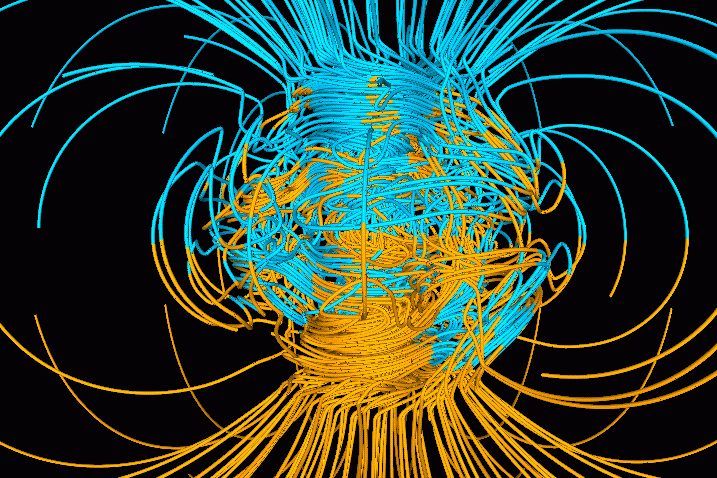
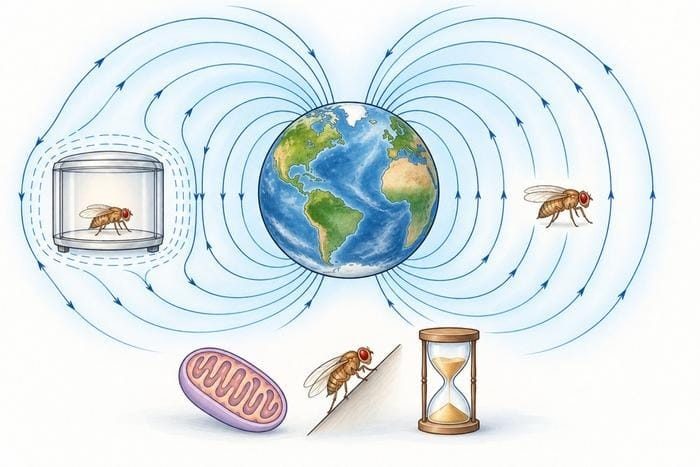
Every organism on Earth developed inside the planet's geomagnetic field, a protective bubble generated in the core and stretching into space that deflects harmful radiation. Fish, birds and insects use the field for navigation, but far less is known about how it interacts with living cells and their mitochondria.
Flies inside a hypomagnetic shield
To probe that gap, the team placed two groups of fruit flies inside a "hypomagnetic" shield — a cylindrical benchtop apparatus that blocks the influence of Earth's magnetic field. One group was made of healthy "wild-type" flies; the other carried a defect in the Pink1 gene, which is associated with early-onset Parkinson's disease in humans and involves mitochondrial dysfunction. Dozens of flies from both groups were followed across their lifetimes, which normally last about two months, while the scientists tracked changes in their energy metabolism with quantum diamond sensors and measured how far the insects climbed up against gravity.
Longer lives, weaker climbs
Shielding the flies from the magnetic field extended the lifespan of the Pink1 group by 20 percent, but reduced their mobility. Healthy flies showed the opposite pattern: their lives became shorter, while their movement improved. "I was really confused at first," said Jacob Reed, a PhD student in bioscience who co-led the study. "Why are these Parkinson's flies living longer than some of the wild-type flies? I had to double-check all of my data." Co-lead Lisa Chakrabarti, a professor of biochemistry, said the team believes it is the first to show such an effect in an organism with a disease phenotype.
What it could mean
Research on magnetic fields stronger than Earth's is well established, while the biological effects of hypomagnetic conditions remain poorly understood. The researchers plan to test other organisms to see whether they show similar mitochondrial and behavioural changes. The work could eventually inform treatments for human conditions and help prepare astronauts for deep-space missions beyond Earth's protective field. "The link with interplanetary space travel is absolutely key," Chakrabarti said. Without knowing which parameters to measure, she warned, astronauts could suffer real harm over the short or long term.
SiTech — AI-powered web development
We build fast, modern websites and bring AI into real business workflows. Have a project or a question? We'd love to help.