
Astronomer turns Starlink's sinking satellites into a planetary barometer
Tony Phillips of spaceweather.com reads the orbital decay of thousands of Starlink and rival satellites from public tracking data, turning the fleet into a daily index of upper-atmosphere density.
Astronomer and author Tony Phillips, who runs spaceweather.com, says he has turned SpaceX's Starlink fleet into a planetary barometer: the daily orbital decay of thousands of satellites reveals the state of Earth's upper atmosphere.
"Starlink has many downsides," Phillips writes, listing interference with astronomy, metallic debris polluting the atmosphere and Low Earth Orbit pushed to the brink of the Kessler Syndrome. "On the other hand, it makes a terrific barometer."
How the measurement works
The atmosphere expands as it heats, and satellites lose a few metres of altitude every day; when the air swells, orbital decay accelerates. The US Space Force publishes fresh orbital elements, known as TLEs, two or three times a day.
Buried in each TLE is a drag term called B*, and that is where air density ends up: the orbit model assumes a fixed atmosphere, so when the real one swells the fitted B* must grow to keep matching the tracking. A single satellite's B* is noisy, so Phillips follows a fixed sample of 1,000 Starlinks launched before 2026 and takes the fleet median.
What 2026 shows so far
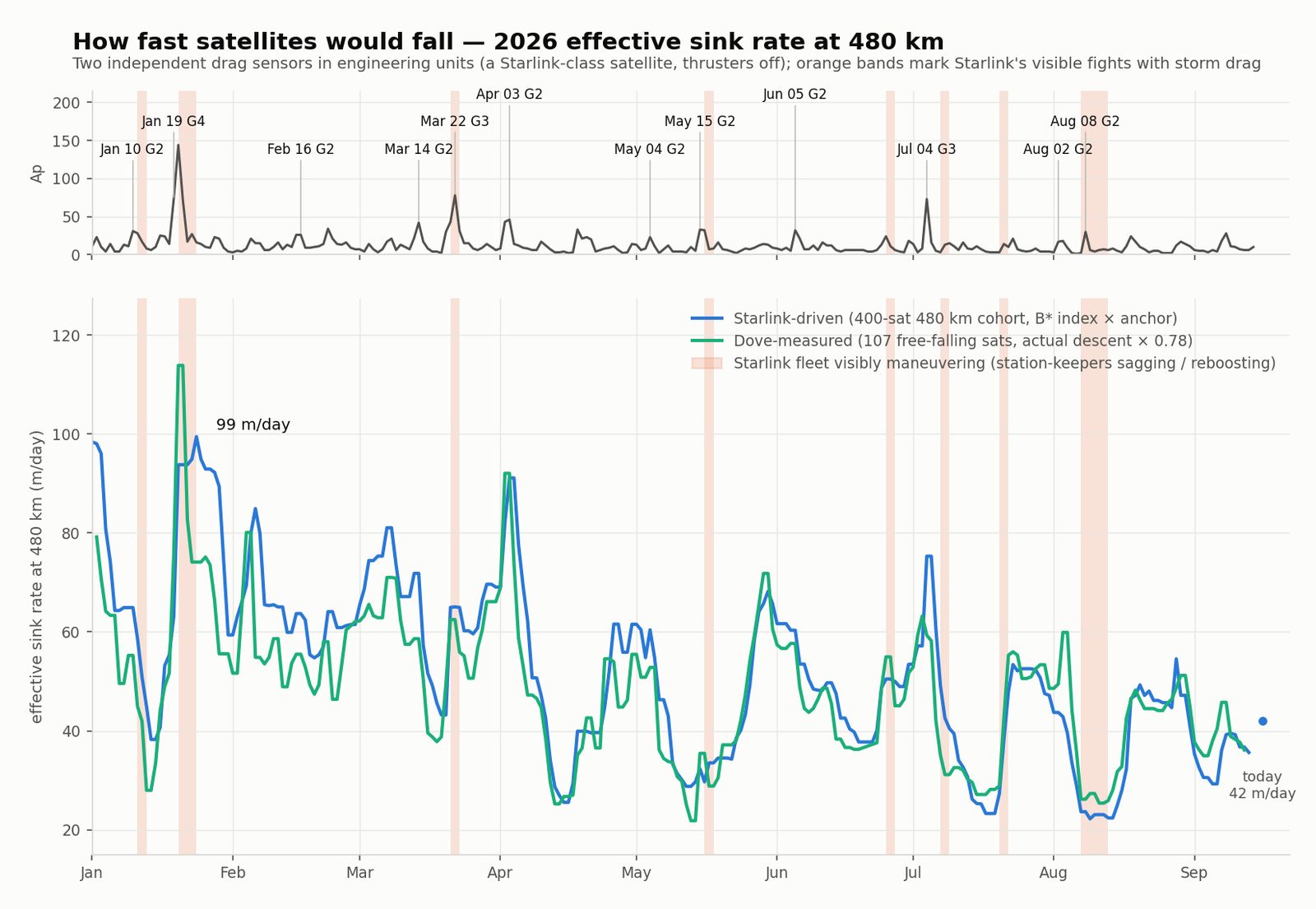
The index gives one number: how many metres a typical Starlink at 480 km would sink in a day. This year it has ranged from 19.7 metres on 10 August to 127.6 metres on 20 January, during the year's biggest geomagnetic storm, a factor of six.
That January G4 storm heated the thermosphere and the air took two weeks to settle; weaker spring and summer storms produced sharp spikes of their own. Solar ultraviolet heats the thermosphere, and the sink rate tracks the Sun's 10.7 cm radio flux with a two-day lag.
Phillips checks three further fleets: 107 Planet Labs SuperDoves with no thrusters, which really do fall (about 62 metres a day this year); 391 Amazon Kuiper satellites; and 651 Eutelsat OneWeb craft. Kuiper and Starlink agree with a correlation of 0.94, while OneWeb, at 1,200 km, stayed almost flat.
Why it matters
Thermosphere density is the largest uncertainty in orbit prediction and collision avoidance: standard models err by 20-30% on ordinary days and far more in storms. What is new, Phillips says, is a running, public, daily index with three independent constellations checking the answer.
The caveats: the index is relative, TLE fits blur over one to three days, and SpaceX turns its satellites edge-on in storms to cut drag, so Starlink storm peaks are lower bounds. The thruster-less SuperDoves supply the check.
SiTech — AI-powered web development
We build fast, modern websites and bring AI into real business workflows. Have a project or a question? We'd love to help.