Calvin and Hobbes and the price of integrity
Bill Watterson stopped drawing Calvin and Hobbes at 37, when the strip ran in more than 2,400 papers. A new essay traces the six-year fight over licensing and what staying uncompromising cost him.
Bill Watterson stopped drawing Calvin and Hobbes at the end of 1995, aged 37, when the strip ran in more than 2,400 newspapers. A new essay by Matthew Morgan in The Republic of Letters revisits the decisions that led him there — and the price of keeping the work his own.
Six years of saying no
Watterson's contract allowed Universal Press Syndicate to turn Calvin and Hobbes into toys, t-shirts and other merchandise. In the 1980s licensing made fortunes: Garfield's Jim Davis earned between $750 million and $1 billion a year, according to Nevin Martell's book Looking for Calvin and Hobbes. Watterson wanted none of it. "I went into cartooning to draw cartoons, not to run a corporate empire," he said.
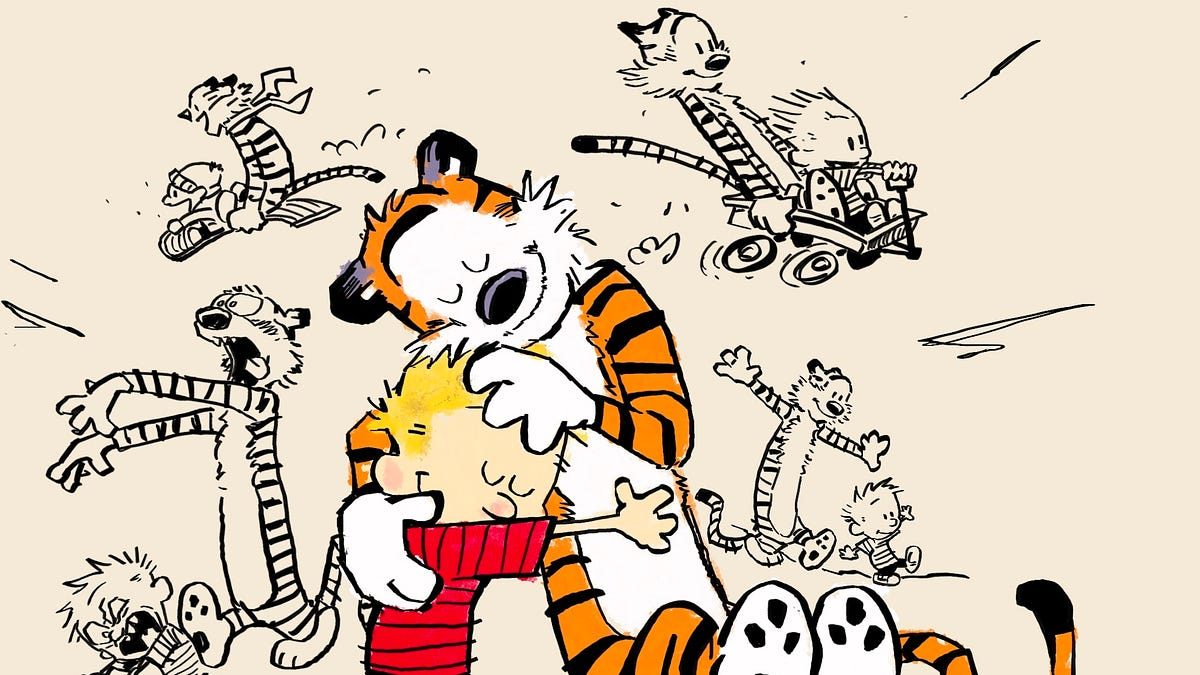
He objected above all to a Hobbes doll, which would settle in plush whether the tiger is real or a toy — a question he deliberately left open: "Calvin sees Hobbes one way, and everyone else sees Hobbes another way." The fight ran six years, until 1991, when the syndicate backed off, agreed not to license merchandise and rewrote his contract in his favour. Lee Salem, the syndicate's president, had even brought a box of bootleg t-shirts to Watterson's house, arguing that licensing would help suppress pirates and that the profits could fund tiger conservation. Watterson said no.
Sabbaticals and the Sunday page
Calvin and Hobbes went into re-runs in May 1991 for nine months — a sabbatical almost unheard of for syndicated cartoonists — and again from April 1994 until January 1995. In between, Watterson won another concession: Sunday strips delivered as a half-page with no panel restrictions, so that the story, not a newspaper's layout, shaped them. The syndicate warned he could lose half his outlets; editors were furious; in the end only fifteen of the 1,800 papers threatened to drop the strip, and seven did.
The freedom cost him time. A Sunday strip that once took a day now took a day and a half or more. He stayed weeks, sometimes months ahead of deadlines — "stay far enough ahead of the deadlines that I can throw away mediocre material and write something better" — working, he said, "as low-tech as you can get" with a sable brush, a Rapidograph pen and a crowquill.
A page left mostly white
His last strip has five panels, the final one the largest, and leaves much of the page blank: Calvin and Hobbes in the snow, a few trees, and the words "Wow, it really snowed last night! Isn't it wonderful?" He had 125 colours available at the end, against 64 when he began, but left the panel borders and speech balloons white for what he called "a very spare and open look".
Then he vanished from public view: three or four interviews in three decades, one book unrelated to the strip, and eventually a notice on his website that he would not read letters mentioning Calvin and Hobbes. "My strip is about private realities, the magic of imagination, and the specialness of certain friendships," he once said. The essay's argument is that the integrity was not a pose but a working method — and that it cost him the audience he might otherwise have kept.
SiTech — AI-powered web development
We build fast, modern websites and bring AI into real business workflows. Have a project or a question? We'd love to help.