Prince Chazz: a chess-pathfinding roguelite that runs in the browser
A two-person studio has released Prince Chazz, a browser game that turns the movement rules of chess into the hazards of a roguelite. Every board is generated from a seed with its own leaderboard, and the Show HN launch drew 433 points.
Prince Chazz is a browser game that its creators describe as a seeded chess-pathfinding roguelite. It was built by Maanraket, the two-person studio of Floris Veldhuizen and Tom Hutman, and released as a Show HN post on Hacker News, where it drew 433 points.
Chess pieces as the hazards
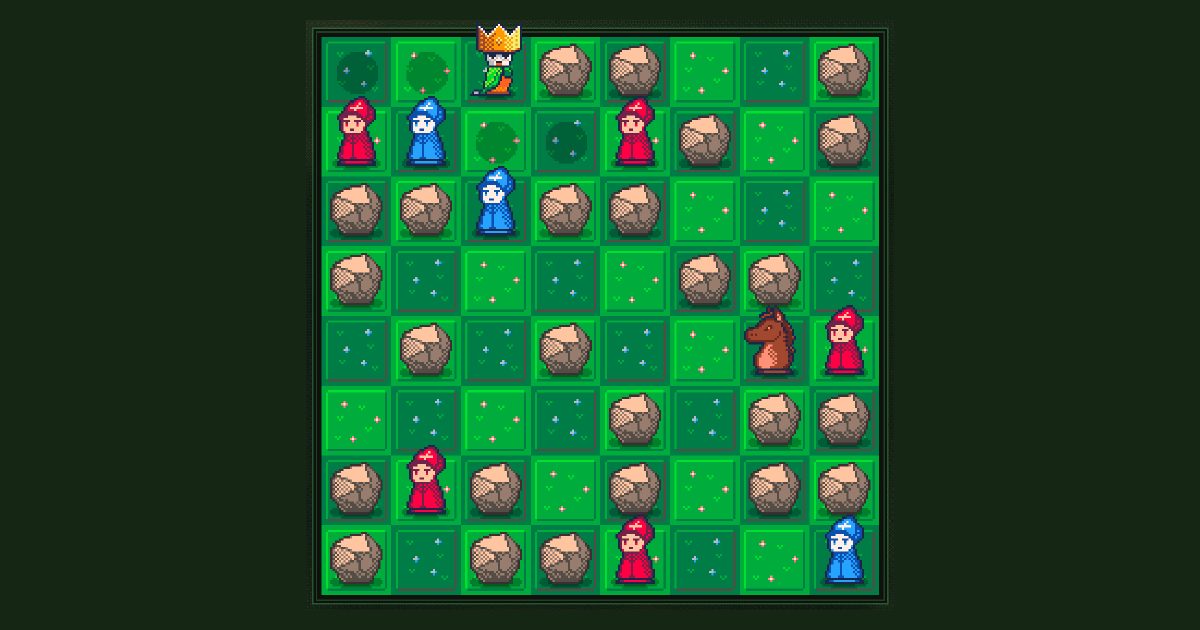
The premise inverts the usual chess problem. Instead of commanding an army, the player guides a single piece — Prince Chazz — across the board, dodging the enemy pieces that stand in the way. Those enemies are chess pieces as well: rooks, bishops and knights, each with its own pattern of movement, which turns the board layout itself into the puzzle. Moves are counted in a HUD at the top of the screen and captures are tallied, while a short tutorial teaches the basic idea, including the advice to move like a queen.
Every run is generated from a seed. The same seed produces the same board, and each seed carries its own leaderboard, so scores are compared only between players who faced an identical layout. There is also a daily board with its own streak counter: play it on consecutive days and the streak grows. Other numbers the game tracks include best score, average score, average moves and captures.
A browser game built like an app
Prince Chazz runs entirely in the browser with nothing to download, but it is packaged as an installable web app. A manifest, maskable icons and a service worker let it be added to a phone's home screen and opened standalone, with launch screens prepared for a long list of iPhone sizes. Offline play works too, though the leaderboard states plainly that it is unavailable offline.
Controls adapt to the device. On a keyboard, the arrow keys or W, A, S, D move the selection around the board, Enter or Space confirms a move and R retries; on touch screens everything is tap-driven, starting from a simple “tap to begin” screen. Settings let players change the board size and the enemy speed, and the leaderboard can be viewed at different scopes.
Small studio, narrow niche
For an independent project in a crowded browser-game space, the pitch is precise: take movement rules that players already understand and use them as the hazard design of a roguelite, then let a seeded board make every attempt comparable with the next. Scores are tied to an account created with passkeys and guarded by a human check that the game describes as a quick check to keep scores fair. With 433 points on Hacker News, the release found an audience willing to try it in a tab immediately.
SiTech — AI-powered web development
We build fast, modern websites and bring AI into real business workflows. Have a project or a question? We'd love to help.