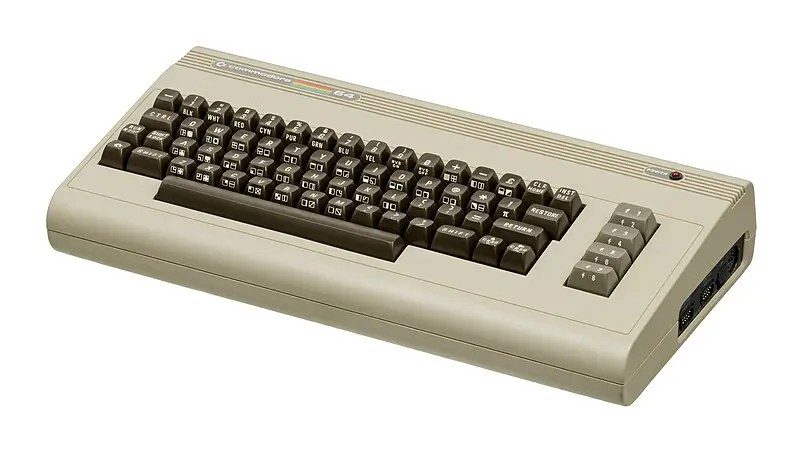
Commodore 64: How the Best-Selling Computer of All Time Arrived in 1982
On September 1, 1982, the Commodore 64 launched: the first computer with 64 kilobytes of memory to sell for under $600. It went on to become the best-selling computer in history.
On September 1, 1982, the Commodore 64 launched. Its name referred to the amount of memory it had on board: 64 kilobytes. It was the first computer with 64K of memory to sell for under $600.
When it actually shipped
When the C-64 first shipped is a bit of a mystery. Commodore showed prototypes at the January 1982 Consumer Electronics Show, but these were not production-ready models yet. Some engineers quoted in Brian Bagnall's books say they shipped some units in August. Michael Tomczyk's book, The Home Computer Wars, says it launched September 1; Tomczyk was writing in 1984, not long after the launch, and the author is inclined to think that date is correct. The discrepancy has a simple explanation: Commodore was not selling direct, so if it intended to sell any machines on September 1, it had to ship the first units in August.
The sales record
Within six months, Commodore had sold half a million units; by the end of its fiscal 1984 year, about 5 million. The machine became the best-selling computer of all time, selling about 12.3 million units — or about 10.6 million for the C-64 alone, if the C-128 is counted as a separate product.
By modern standards it was not cheap. Even in 1984, the computer with a disk drive typically cost $450 unless you really shopped around. The only comparable machine in price and capability was the Atari 800XL, and Atari was having supply chain problems in 1983, so it was a lot easier to find a Commodore 64 that year. Its predecessor, the VIC-20, had been the first computer to sell a million units.
Compromises that worked
To hit its price point the C-64 went through plenty of compromises. The disk drive was slower than it needed to be, largely because of a last-second design change, and modem support was limited — though there was not much demand for modems in 1982. But it had 16-color graphics at a resolution of 160x200 or 320x200, and 8 sprites, which was very useful for game programming.
The sound chip was also a compromise. Its designer, Bob Yannes, was both an engineer and a musician; the chip he wanted to build would have been impressive for 1992, let alone 1982. He built the elements he needed and replicated them until he ran out of room on the silicon wafer at three voices. Some competing designs had four, but the SID chip had more flexibility with the volume of each channel and could produce more complex sound waves than rival chips.
A lasting legacy
Creative programmers coaxed video and audio effects out of the C-64 that its designers never imagined, so interesting new software was still being released for it late in the decade. For the author of the original account, it was the machine he learned BASIC and 6502 assembly language on, the one he could take apart and repair by age 12, and the one he used to recover data from corrupted disks with a sector editor as a teenager.
It was not only about games. Homework, printouts and concepts such as buffer overflows all came from the C-64. In 2019, when a new job required learning Python, the author dug a C-64 out of storage and spent a few weeks programming it in BASIC — doing familiar things — until programming started to make sense again.
SiTech — AI-powered web development
We build fast, modern websites and bring AI into real business workflows. Have a project or a question? We'd love to help.