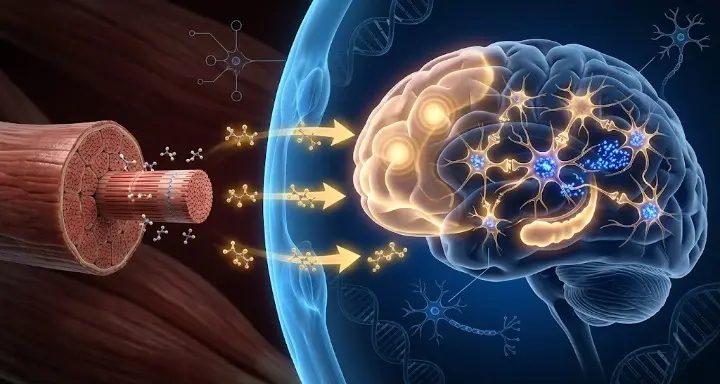
Creatine and the brain: studies point to higher energy levels and slower cognitive decline
A 2025 review and a pilot trial in Alzheimer's patients have gathered the evidence on what creatine does inside neurons, including a reported 30% slower cognitive decline in early-stage patients in a controlled trial.
A 2025 review in the Journal of Psychiatry and Brain Science and a pilot trial published in Alzheimer's & Dementia: Translational Research and Clinical Interventions have assembled the evidence on what creatine does inside the brain. Most buyers take it for their muscles; the research concerns energy metabolism in neurons.
Why neurons need creatine
The brain consumes roughly 20% of the body's energy output while accounting for about 2% of its mass, and neurons hold no meaningful energy reserves. They depend on a continuous supply of ATP. Creatine is taken up by cells and converted into phosphocreatine, which creatine kinase breaks down to regenerate ATP. In muscle that system fuels explosive effort; in neurons it acts as an emergency buffer during periods of high demand, such as rapid firing or memory encoding. When brain creatine is insufficient, neurons at high intensity hit an energy ceiling and processing slows.
What changes in Alzheimer's disease
Phosphocreatine levels in the brains of Alzheimer's patients are significantly lower than in age-matched healthy controls, and creatine kinase activity is reduced in diseased tissue. Mitochondrial dysfunction in those neurons produces what researchers describe as a bioenergetic crisis. The creatine system can partly compensate, because it supplies ATP through a pathway that does not depend on fully functional mitochondria.
The clinical trials
The University of Kansas Medical Center's CABA trial reported its results in early 2026. Twenty patients with clinically confirmed Alzheimer's disease took 20 grams of creatine monohydrate daily for eight weeks and scored higher on sorting, reading and attention tests afterwards. Magnetic resonance spectroscopy showed that brain phosphocreatine had risen, confirming that oral creatine crosses the blood-brain barrier. A 2026 multicentre placebo-controlled trial enrolled 240 participants with early Alzheimer's; twelve weeks of 5 grams a day raised brain phosphocreatine by 10 to 15% on MRS scans, and the intervention group declined about 30% more slowly on standard cognitive scales than the placebo group. The CABA trial was a pilot with a small sample, and the review notes that higher doses than the standard 5-gram athletic dose may be needed for the brain.
Beyond Alzheimer's
A study in Scientific Reports found that a single dose of creatine improved cognitive performance during sleep deprivation and produced measurable changes in cerebral high-energy phosphates. A 2025 study tested 5 grams a day as an add-on to cognitive behavioural therapy for depression and reported significantly improved depressive symptoms, through the same energy pathway in the prefrontal cortex and hippocampus.
The picture is of a cheap, widely used supplement whose effects on the brain are documented in specialist literature rather than on the packaging — and of a field where small trials have produced promising but not yet conclusive results.
SiTech — AI-powered web development
We build fast, modern websites and bring AI into real business workflows. Have a project or a question? We'd love to help.