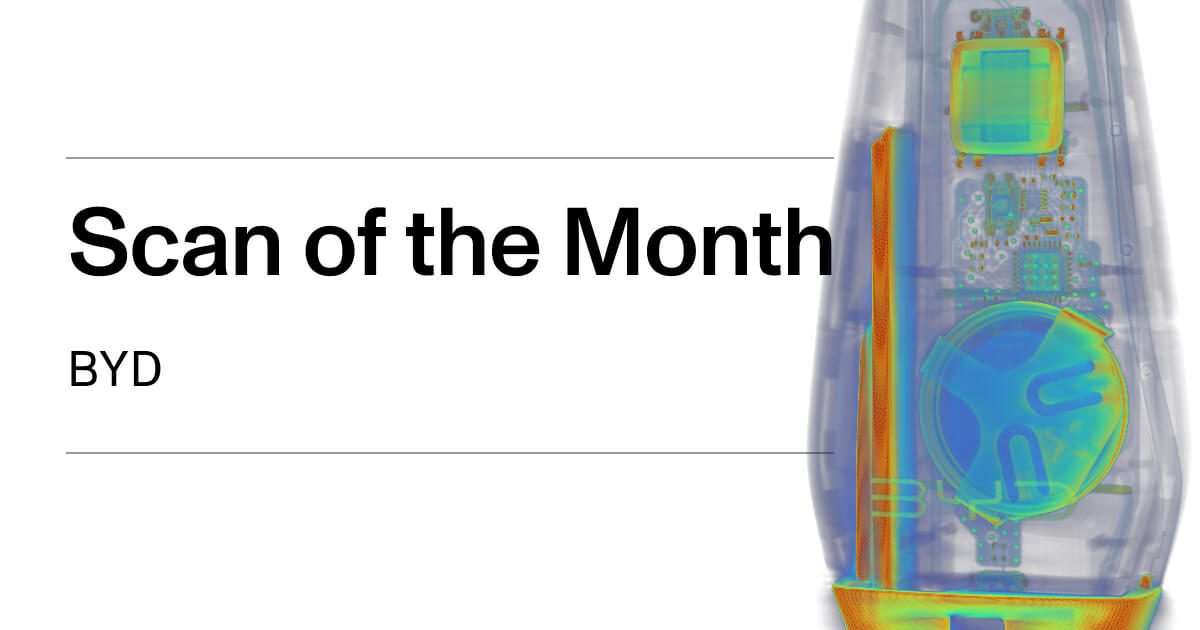
BYD parts under the CT scanner: what vertical integration looks like inside
Lumafield put four components from the world's largest EV maker through industrial CT scanning: an LFP battery cell, a window switch panel, a portable charger and a key fob, revealing how far BYD's in-house manufacturing goes.
BYD delivered 4.6 million vehicles in 2025, making it the world's largest electric vehicle maker by volume. In America the name is known mostly from trade headlines — tariffs, national security investigations, ships racing to beat duty deadlines — not from the cars. Lumafield, which builds industrial CT scanners, obtained four components from the lineup and scanned them: a lithium iron phosphate (LFP) battery cell, a window switch panel, a portable charger and a key fob.
A carmaker that builds its own parts
BYD manufactures roughly 75% of the components in its own vehicles. Batteries, motors, inverters, onboard chargers and much of the electronics come from FinDreams, BYD's in-house supplier network, rather than from the Bosch, Valeo and Denso supply chains most Western automakers depend on. According to Lumafield, the last company to vertically integrate a car from raw material to finished product at this scale was Ford.
Inside an LFP prismatic cell
The cell that made BYD famous is the Blade, a long, thin LFP prismatic designed to lie flat across a vehicle floor, with the cells forming part of the car's structure rather than sitting in a separate enclosure. The scanned cell is not a Blade but shares the chemistry: LFP gives up some energy density against the chemistries that dominate Western packs, and in exchange runs cooler, tolerates more charge cycles, and replaces nickel, manganese and cobalt with iron. The two threaded terminals are the densest structures in the cell, with an explosion-proof valve between them that vents internal gas pressure as a last-resort safety feature. Below the aluminium housing the cell resolves into two parallel jellyrolls, which improve current distribution; the cross-section shows tightly packed electrode layers in four groupings, with edges mostly well aligned and consistent overhang between anode and cathode, an indicator of good process control.
Panel, charger and key fob
The window switch panel comes from the BYD Tang, a seven-seat SUV competing roughly with the Ford Explorer and Toyota Highlander. It folds mirror adjustment, mirror fold, door locks, all four window controls and child locks into one networked module, with button caps above the board and a grid of circular tact switches below. Automotive connectors are among the most common failure points in modern cars, and because this module is so integrated, one intermittent connection can take out mirrors, windows, locks and child safety at once. Every BYD sold in Europe and the UK ships with a Type 2 IC-CPD, an in-cable control and protection device: a portable Mode 2 charger that plugs into the car at one end and a household socket at the other. Its seven-pin housing holds more than the charger uses — only L1, neutral and ground are connected. The key fob, meanwhile, stacks a button cluster, a circuit board and a mechanical backup key into a two-piece housing shared across sedans, hatchbacks and SUVs.
SiTech — AI-powered web development
We build fast, modern websites and bring AI into real business workflows. Have a project or a question? We'd love to help.