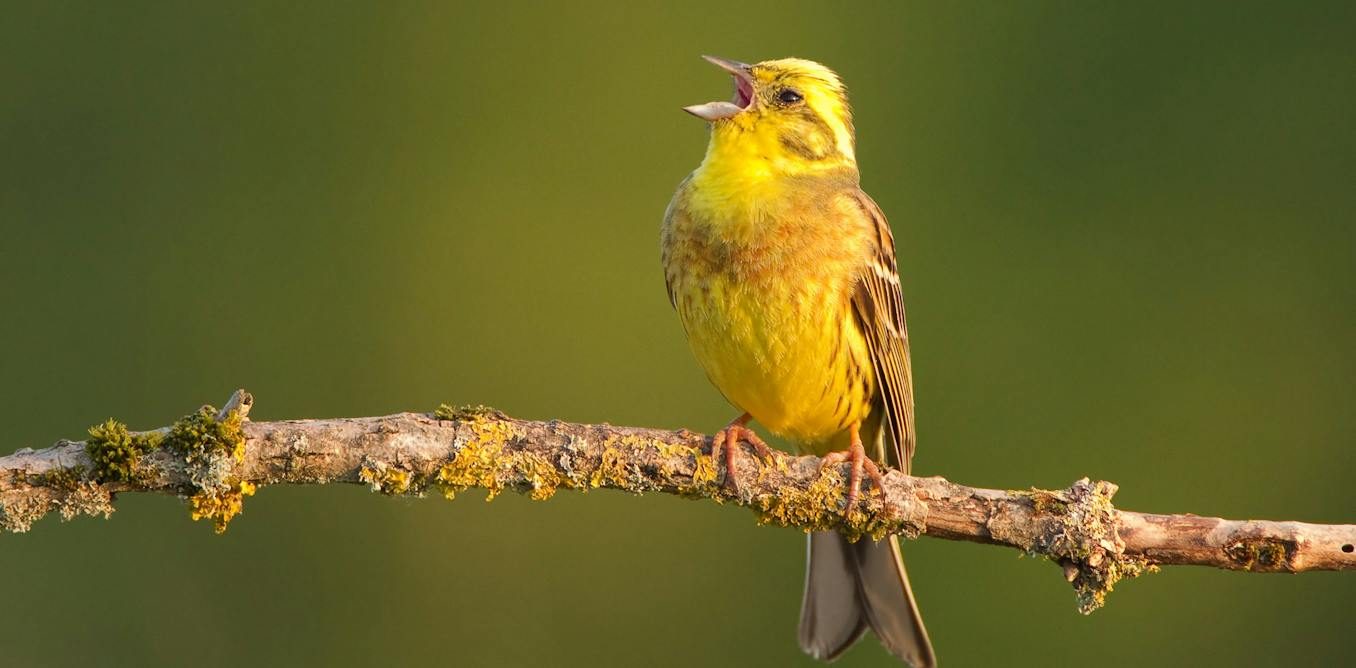
Do birds have accents? The regional differences in birdsong
Birds of the same species sound different from one region to the next — and New Zealand’s yellowhammers still sing 19th-century British dialects. An explainer from The Conversation.
Birds sing most around an hour before dawn, when the air is stillest — conditions that let song travel further and make it up to 20 times more effective than at midday. Yet the chorus is not uniform: even in one neighbourhood, birds of the same species do not always sound alike.
Individual and regional accents
Writing for The Conversation, Louise Gentle of Nottingham Trent University describes students recording blue tits on campus: some sang the classic “he-llo, I’m a little blue tit”, others a longer version, and some only “he-llo”. Regional accents are just as real — the woodpigeon’s “my toe bleeds Be-tty” becomes “my toe bleeds Ju-li-a” in parts of the UK, adding a syllable. Such dialects have been reported in British blackbirds and great tits.
Two British dialects, seven in New Zealand
The farmland yellowhammer sings something like “a little bit of bread and no cheese please”. In the UK it largely has two dialects that differ in the closing “cheese please”: in eastern England “cheese” is lower in pitch than “please”, while in the south and west the pattern is reversed.
New Zealand’s yellowhammers are stranger still. Introduced from the UK in the 1860s and 70s, they have around seven dialects despite originating in southern England. Five of those extra dialects also occur in European birds, indicating that New Zealand still sings 19th-century British dialects that have since disappeared at home — probably because a steep decline in UK yellowhammers drove some populations extinct.
Learned dialects and city noise
Most birds sing one dialect, learned from parents or neighbours, forming a geographical mosaic of regional accents. The cuckoo sings innately, but elaborate singers must learn: young birds inherit a template and add to it from the songs around them. Chaffinches hand-reared in isolation produce simple songs, while wild birds learn complexity from their parents and neighbours.
Cities change song too. Urban birds sing higher than rural ones, because higher notes carry better over low-pitched traffic noise; great tits sing shorter, faster songs in cities than in forests, and blackbirds sing louder. These traits persist even when the city is quiet, suggesting sound echoes off large buildings. Traffic noise pushes city blackbirds to start the dawn chorus up to five hours earlier than rural birds, and artificial light makes song thrushes begin ten minutes earlier, and robins and great tits 20 minutes earlier.
Much remains unknown about variation within species, including female song: a 2016 analysis found that for 3,500 of 4,814 species there is not even enough data to know whether females sing.
SiTech — AI-powered web development
We build fast, modern websites and bring AI into real business workflows. Have a project or a question? We'd love to help.