Eight eMudhra CA Private Keys Compromised, Triggering Emergency Browser Blocks
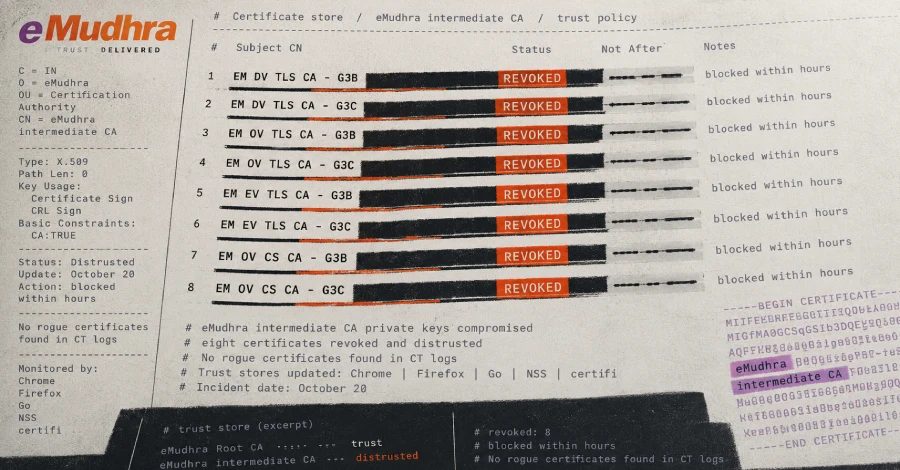
The private keys of eight eMudhra intermediate certificate authority certificates were compromised, Mozilla and Chrome confirmed on October 20. Both browsers blocked them within hours of the October 17 report.
Compromise and Immediate Response
The private keys of eight eMudhra intermediate certificate authority (CA) certificates are compromised, Mozilla and Google's Chrome Root Program confirmed on October 20. eMudhra is an Indian CA that sells certificates under the emSign brand. An intermediate CA signs the certificates that websites present, so anyone holding one of these keys could issue a certificate for any website that a browser would accept.
A researcher credited by Mozilla only as Wayne reported the compromise on the evening of October 17, and Chrome and Firefox blocked the eight certificates within hours after Chrome verified the findings. No TLS certificate chaining to the six intermediates used for websites had been logged to Certificate Transparency before Chrome's block, so none could have been trusted by default.
Chrome received the report at 18:05 UTC on October 17 and had a CRLSet update blocking the six TLS intermediates in place by 19:45 UTC. Mozilla received it at 20:06 UTC and finished pushing a OneCRL block to Firefox installations by 22:59 UTC. Neither browser needed an update or restart.
Affected Certificates
The eight compromised certificates span domain validated, organization validated and extended validation TLS intermediates, plus two code signing certificates. The six TLS certificates were issued by emSign Root TLS CA - G3 and chain to emSign ECC Root CA - G3, a root in the Chrome and Apple stores and, until October 20, in Mozilla's.
Each of the eight also exists as a cross-signed copy under Sectigo's AAA Certificate Services root. Chrome's block matches the public key rather than the certificate, so it also catches these copies. The cross-signed copies did not widen risk in Chrome or Firefox, which stopped trusting Sectigo's root for websites in April 2025.
Software Fixes
Go handled the fix on its URGENT track in its October 20 releases (Go 1.27.3 and 1.26.10), rejecting any chain containing one of the eight keys (CVE-2026-111943). Firefox 158.0.1 and ESR versions carry the OneCRL block. NSS 3.131.1 removes emSign ECC Root CA - G3 from the trusted list. Python certifi, Rust webpki-roots and Homebrew ca-certificates drop the same root. Node.js and Composer ca-bundle have pending changes.
Three fixes remove roots rather than blocking keys, which also cuts off every legitimate certificate chaining to those roots. Mozilla said some servers will become unavailable to non-Firefox users of its trust list until those servers move to new certificate chains.
Root Removal and Broader Impact
Mozilla removed emSign ECC Root CA - G3 from NSS on October 20. Chrome will remove it in version 43 of its root store and is reviewing eMudhra's other root, emSign Root CA - G1. Apple blocked the certificates on October 19 and Microsoft on October 20.
Mozilla does not believe the problem affects other CAs. Chrome said it checked every other CA certificate in its store and found no other instances of this failure mode. How the keys left eMudhra and when remain open questions.
Sources: The Hacker News · Ars Technica
SiTech — AI-powered web development
We build fast, modern websites and bring AI into real business workflows. Have a project or a question? We'd love to help.