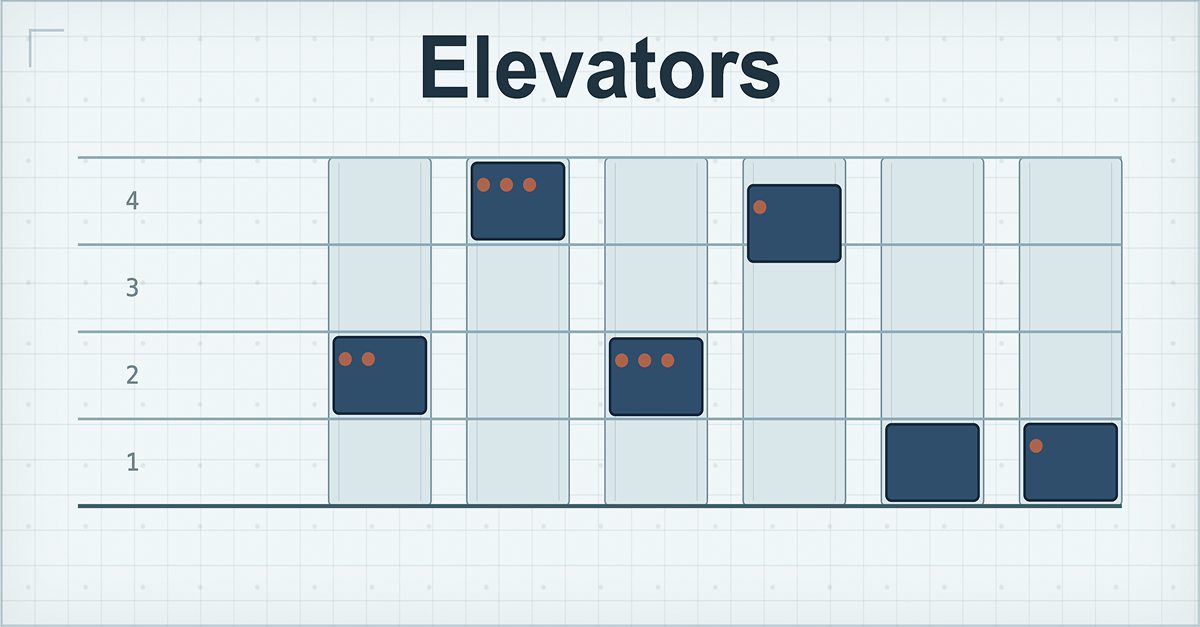
How Elevator Algorithms Decide Which Car Answers Your Call
A technical write-up on john.fun walks through elevator dispatch algorithms — from the 1961 SCAN patent to Otis's RSR scoring and destination dispatch — and finds that smarter is not always faster.
An article published at john.fun/elevators looks at what happens between pressing a call button and a car arriving, comparing the algorithms that decide which elevator serves which passenger. Its conclusion runs against intuition: in many buildings, the simplest dispatch rules deliver the shortest waits.
One car: SCAN and LOOK
The simplest algorithm, SCAN, was patented in 1961. A car starts at the lobby, travels all the way to the top floor, then reverses and comes back down, picking up and dropping off passengers along the way. LOOK is the variant most riders actually experience: the car travels only as high as the highest request before turning around.
Scoring cars with RSR
With several cars, the most basic system uses a central scheduler that assigns every new request to the closest elevator. A more sophisticated approach is Otis's Relative System Response (RSR), which gives each car a score for how well suited it is to make a pickup, with lower scores being better. The score combines the estimated time to reach the caller with an onboard load penalty, a same-direction anti-bunching penalty, a direction-match bonus, an idle-nearby bonus and a low-load bonus.
RSR also re-optimises every five seconds, so a passenger originally assigned to one car can be rerouted to another if the first encounters delays. According to the article, that rebalancing step is what keeps traffic flowing.
Measuring waits, and why simple can win
The piece argues that wait time should be judged as a distribution rather than an average: a p90 of two minutes means 90 percent of riders wait two minutes or less, while a p50 of one minute means half of all waits are under a minute. Riders remember the worst cases, not the average, which is why the tail of the distribution matters.
Benchmarks in the article show that as passenger flow rises, LOOK can outperform RSR: when the cars are full and stopping at nearly every floor, the extra scoring rules matter less. LOOK also tends to beat RSR in small buildings with fewer cars per bank. Destination dispatch — kiosks that tell you which car to board before you enter — is generally worse for wait times than traditional up and down buttons, except in very tall buildings with eight or more cars per bank. The reason is that a kiosk enforces a fixed assignment, while the conventional system can re-optimise every five seconds. The page includes an interactive simulation with all the parameters exposed.
SiTech — AI-powered web development
We build fast, modern websites and bring AI into real business workflows. Have a project or a question? We'd love to help.