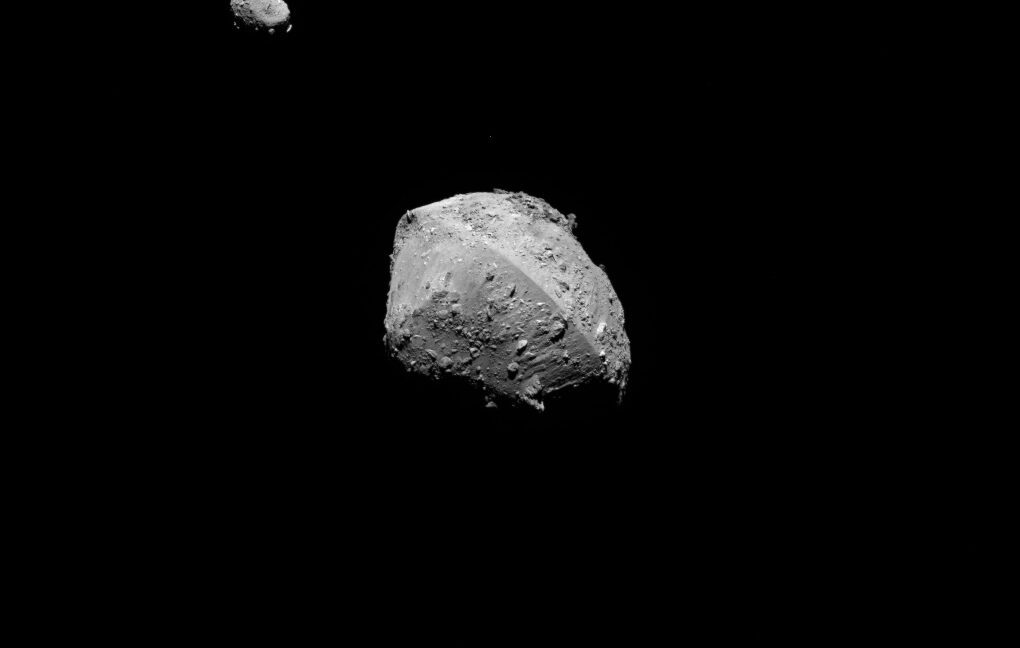
Hera spacecraft finds chaotic aftermath of NASA's DART asteroid test
ESA's Hera spacecraft has reached the Didymos-Dimorphos asteroid pair and found Dimorphos tumbling, a giant impact crater, and hundreds of boulders after NASA's DART mission.
ESA's Hera spacecraft has arrived at the Didymos and Dimorphos asteroid system after a two-year journey and found a chaotic aftermath from NASA's DART impact in September 2022. Dimorphos is tumbling wildly, a stadium-sized crater marks the impact site, and hundreds of boulders surround the pair. Hera will study the system for six months to help improve asteroid deflection models.
What Hera saw
DART impacted Dimorphos in September 2022 at more than 13,700 mph (6.14 km/s), releasing about 10 billion joules and shortening its 12-hour orbit around Didymos by about 33 minutes. Hera's first views show the car-sized impactor carved a crater the size of a stadium, nearly as big as Dimorphos itself, which measures about 500 feet (151 meters) across. Didymos is still spinning as observed in 2022, but Dimorphos is no longer stable and is tumbling in its orbit.
Boulders and debris
Hera spotted hundreds of boulders around the two asteroids. A composite image from November 6 at about 29.9 km (18.6 miles) distance combines 11 long-exposure frames; the asteroids were removed to reveal moving rocks ranging from football to washing machine size. Scientists are not yet sure whether the boulders came from the DART impact or are older debris from Dimorphos's formation.
Next steps
Hera will fly closer over the next six months and release two CubeSats to attempt landings on Dimorphos and collect data on composition, internal structure and mass. The boulder field creates navigation challenges, but the spacecraft and debris move at only about a quarter-mile per hour, or 12 centimeters per second. Scientists hope the data will help reconstruct the impact and improve models for deflecting asteroids that could threaten Earth.
Sources: Ars Technica · engadget.com
SiTech — AI-powered web development
We build fast, modern websites and bring AI into real business workflows. Have a project or a question? We'd love to help.