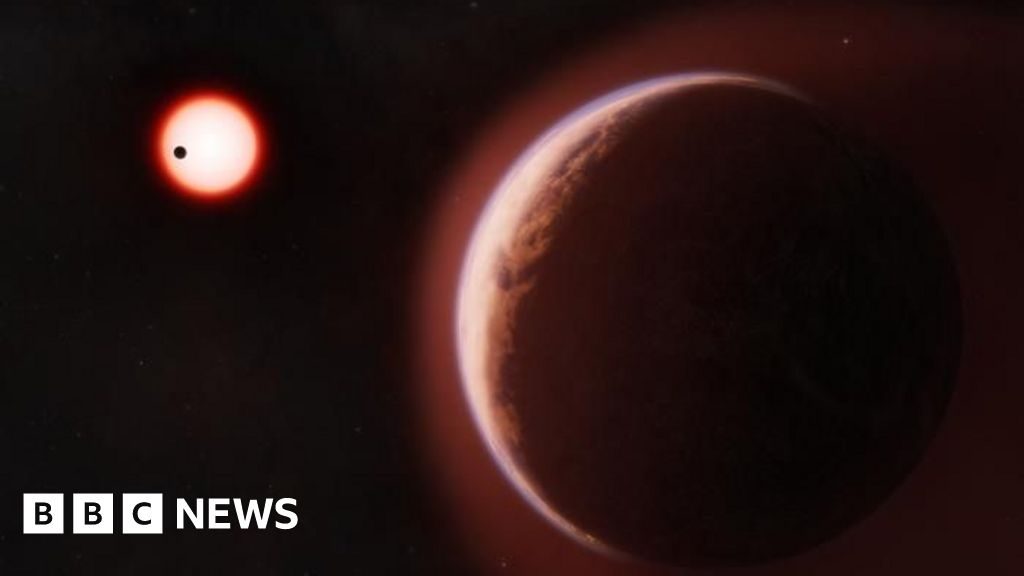
First atmosphere found on an Earth-like planet in a habitable zone
Astronomers have detected an atmosphere around a rocky, Earth-like planet orbiting in its star's habitable zone — a first for a world of this kind. The gas found, helium, cannot support life on its own.
A first for rocky planets
Astronomers have detected an atmosphere around a rocky, Earth-like planet orbiting in the habitable zone of a distant star — the first time such a signal has been found on a world of this kind. The results, published in the journal Science, are described by the team as the strongest evidence yet that planets with conditions similar to Earth's can exist beyond the solar system.
The planet, LHS 1140 b, lies 48 light-years away and orbits a red star considerably smaller and cooler than the Sun. The gas identified in its atmosphere is helium, which cannot support life on its own, though other gases may also be present lower down.
Why the finding matters
More than 6,000 planets are now known to orbit distant stars, and hundreds sit in their stars' habitable zones — the band where water can stay liquid. Only a few dozen of those are small and rocky like Earth, and none had shown evidence of an atmosphere until now.
The lead author, Dr Collin Cherubim of Harvard University, called the result a big deal, noting that it is the first time an atmosphere has been found on a rocky planet in the habitable zone of another star. Dr David Charbonneau, also at Harvard, said the important thing is that an Earth-like planet outside our solar system has been found with an atmosphere at all, given how central the search for life elsewhere is.
Not a sign of life yet
The helium is thought to sit in the planet's upper atmosphere; on its own it would not sustain biology. The team is clear that the work does not show that LHS 1140 b is inhabited. A planet needs water to support life, and to keep water it must orbit at the right distance from its star: not too close, where it would be too hot, and not too far, where it would be too cold.
Other candidates under scrutiny
LHS 1140 b is not the only world under scrutiny. K2-18 b, a sub-Neptune that may have a water-rich interior, drew attention when scientists reported signs of dimethyl sulphide, a gas linked to marine life on Earth; a Nasa-led reanalysis in 2025 found the signal too weak to confirm and showed the gas can form without biology. The seven rocky planets of TRAPPIST-1 remain tempting targets: the James Webb Space Telescope has ruled out an Earth-like atmosphere on TRAPPIST-1 d, while data for TRAPPIST-1 e remain inconclusive.
SiTech — AI-powered web development
We build fast, modern websites and bring AI into real business workflows. Have a project or a question? We'd love to help.