Researchers Run Code in Windows SmartScreen Enclave via Four-Byte Write and Timing Bug
Security researchers at Doyensec exploited a four-byte write and a timing bug to execute their own code inside the VBS enclave protecting Windows SmartScreen password checks. Microsoft patched the flaw in September 2026.
Code Execution Inside a Protected Enclave
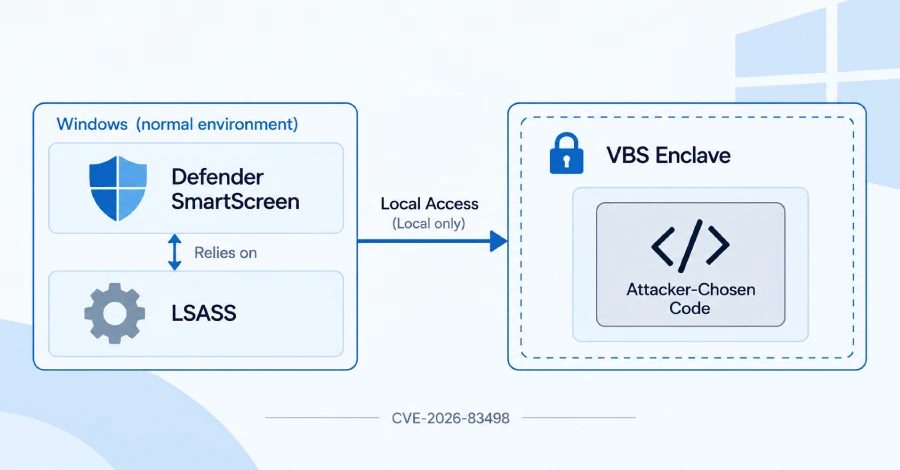
Security researchers have run their own code inside a VBS enclave in Windows, a protected memory area meant to stay sealed off even if the rest of the system is compromised. The enclave in question, part of Microsoft Defender SmartScreen's Enhanced Phishing Protection, guards hashed passwords so the feature can warn users who type their Windows credentials into unsafe locations. The work, done by Doyensec as a lab proof of concept, has not been seen in real attacks, and Microsoft fixed the flaw in its September 8, 2026 update, tracked as CVE-2026-83498.
How the Attack Works
A VBS enclave is a signed library that normal programs load but cannot read or modify. The hypervisor keeps its memory in a more trusted world (VTL1) unreachable from the normal world (VTL0), even by attackers who own the kernel or run as SYSTEM. On Windows 11, lsass.exe loads the SmartScreen enclave. The attack requires local code already on the machine and no user interaction, so it lets existing footholds reach into the trusted world rather than breaching it from outside. Doyensec chained a second call to the enclave's Initialize function, which writes a fixed four-byte error value to an attacker-controlled address while skipping the first call's address check. That write corrupts the boundary between enclave and host memory, and a timing bug in another function then triggers a controlled wipe that redirects object lookups. The resulting read and write let the researchers replace the table governing which code the enclave may run, achieving code execution inside it.
Microsoft's Fix and Remaining Gaps
Microsoft rated the issue Critical with a CVSS score of 7.8 and says it was found internally, never exploited, and not publicly known before the fix. The September cumulative update KB5124008 for Windows 11 24H2 and 25H2 adds the address check before the first write, tightens the timed function, and ships a policy blocking the old vulnerable enclave from loading; installing the update is the only action needed. However, Windows lacks a general blocklist for vulnerable enclaves like its vulnerable driver list, and an older Microsoft Edge enclave with a similar flaw (CVE-2023-36880, 2023) can still load, leaving the "bring your own vulnerable enclave" technique available to attackers.
Sources: The Hacker News
SiTech — AI-powered web development
We build fast, modern websites and bring AI into real business workflows. Have a project or a question? We'd love to help.