
Google launches first Suncatcher satellite, publishes research on orbital data centers
Google has launched its first Project Suncatcher satellite, MVP, which carries four TPUs and will test whether Google's chips survive space radiation and vacuum cooling. The company also published peer-reviewed research on orbital data centers.
Google's first Project Suncatcher experimental satellite is in orbit. Named MVP, it launched on October 1 on a SpaceX Falcon 9 from Vandenberg Space Force Base on the Transporter-18 rideshare mission.
MVP is about the size of a refrigerator and carries four TPUs, roughly the compute power of one data-center server, with solar panels generating about one kilowatt. It is a ready-made Planet Labs platform carrying Google's own chips.
What the mission will test
The point is to find out whether Google's Trillium TPUs survive launch and space. During liftoff the satellite sees acceleration up to 10 times the force of gravity, while individual components can face 50 to 100 times that. Radiation tests showed the chips survive an ionizing dose greater than a five-year mission would deliver.
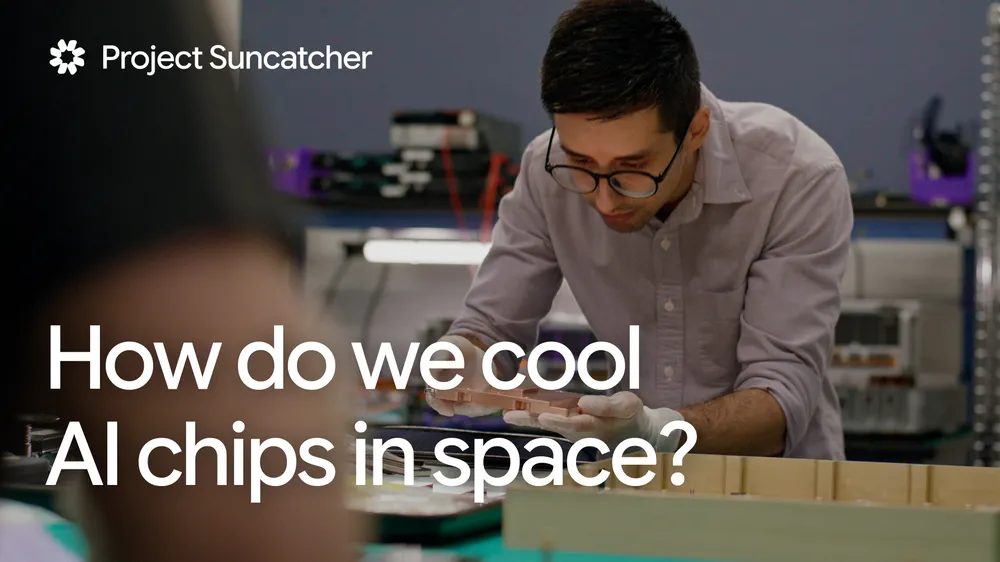
Cooling is the hardest problem: a vacuum offers no airflow, so heat can only be shed through radiators. Google's design runs heat through aluminum and copper pipes to a radiator, and the TPUs run for about 15 minutes before shutting down to cool. For the tests, Google will run Gemini models on the chips.
Research: possible, with conditions
Alongside the launch, Google published peer-reviewed research. The paper notes orbital data centers become worthwhile once launch costs fall to $200/kg, and that SpaceX has cut costs 20 percent for each doubling of cumulative launched mass; keeping that pace would take 370,000 tonnes of extra mass, around 1,800 Starship launches and components reused 100 times. Google calls $200/kg "plausible under reasonable assumptions."
Other pieces remain theoretical. Existing network technologies are probably unsuitable for linking satellites into clusters: the system would need to be far larger and fly in much tighter formation than any current constellation. Optical ground links will also be critical; NASA's TBIRD mission has shown 200 Gbps from low orbit to the ground. The researchers conclude the effort "will require sustained research, iterative refinement of our design, and the achievement of several critical future milestones."
What comes next
The next milestone is 2027, when Google plans to launch two satellites, and future fleet designs call for over 80 satellites in close formation. Google estimates orbital data centers could become cost-competitive with ground facilities by the mid-2030s. Expectations stay measured: James Manyika says he does not expect anything "usefully operational in the next few years," comparing it to Google's early driverless-car research.
SiTech — AI-powered web development
We build fast, modern websites and bring AI into real business workflows. Have a project or a question? We'd love to help.