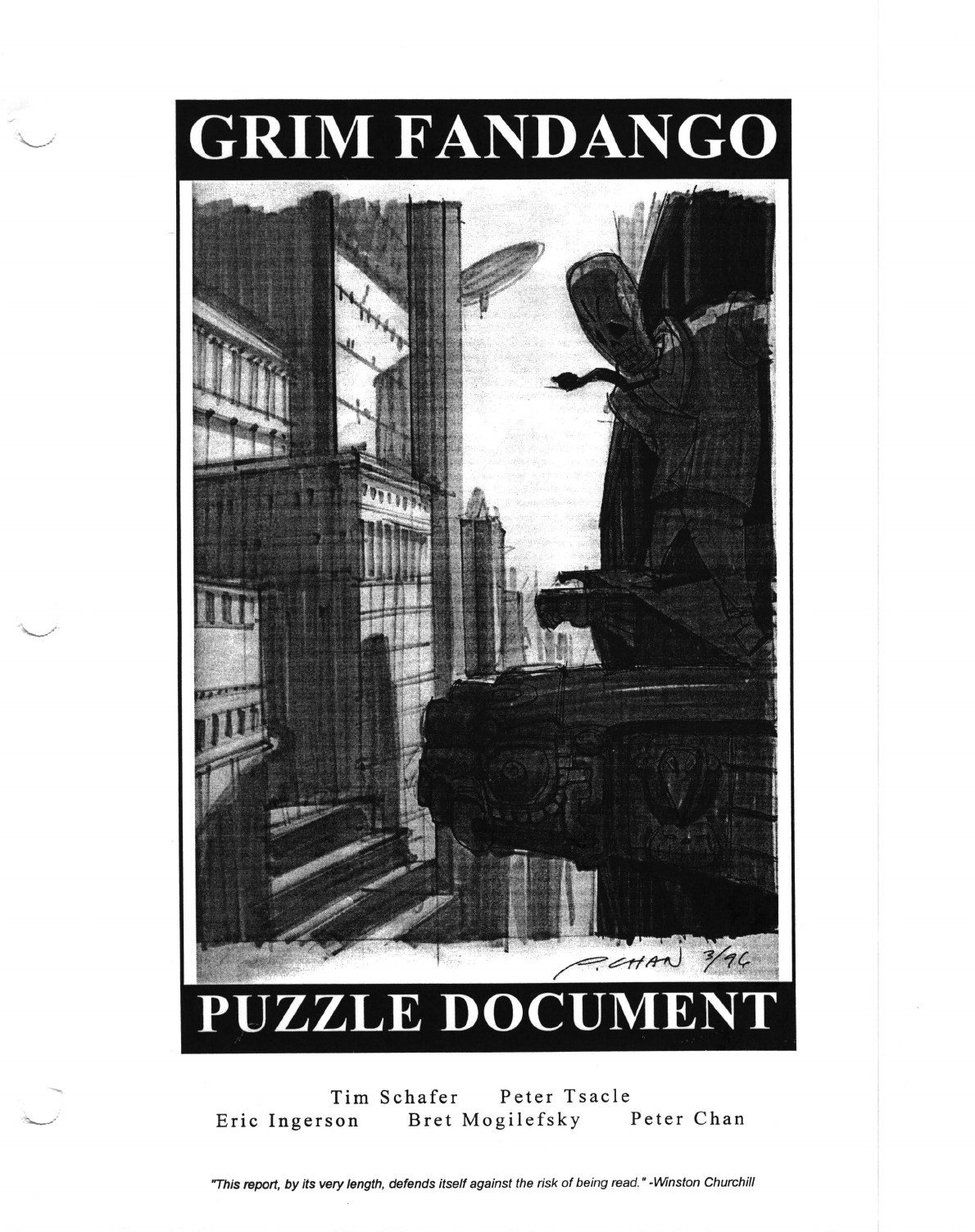
Grim Fandango's 1996 puzzle document survives as a 72-page design artifact
A mirror of Tim Schafer's Grim Fandango puzzle document keeps the 72-page first draft online, complete with puzzle charts, cut characters and Schafer's admission that he faked the final puzzle description to meet a deadline.
A first draft dated April 30, 1996
The 2.4-megabyte PDF circulating today is the puzzle design document for Grim Fandango, marked confidential and proprietary and credited to LucasArts Entertainment and Tim Schafer. Every page carries the date April 30, 1996, along with a timestamp.
Schafer wrote it with Peter Tsacle, Eric Ingerson, Bret Mogilefsky and Peter Chan, two years before the game shipped. Its 72 pages hold puzzle structure charts, location layouts and cut-scene descriptions with solutions.
What is inside: Year One, El Marrow and the puzzles
The document opens with a character list for Year One — El Marrow, describing Manny Calavera as a travel agent of the dead desperate for a good soul, his rival Domino Hurley, the crime boss Hector LeMans and the demon driver Glottis, whose blood type it lists as 10W-30. The Pizza Demon appears with a single line: using Manny's car to deliver in 3 minutes or less.
Puzzle charts map the first year, from the first reap and stealing a reap to tasks for the L.S.A., stealing the bone wagon and getting through the petrified forest. The text marks where nonlinearity begins — puzzles that must all be solved but can be worked in any order. The cut-scene scripts include the opening, in which Manny sells a dead client on travel packages across the Land of the Dead, among them an express train that crosses it in four minutes instead of four years.
Why the document outlived its takedown
Schafer published the file in November 2008, ten years after Grim Fandango's release, and admitted he had faked the final puzzle description: he wrote two nonsense paragraphs and overlapped them in the file so the page looked like a print formatting error, which let him turn the document in by the deadline. Days later he removed both the post and the file, hinting that it had not been his to publish.
The Gameshelf blog, which had linked to it, put a copy of the PDF on its own site, saying it believed in historic preservation; that copy is the one still circulating. Reviewing the old notes, Schafer said game documentation had changed a great deal since 1996, that the puzzles now looked harder than he remembered — nuts, obscure, mean, even — and that the team could have used one or two more years.
SiTech — AI-powered web development
We build fast, modern websites and bring AI into real business workflows. Have a project or a question? We'd love to help.