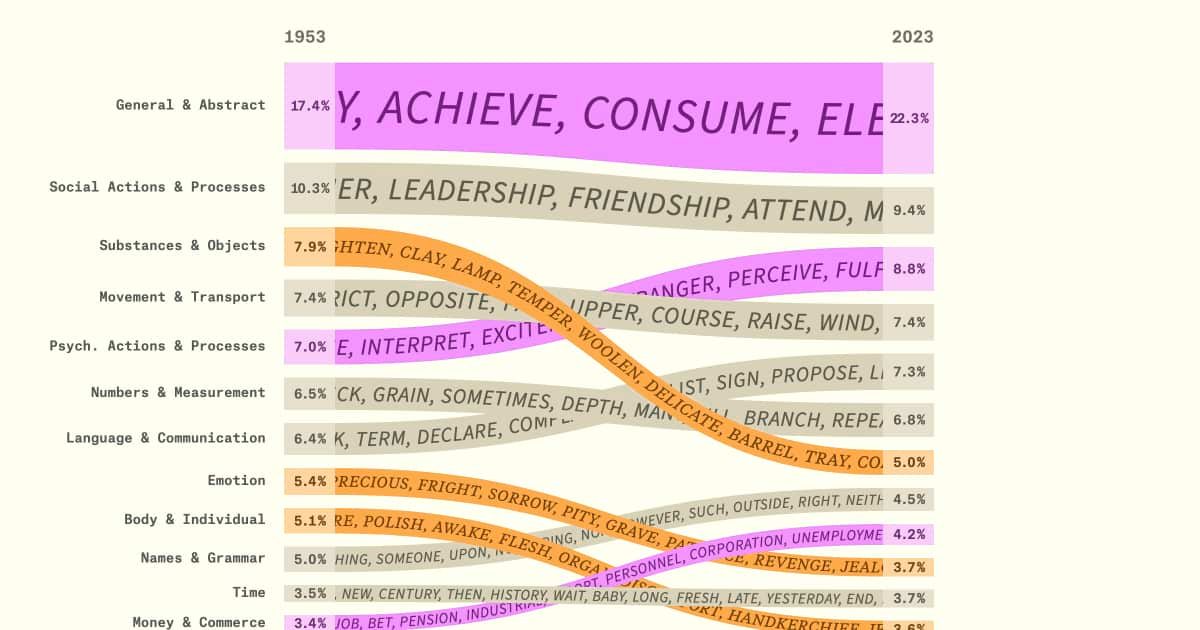
How the words we teach English learners changed
A new visual essay compares the General Service List of 1953 with its 2023 successor and finds a vocabulary that moved from the physical world — apples, forks, flour — towards abstract, systemic and institutional language.
The vocabulary taught to English learners has drifted away from the physical world and towards the abstract, according to a visual essay published by the data site Pudding.cool. It compares the General Service List, a teaching vocabulary of about 2,300 words compiled in 1953, with the New General Service List of 2013, revised in 2023, which covers more than 90% of general English with roughly 2,800 words.
What was dropped and added
Between the two lists, roughly 600 words were removed and more than 1,100 added, while about 1,650 stayed on both. Telegraph and tobacco fell away; computer, website and blog arrived; cigarette replaced tobacco; motherhood gave way to mom, and dad joined the list. Plenty of everyday objects did not survive: apple, fork, soap, umbrella and leaf are gone. Dog stayed, but goat and donkey did not; bread stayed while flour and wheat, its ingredients, dropped; cook is on the new list even though boil, bake and fry are not. The additions — mortgage, corporation, analysis, appropriate, despite — are overwhelmingly abstract.
Measuring the drift
The author sorted every word by meaning using the UCREL Semantic Analysis System, whose 21 categories were grouped into five scopes: the self, the immediate world, institutions, social life and communication, and abstract terms. The categories that shrank describe the immediate, physical world; the gains sit furthest from it. Using the Brysbaert concreteness ratings, the essay finds that highly concrete words fell from 21% of the 1953 list to 14% in 2023.
More qualifiers, more systems
Nouns still dominate both lists and verbs held steady, but adverbs nearly doubled: words such as barely, precisely, presumably and somewhat calibrate how much of a statement is true, how often, and how certain. The shift tracks a broader change in working life: by 1957 white-collar workers outnumbered blue-collar workers for the first time in US history, and by 2000 fewer than one in four workers did manual labour. "Bread survived both lists. Flour, wheat, harvest and bake didn't," the piece concludes — a life less tied to the kitchen and more to institutions and ideas.
SiTech — AI-powered web development
We build fast, modern websites and bring AI into real business workflows. Have a project or a question? We'd love to help.