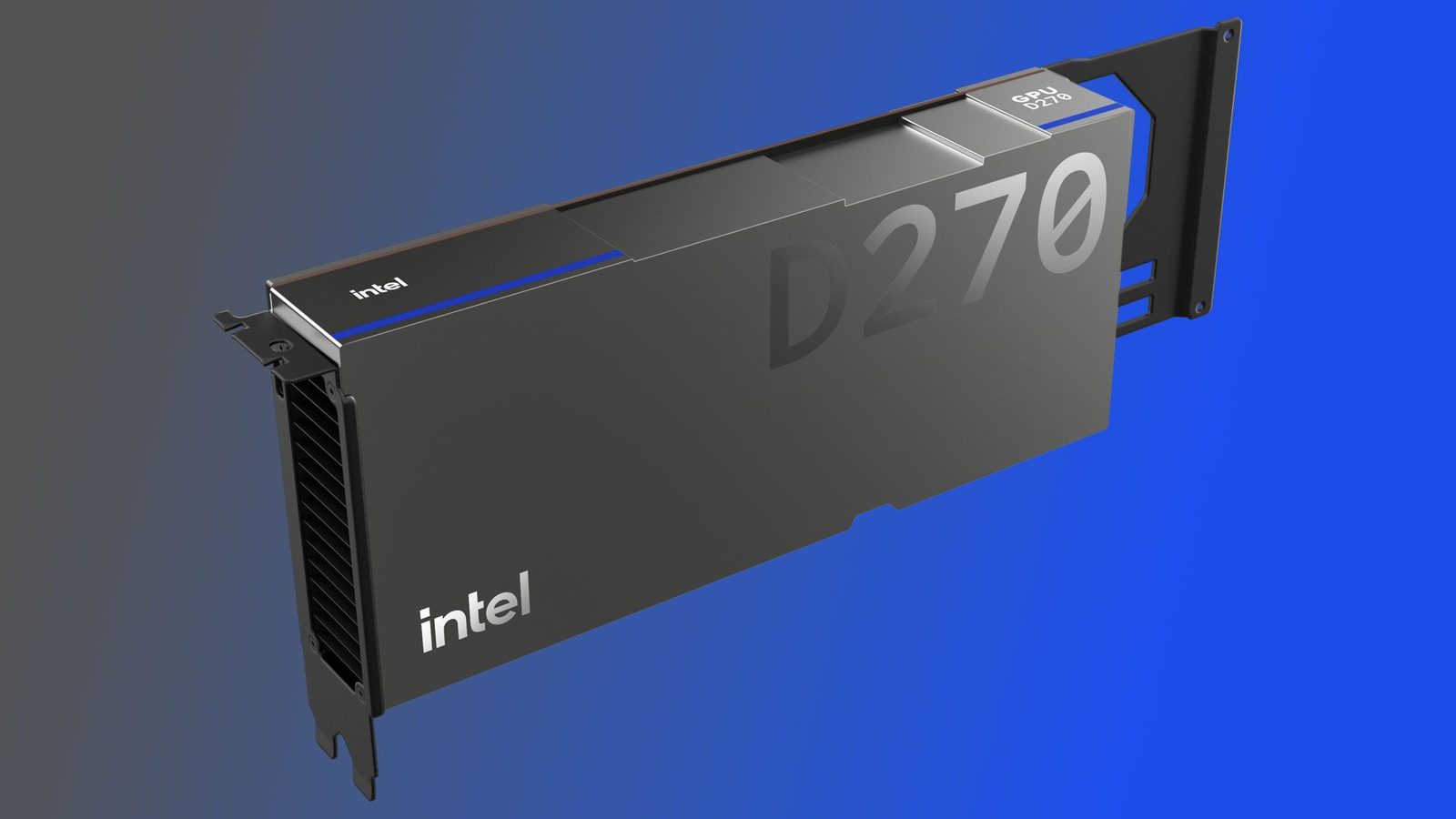
Intel Names Crescent Island as GPU D-Series, Targets Air-Cooled AI Inference
At OCP 2026, Intel branded its Crescent Island accelerator as the Intel GPU D-Series, revealing 1.3 PFLOPS of peak FP8 compute, 1.5 TB/s of memory bandwidth, a 350W air-cooled PCIe design, and up to 480GB of LPDDR5X memory.
Intel Officially Names Crescent Island as GPU D-Series
At OCP 2026 today, Intel has given its Crescent Island AI accelerator an official product name: the Intel GPU D-Series. With the announcement, the company also disclosed the chip's theoretical peak performance target of 1.3 PFLOPS of FP8 compute and a final memory bandwidth figure of 1.5 TB/s for these AI inference accelerators.
The disclosures add to a gradual stream of information Intel has released about Crescent Island throughout 2026. Crescent Island is the first chip built on Intel's Xe3P graphics architecture, a massively parallel computing design that lacks most or all of the graphics-specific functional units found in a true GPU.
Air-Cooled PCIe Design with Up to 480GB of LPDDR5X
Intel will release GPU D-Series products in an air-cooled PCIe form factor with a TDP of 350W and up to 480GB of LPDDR5X memory. That positions the chips well below Nvidia's Rubin GPUs: each of the 72 Rubin GPUs in Nvidia's Vera Rubin NVL72 rack-scale system delivers a theoretical 17.5 PFLOPS of FP8 throughput, but each chip requires liquid cooling and likely carries a TGP measured in kilowatts.
Instead of competing in that envelope, Intel is targeting traditional air-cooled rack servers scaling up to eight GPUs, similar to Nvidia's HGX systems. In such a configuration, Intel says GPU D-Series chips could power inference on models spanning more than one trillion parameters. The company also highlighted the chip's suitability for large language models, long-context inference, and concurrent inference services, creating a foundation for multi-tenant AI services, robotics, and other latency-sensitive workloads.
Software Stack and Ecosystem
For distributed inference deployments in which multiple GPUs act as one, Intel will need a robust software stack. The company is pointing to the common Xe software foundation it has already built for AI across its Xe Cores in integrated and discrete GPU products. To bring Xe accelerators into the data center, Intel says it is working with a broad ecosystem of OEMs, ODMs, neoclouds, independent software vendors, appliance providers, and AI-native companies.
Customer sampling of GPU D-Series products is already in progress, though Intel did not provide details of a broader launch. The product represents Intel's attempt to secure an AI accelerator foothold after the failure of the Data Center GPU Max family, code-named Ponte Vecchio, its mothballed follow-ons, and a series of silicon acquisitions that never coalesced into a coherent AI strategy. Whether the GPU D-Series gains traction remains to be seen, but a proven architectural shape aimed squarely at inference in an accessible thermal and electrical envelope could be what Intel needs as models advance and agentic workflows grow in importance.
Sources: Tom'S Hardware
SiTech — AI-powered web development
We build fast, modern websites and bring AI into real business workflows. Have a project or a question? We'd love to help.