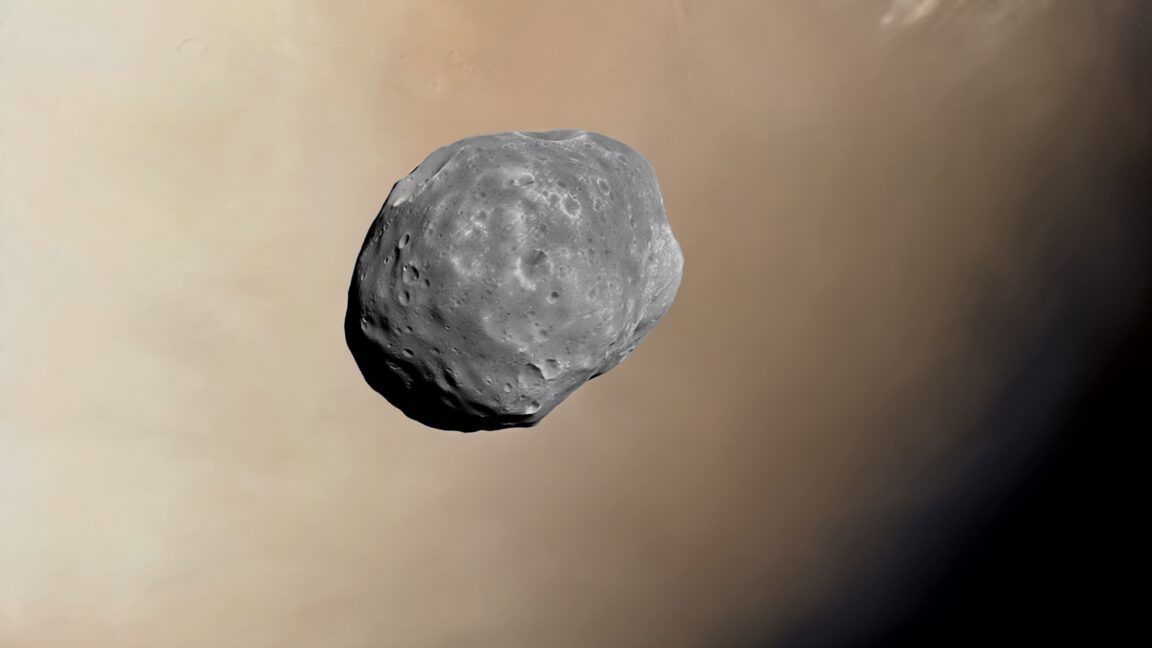
Japan Launches MMX Mission to Retrieve Samples From Martian Moon Phobos
Japan's Martian Moons eXploration (MMX) mission lifted off Monday on a five-year expedition to land on Phobos, the largest moon of Mars, and return samples to Earth by 2031.
Launch and Mission Overview
Japan launched its $578 million Martian Moons eXploration (MMX) mission Monday at 3:41 pm EDT from Tanegashima Space Center. The spacecraft rode a 63-meter H3 rocket in a new configuration with four strap-on solid rocket boosters, separating from the vehicle about 71 minutes after liftoff. The nearly 9,900-pound spacecraft, two-thirds of whose mass was propellant, established contact with ground controllers soon after separation. Hiroshi Yamakawa, president of the Japan Aerospace Exploration Agency (JAXA), declared the launch a success.
MMX is now on a 10-month voyage to Mars. After arriving next August, the spacecraft will spend about three years conducting encounters with the Martian moons Phobos and Deimos before attempting a sample return to Earth.
Science Goals and International Contributions
MMX builds on Japan's Hayabusa and Hayabusa 2 missions, the first to return asteroid samples to Earth. One primary science goal is determining whether Phobos is a captured asteroid or debris from a giant impact on Mars early in the planet's history. NASA and European space agencies contributed instruments and expertise. Tom Statler, lead scientist for solar system small bodies at NASA, said studying samples in laboratories will help resolve the long-standing debate over the moons' origins.
Landing, Sampling, and Return
After arriving at Mars, MMX will jettison its propulsion module and maneuver into a quasi-satellite orbit around Phobos. In late 2028 or early 2029, the mothership will release a small rover named Idefix, a French-German contribution, to explore the surface for up to 100 days in gravity less than one-thousandth that of Earth's. Later in 2029, the main spacecraft will attempt up to two landings on Phobos, using a coring drill on its robotic arm and a NASA-provided pneumatic sampler to collect at least 10 grams of material. The samples will be returned to a landing zone in South Australia in 2031, with 15 percent allocated to US researchers.
Why Phobos Matters
Phobos is the larger of Mars's two moons, with an average diameter of 22 kilometers and a surface area comparable to Houston. Its proximity to Mars means MMX might collect traces of the red planet itself that settled on the moon's surface. The mission could also inform future human exploration plans. Previous attempts to sample Phobos, including Russia's Phobos-Grunt in 2011 and two Soviet missions in 1988, all failed before completing their objectives.
Sources: Ars Technica
SiTech — AI-powered web development
We build fast, modern websites and bring AI into real business workflows. Have a project or a question? We'd love to help.