JetBrains Air: A System of Products for Agentic Software Development
JetBrains has folded six months of agentic-development work into JetBrains Air: Air in JetBrains IDEs, Air Teams and Air Governance — an open, multi-vendor system for directing, coordinating and auditing AI agents.
JetBrains has announced JetBrains Air, an open system of products for agentic software development spanning the company's IDEs and the services around them. Published on the JetBrains blog on September 22 by Kirill Skrygan, it gathers six months of experiments with agentic development environments and earlier work on JetBrains Central.
Three products under one name
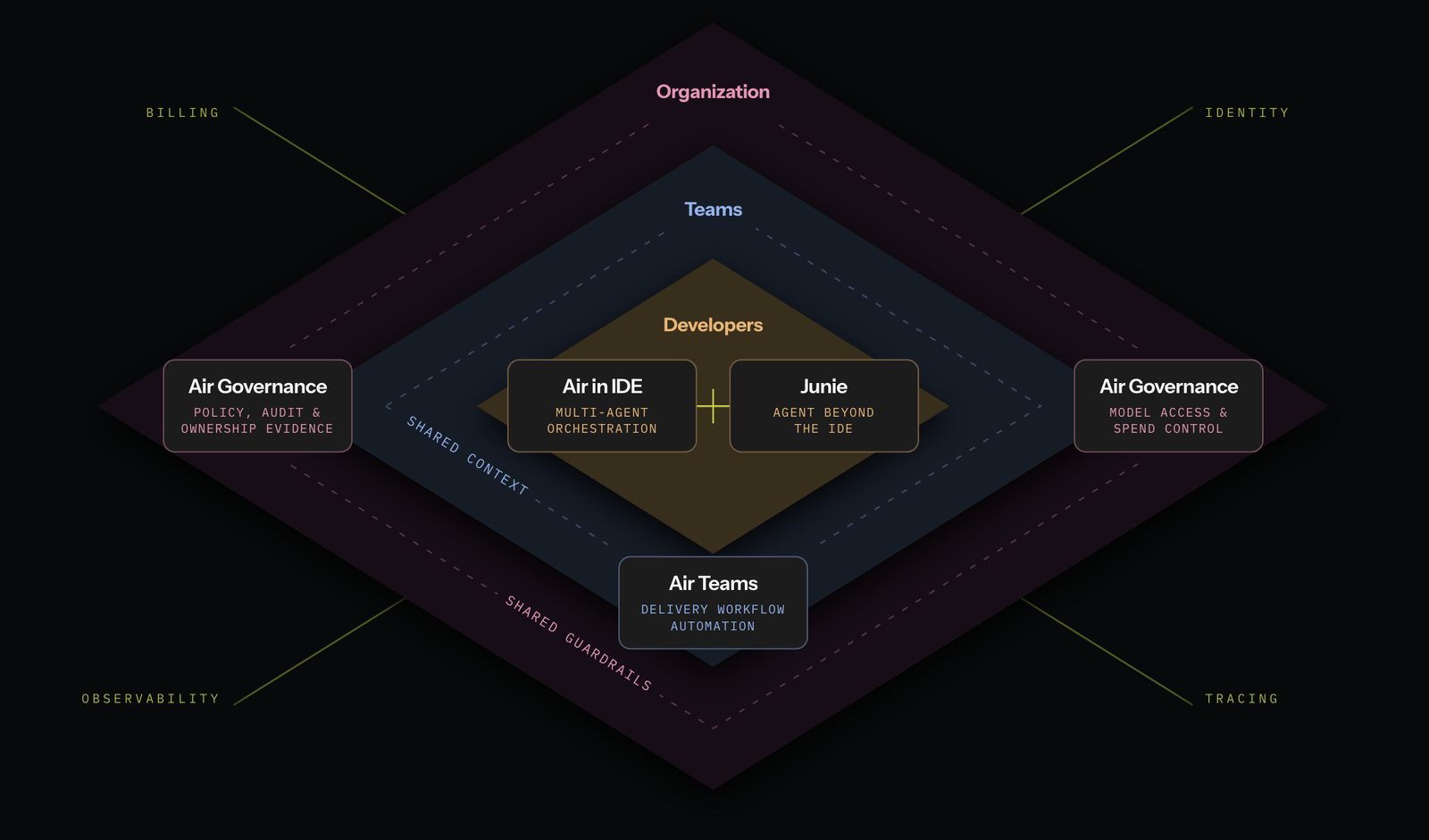
Air covers three levels. In JetBrains IDEs it lets developers direct agents and verify their output with the company's code intelligence. Air Teams turns individual agent activity into coordinated team workflows and automates part of software delivery. Air Governance, formerly JetBrains Central, handles organizational policy, visibility, auditability, cost management and accountability.
Junie, JetBrains' coding agent, will be supported across all Air surfaces. The system also stays open to outside tools: the Agent Client Protocol (ACP) standardizes the link between an IDE and an agent's full harness — planning, tools, model routing and observability — while the ACP Registry lets developers find and run compatible agents without leaving the editor.
Multi-vendor as a design principle
JetBrains calls multi-vendor support foundational, not an add-on. It argues the market is unlikely to consolidate soon: models differ in what they are good at, rankings shift every few months, and teams inside the same company often make different choices. Standardizing on one vendor, it warns, means a multi-year commitment in a market that will look different next quarter.
Openness has a cost current tooling does not absorb: context does not carry between tools, spending cannot be attributed, and policies must be rebuilt for each service. JetBrains positions itself above that layer — shared context, one set of policies, a single cost view and a record of what happened, whichever vendor produced a change.
Where the bottleneck moves
As agents take on more execution, the constraint shifts from producing change to understanding, verifying and owning it: code becomes cheaper to generate but more expensive to verify. Accountability, in JetBrains' phrasing, cannot be delegated — an agent will not get the call at 3 a.m. when something breaks.
Air will arrive through a rolling series of releases, labelling what is available now, what is in preview and what remains long-term direction. Later stages point to mobile and remote experiences, and to work triggered by repository events, schedules and delivery processes rather than a developer opening an editor. JetBrains will not name future products before their scope and availability are settled.
SiTech — AI-powered web development
We build fast, modern websites and bring AI into real business workflows. Have a project or a question? We'd love to help.