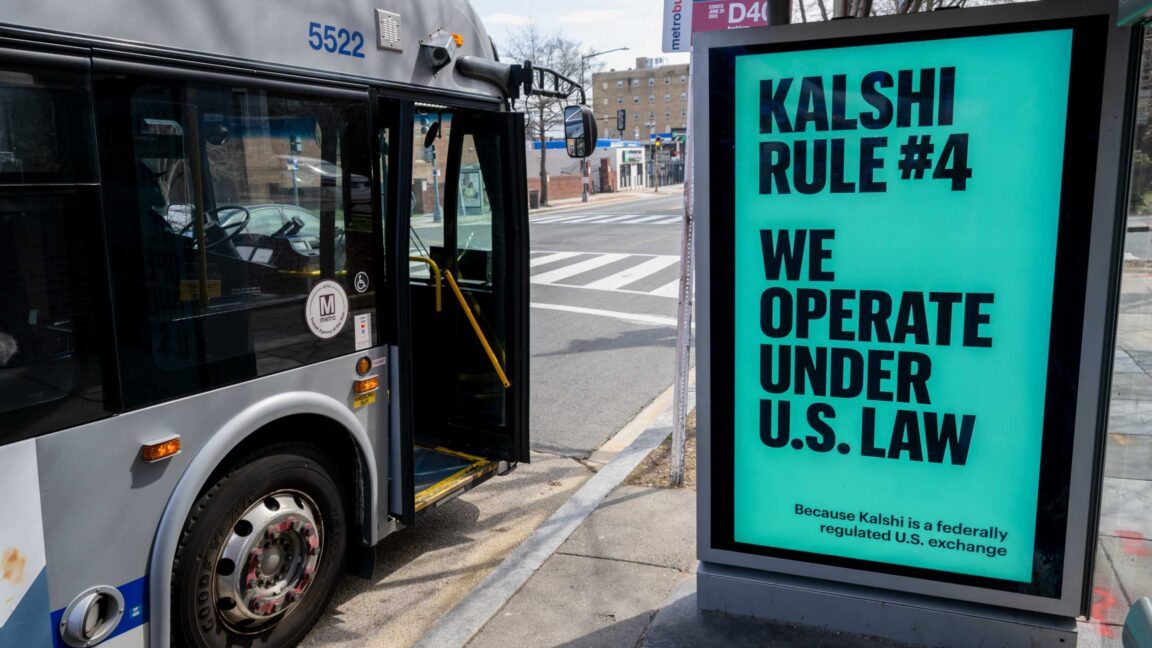
Kalshi loses again as judges rule prediction markets must obey gambling laws
A US appeals court has ruled unanimously that Kalshi's sports bets are not swaps under federal law, so Ohio and Tennessee can enforce their own gambling rules on the prediction market.
Another federal appeals court has ruled that states may enforce their gambling laws against Kalshi, rejecting the prediction market's position that only the US government can regulate it. On Friday, a three-judge panel of the US Court of Appeals for the Sixth Circuit ruled unanimously in favor of Ohio and Tennessee.
The Sixth Circuit's ruling
The panel held that sports wagers offered on Kalshi do not meet the legal definition of "swaps," over which the Commodity Futures Trading Commission (CFTC) claims exclusive jurisdiction. The judges added that even if the contracts were swaps, the regulatory scheme Congress created would not stop states from enforcing gambling laws on prediction markets.
The ruling, written by Judge Julia Smith Gibbons, a George W. Bush appointee, upheld an Ohio district court decision against Kalshi and vacated a Tennessee district court order that had favored the company.
Why sports bets are not swaps
Under US law, swaps include contracts tied to events "associated with a potential financial, economic, or commercial consequence." The Sixth Circuit read that narrowly: an event must be intrinsically tied to a financial consequence, so that hedging financial risk or obtaining pricing information would be useful, as with a change in interest rates.
Kalshi's sports contracts have only downstream economic consequences, the court said, "assuming they have the potential to cause economic consequences at all." It also rejected the argument that Congress preempted all state regulation of designated contract markets (DCMs) such as Kalshi, noting that Congress wrote express preemption clauses elsewhere in the Commodity Exchange Act but not in the section on the CFTC's exclusive jurisdiction.
A widening split over prediction markets
The Sixth Circuit is the third federal appeals court to weigh in. Kalshi won a Third Circuit case involving New Jersey but lost in the Ninth Circuit over Nevada, so states now hold two major victories against one for the company. A Fourth Circuit case involving Maryland is pending, and New Jersey has asked the Supreme Court to settle the question nationwide.
Kalshi criticized the ruling in a statement to Ars Technica, saying it disagrees with the decision. The company argues that different courts reaching different conclusions shows why a state-by-state patchwork does not work. The CFTC, which filed an amicus brief backing Kalshi, has separately sued nine states over what it calls infringement of its exclusive jurisdiction.
SiTech — AI-powered web development
We build fast, modern websites and bring AI into real business workflows. Have a project or a question? We'd love to help.