Micron Ends 4F² DRAM Development After Two Decades, Cites No Density Gain
Micron ends 4F² DRAM work after 20 years, saying it offers no real density gain, adds cost and complexity, and has fundamental scaling limits. The firm will keep scaling 6F² DRAM and move to 3D DRAM.
Micron Ends 4F² DRAM Development
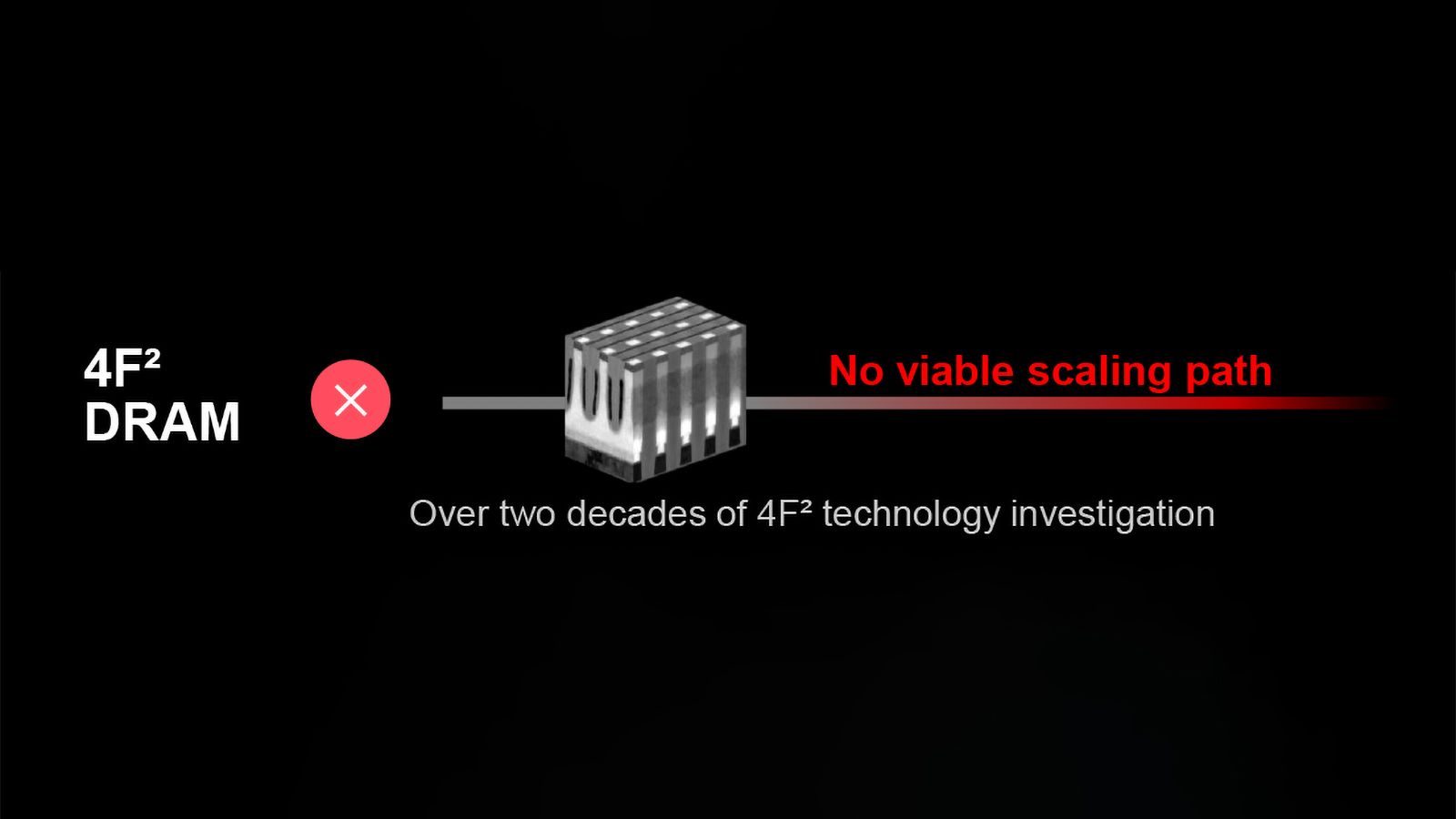
Micron has decided to stop future development of 4F² DRAM after roughly two decades of research. The company states that the architecture does not provide meaningful density advantages, increases manufacturing complexity and cost, and faces fundamental scaling limitations.
Scott DeBoer, Micron's president and chief technology and products officer, said the company invented 4F² DRAM but evaluated it over the past twenty years and chose not to pursue it because of higher complexity and cost.
Technical Reasons Behind Decision
The theoretical benefit of 4F² DRAM is a cell area about 33 percent smaller than conventional 6F² designs, which could raise the number of memory cells per wafer by roughly 50 percent. However, DeBoer explained that capacitor pitch and dimensions, not transistor footprint, ultimately set DRAM bit density. Both 4F² and 6F² transistors must fit under the capacitors, so reducing transistor area alone does not guarantee a smaller overall cell.
Micron also found that 4F² introduces additional manufacturing steps that raise costs without delivering sufficient benefits. DeBoer described the claimed density advantage as a myth, emphasizing that capacitor pitch defines the DRAM cell size.
Future Roadmap Focuses on 6F² and 3D DRAM
Instead of adopting 4F², Micron will continue scaling conventional 6F² DRAM using advanced lithography, new materials, and wafer bonding. The upcoming 1δ process technology is scheduled for volume production in the second half of 2027 and promises a mid-20 percent improvement in bit density over its predecessor.
The company also plans to adopt high-NA EUV lithography for future DRAM generations. DeBoer acknowledged that 4F² is technically feasible and that Micron has built experimental devices, but he said its complexity and cost become increasingly problematic as feature sizes shrink. He noted that 4F² has no sustainable scaling path beyond a certain point and that fundamental physics problems will lead to 3D DRAM instead.
Micron is already developing multiple generations of 3D DRAM production nodes and will transition when the technology offers the right combination of density, manufacturing complexity, and cost. While Samsung and SK hynix keep 4F² in their roadmaps, Micron believes extending 6F² scaling and eventually moving to 3D DRAM provides a better long-term strategy.
Sources: Tom's Hardware
SiTech — AI-powered web development
We build fast, modern websites and bring AI into real business workflows. Have a project or a question? We'd love to help.