North Korea-Linked PolinRider Hits Over 7,600 GitHub Repositories
A North Korea-linked campaign called PolinRider has planted a Python loader in GitHub repositories, with Apiiro estimating at least 7,609 repos and 2,330 accounts affected.
Security researchers have linked a malware campaign called PolinRider to North Korean threat actors and found it planting a Python loader in public GitHub repositories. SafeDep said it identified the loader in 375 public repositories belonging to 260 accounts, while Apiiro estimated the campaign has been detected in at least 7,609 GitHub repositories owned by 2,330 accounts. The campaign abuses repository access to turn projects into a malware distribution channel.
How the loader works
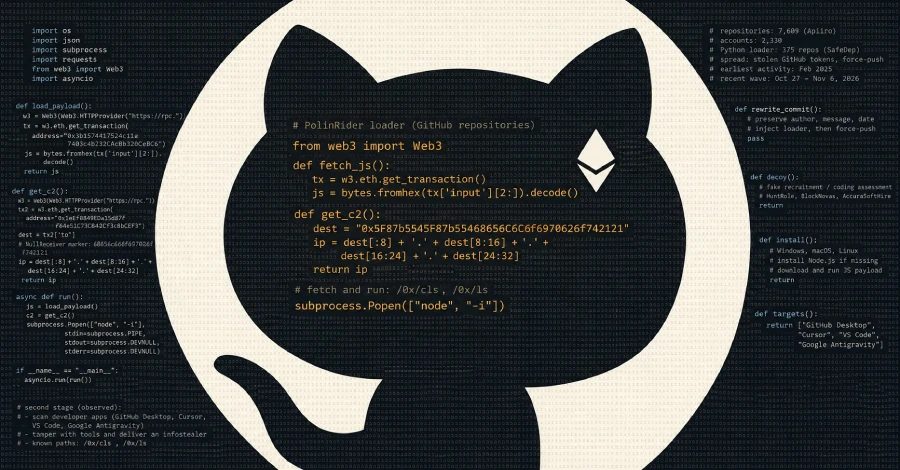
SafeDep said the loader hides in a small utils package or in conftest.py. When Python imports the file, the loader reads the newest transaction that an Ethereum wallet sent to itself, decodes the input data as JavaScript and runs it with Node.js. The JavaScript reads a second wallet to locate the command-and-control server and passes the next stage to a detached interactive Node.js environment by means of a node -i process.
SafeDep described a 58-line Python loader that reads the wallet 0x3b1574417524c11a7403c4b232CAcBb320CceBC6 to extract JavaScript code. That code reaches out to a second wallet, 0x1eEf0849EDa15d87f64e51C73C8442Cf3c8bCEF3, to obtain the destination wallet associated with the latest transaction, 0x5F87b5545F87b55468656C6C6f6970626f742121, which is then used to parse the C2 server 95.135.181[.]84. The researchers said a marker in the destination wallet address consistently translates to "helloipbot!!."
Delivery channels and targets
The campaign has used fraudulent recruitment campaigns with phishing emails and fake hiring portals including BlockNovas, AccuraSoftHire and HuntRole to trick targets into running malware-laced projects under the pretext of a take-home assessment. It has also published malicious packages by hijacking maintainer accounts, planting obfuscated malware through fake font files, VS Code auto-run tasks and Git history rewriting, and used compromised developer machines to steal GitHub tokens and force-push malicious commits.
At a high level, the loader retrieves an encrypted second-stage Node.js payload that scans the infected host for developer applications such as GitHub Desktop, Cursor, VS Code and Google Antigravity. It then tampers with the most frequently used tools to execute attacker-controlled code and deliver infostealer malware. Prior waves have been observed installing a stealer that harvests environment secrets, browser passwords, cookies and wallet data.
Scale and earlier activity
Apiiro said the campaign has been detected in at least 7,609 GitHub repositories owned by 2,330 accounts, most belonging to developers. Some victims include Neutralinojs, InstaWP Connect and fxhash. The loader was pushed to 2,040 repositories between October 27 and November 6, 2026.
Apiiro researcher Shmulik Cohen said the worm uses stolen GitHub access to rewrite commits the developer already made, keeping the author, message and date, and adds a loader hidden after hundreds of spaces in a build config. Building the project runs it, and in the newest wave opening the folder in VS Code is enough. The loader reads its server from an Ethereum wallet, so taking a server down changes nothing because one transaction moves every loader to the next.
Sources: The Hacker News
SiTech — AI-powered web development
We build fast, modern websites and bring AI into real business workflows. Have a project or a question? We'd love to help.