NVIDIA's SoL-Pi cuts coding agent token use nearly in half by optimizing the harness
NVIDIA researchers built SoL-Pi, a system that automatically rewrites a coding agent's control layer. It keeps only changes that preserve capability while cutting token traffic by up to 49 percent.
NVIDIA researchers have built SoL-Pi, which optimizes the harness, the control layer between a model and its environment that coding agents such as Codex, Claude Code and OpenClaw run on. The arXiv paper of 17 September, reported by The Decoder, cuts recorded token traffic by 44.7 to 49 percent and API cost by about a third while keeping comparable performance.
The harness becomes the target
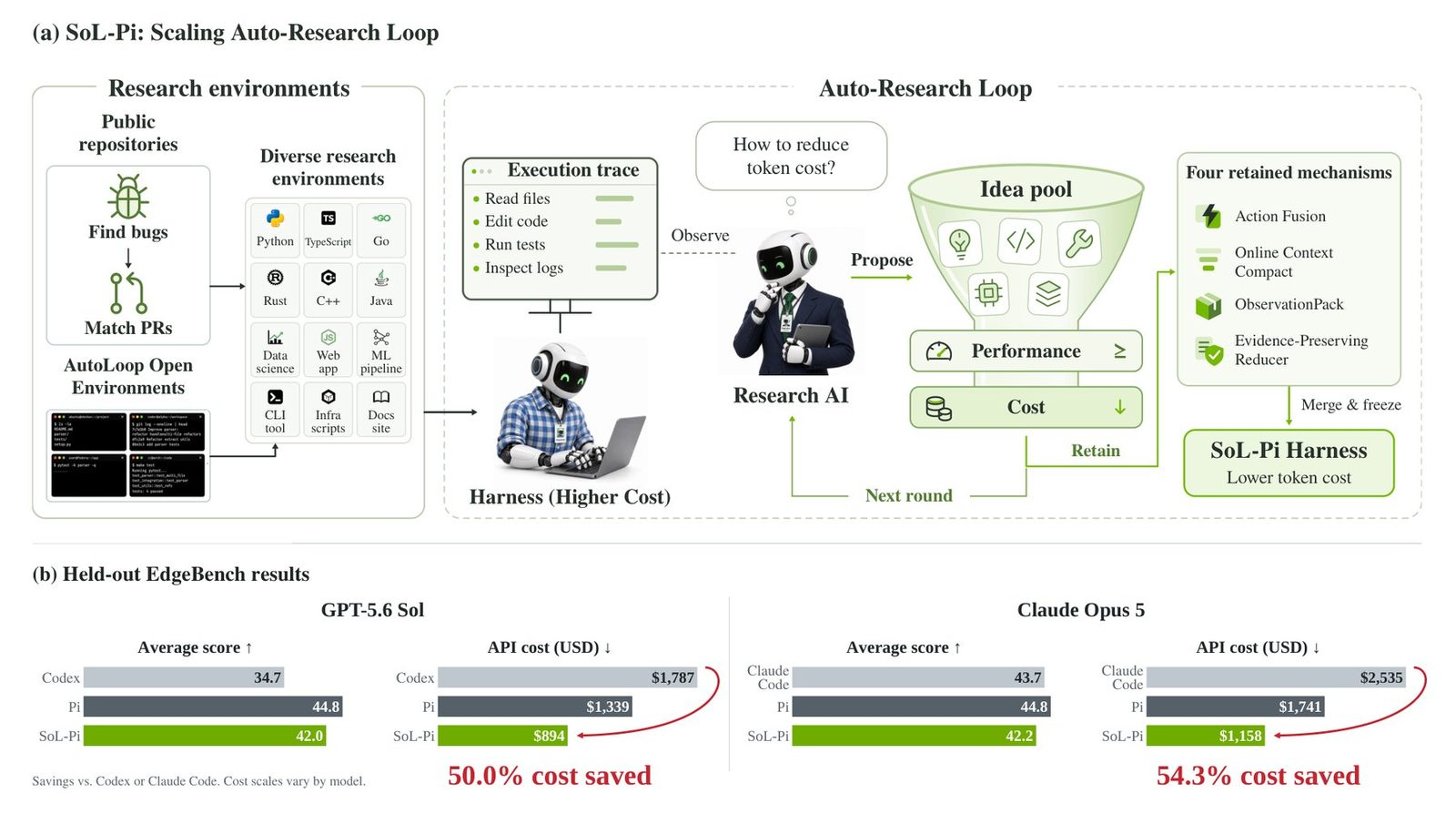
Efficiency work usually targets the model: faster attention kernels, quantization or cheaper models. SoL-Pi instead changes how an agent sees states, runs actions and processes feedback. A research AI reads traces from an agent on the base harness, proposes changes and tests them in prepared environments; a candidate survives only inside a pre-declared capability tolerance that improves an efficiency metric.
The search covered 152 directions in six families, including context, tools, delegation and evaluation, across 535 executable environments. It produced more than 3,000 runs and over 60,000 agent-environment interactions.
Four mechanisms survive
Four mechanisms came out of the search. Action Fusion merges two consecutive steps into one and removes a whole model call. Online Context Compact trims accumulated context after each planning step when nothing important is lost. ObservationPack archives long tool outputs and later sends a short summary instead of the full text. Evidence-Preserving Reducer sends large error and test logs to a cheaper model that distills the key findings.
On EdgeBench, the variant combining all four mechanisms uses 49 percent fewer tokens and reaches 93.7 percent of Pi's baseline score; API cost falls 50.0 percent against Codex and 54.3 percent against Claude Code. A variant with the strongest single mechanism beats Pi by 5.3 percent. In one test run total cost fell from $1,339 to $894; the authors estimate hourly savings of $8.75 to $13.50 against Codex and Claude Code and $4.36 to $5.71 against Pi.
Built with GPT-5.6 Sol and applied unchanged to Opus 5, SoL-Pi kept 94.3 percent of Pi's performance with similar savings, though the mechanisms fired less often.
Other benchmarks are messier
On 63 CPU tasks from Terminal-Bench 4, SoL-Pi solved 15 while Codex and Pi each solved 18, though costs stayed a quarter below Pi's. On verified Lean 4 tasks from IMO 2026 it solved three of six at the lowest cost per solved problem, and a swarm of 20 SoL-Pi workers cut kernel-optimization costs by 26.8 percent.
Shrinking context has a price: shorter prompts can reduce prompt-cache reuse. The Decoder notes a separate study found compression preserves only 17 percent of user instructions on average.
SiTech — AI-powered web development
We build fast, modern websites and bring AI into real business workflows. Have a project or a question? We'd love to help.