How Anthropic made claude.ai about 3x faster in two weeks
Anthropic says a two-week August sprint made claude.ai and the Claude desktop app roughly three times faster: at the 75th percentile a fresh load fell from 3.1 seconds to 0.55. More than 3,000 changes were merged without a rollback.
Anthropic says the core experience of claude.ai and the Claude desktop app became about three times faster during a two-week sprint in August 2026. The work ran out of one Slack channel, with Claude in every thread. Users had told the team the product felt slow, and the team agreed.
Four journeys, thirteen measurements
The sprint covered the four journeys that make up 95% of user activity: launching the app, starting a conversation, loading an existing one and sending a message. Measured with real user monitoring across web and desktop, they became thirteen numbers.
At the 75th percentile, a fresh load of claude.ai fell from 3.1 seconds to 0.55, a desktop cold start from 6.31 to 3.33 seconds, and sending a message in Claude Cowork from 928 to 48 milliseconds. The average across the thirteen measurements was 3.1x, and Anthropic estimates the sprint saves tens of thousands of user-hours of waiting daily.
Benchmarks Claude could climb
Claude Tag (beta), running an internal research model roughly comparable to Opus 5.5, read usage data through the Datadog MCP server and found the bottlenecks. Engineers set goals, weighed tradeoffs and approved every change; more than three thousand changes were merged without a customer-facing incident or rollback.
Wall-clock time is too flaky to gate CI, so the team measured deterministic proxies instead: instruction counts under Valgrind with node --predictable, React commits and DOM mutations. On the routine that assembles a conversation's message tree, Claude cut instructions 48% and wall-clock time 78%. Those ceilings became ratchets that can only move down.
What shipped, and what guards it
A static composer is baked into the HTML so users can type while React initializes; the desktop shell precompiles a V8 code cache; the composer stays mounted between conversations; sessions are prefetched on hover; sidebar re-renders fell 90%.
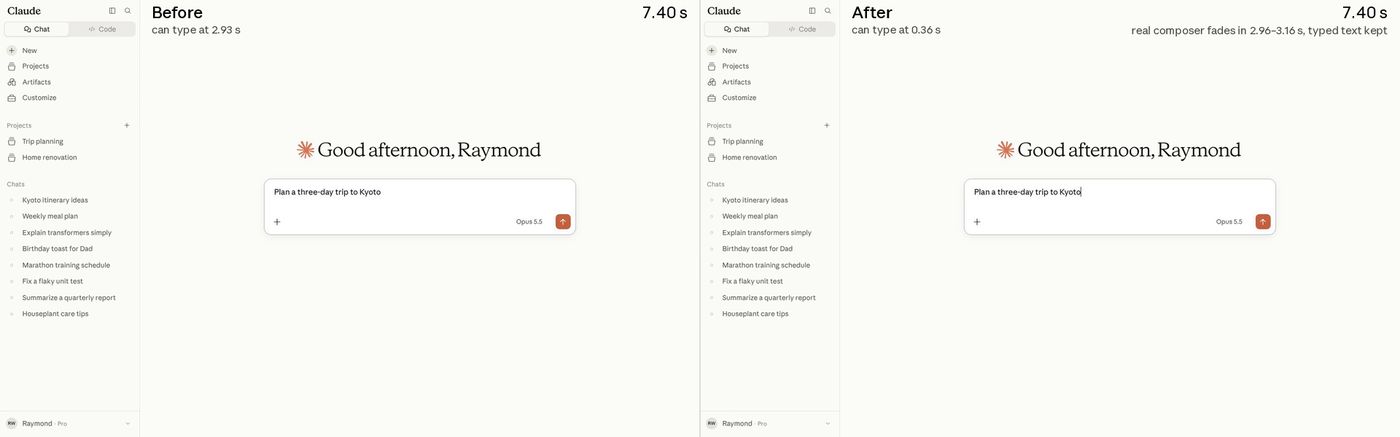
For streaming, Claude stepped through long replies frame by frame against an 8.33 millisecond budget. Nearly sixty pull requests in one thread cut main-thread blocking from about 750 to about 200 milliseconds and held 120 fps on a 120 Hz MacBook. Safety rested on automated review with at least one human approval and short-lived feature flags.
Still climbing
claude.ai is about 3x faster than in early August, and the ratchets should hold it there. The 95th percentile and very long conversations still have room, and a later post will cover fixes contributed upstream to Electron, Chromium and Node.js.
SiTech — AI-powered web development
We build fast, modern websites and bring AI into real business workflows. Have a project or a question? We'd love to help.