OpenAI and Anthropic LLM price cuts: timeline, competition, and IPO questions
OpenAI and Anthropic cut LLM prices sharply between June and September 2026, driven by competition from each other and open-weight models, while questions remain about IPO timing and inference margins.
OpenAI and Anthropic repeatedly cut prices for their major LLMs between June and September 2026, in some cases by 80%.
OpenAI and Anthropic price cuts
OpenAI announced GPT-5.6 Sol at $5 / $30 / $0.50 and GPT-5.6 Luna at $1 / $6 / $0.10 on June 26, 2026. It cut GPT-5.6 Luna by 80% on July 30, 2026 to $0.20 / $1.20 / $0.02, and cut GPT-5.6 Sol by about 20% on August 21, 2026 to $4 / $20 / $0.40 for three months. On September 22, 2026, OpenAI announced GPT-6 Sol at $2 / $10 / $0.20 and GPT-6 Luna at $0.10 / $0.50 / $0.01. On September 29, 2026, it announced GPT-6.1 Sol and halved its cache price to $2 / $10 / $0.10.
Anthropic announced Claude Sonnet 5 on June 30, 2026 at $2 / $10 / $0.20, then made the temporary launch price permanent on August 10, 2026. Claude Opus 5 launched on July 24, 2026 at $5 / $25 / $0.50. Fable 5.1 launched on September 1, 2026 at $10 / $50 / $0.25 and cut cache read cost by 75%. On September 22, 2026, Anthropic announced Claude Opus 5.5 at $4 / $20 / $0.20 with lower input/output and cache read costs.
Competition and open-weight pressure
The dates show a tit-for-tat between Anthropic and OpenAI, and Max Woolf, who compiled the timeline, notes that no one cuts prices by 80% without an externality. Agentic LLMs have become more of a commodity with little moat, because users can try a new model through a toggle in harnesses such as OpenCode and Zed Agent or a different API endpoint through OpenRouter. Large competitors such as Google and Meta, plus open-weight models, provide sufficient substitutes and pricing pressure.
Open-weight pressure is visible on OpenRouter. DeepSeek Flash V4.1 1017 performs better than DeepSeek Flash V4 on benchmarks, 45 versus 24 on the Artificial Analysis index, with pricing from DeepSeek at $0.15 / $0.60 / $0.003. The number of distinct providers hosting the DeepSeek variant on OpenRouter rose from 13 in May to 29. Moonshot AI announced Kimi K3.1 Pro with performance comparable to Opus 5.5, 55 versus 58, at half the input/output price and the same cache read cost of $2 / $10 / $0.20.
IPO timing, margins, and outlook
Both OpenAI and Anthropic are rumored to be IPOing soon, OpenAI in 2027 and Anthropic within a couple months. Leaked financials show they are losing billions due to R&D and scaling, though the reports do not account for hyperexpansion of agentic LLM use. Woolf notes that cutting the primary revenue source by up to 80% seems the opposite of what would look good on an S-1 prospectus, while reports say profit-per-token margins can be as healthy as 80% with caveats. The cuts also apply to subscription harnesses such as Codex and Claude Code, and OpenAI cut the usage allowance by 50% for the $200 per month Codex tier when GPT-6.1 Sol was announced.
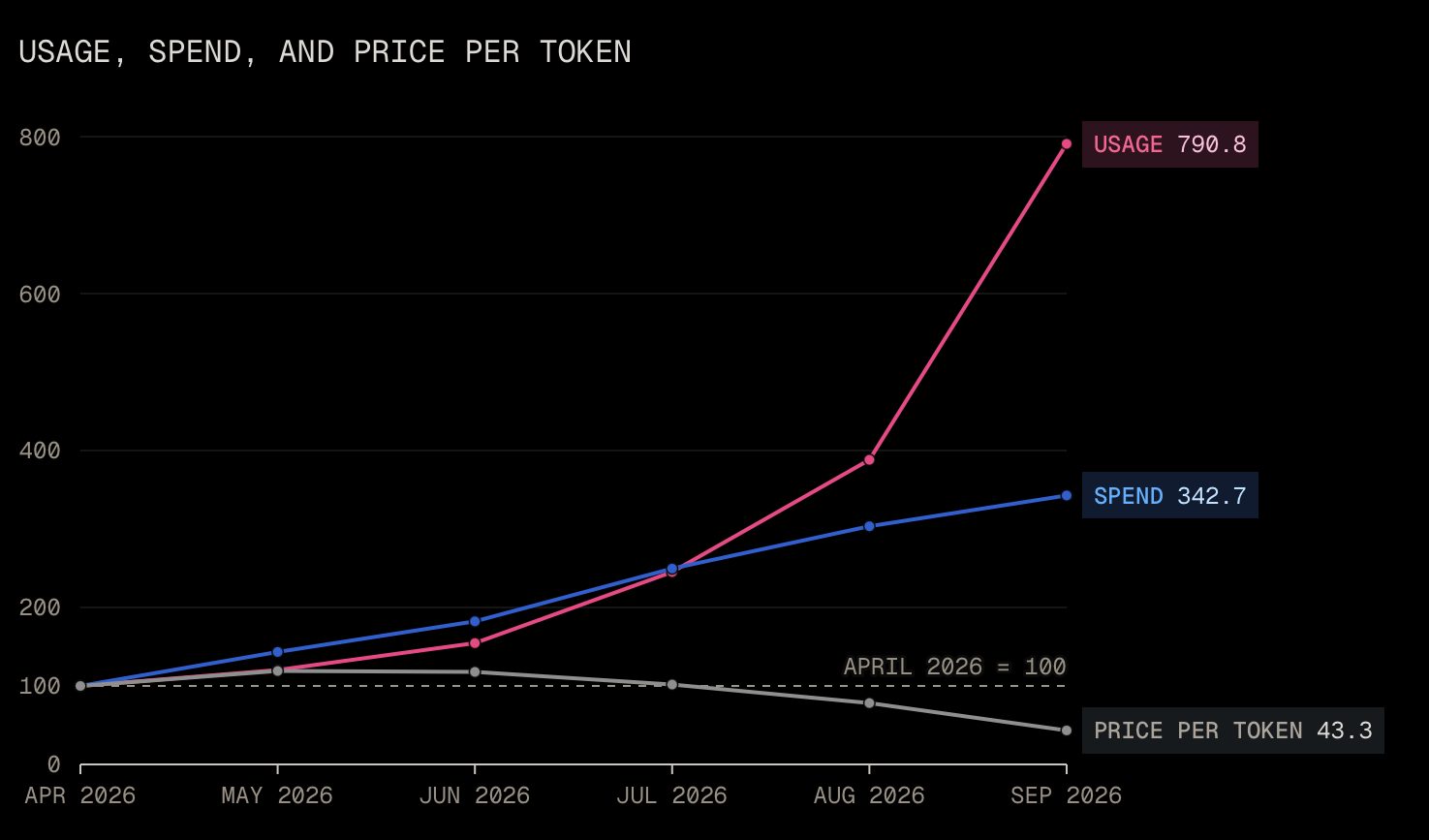
Woolf writes that the cuts do not appear to have come at the cost of output quality. Vercel AI model gateway data shows cost per token falling to 43.3% of the April 2026 cost, while aggregate spend has been increasing because models are getting better faster than they are getting cheaper. He also cites Anthropic's statement that Opus 5.5 requires less compute to serve than Opus 5 and that its pricing reflects that. Open-weight models and secondary inference providers, he argues, will continue to serve as an economic check on LLM prices, and even if the OpenAI and Anthropic IPOs are catastrophic and cause both companies to fold, LLMs and agents as an industry would not suddenly die.
Sources: minimaxir.com
SiTech — AI-powered web development
We build fast, modern websites and bring AI into real business workflows. Have a project or a question? We'd love to help.