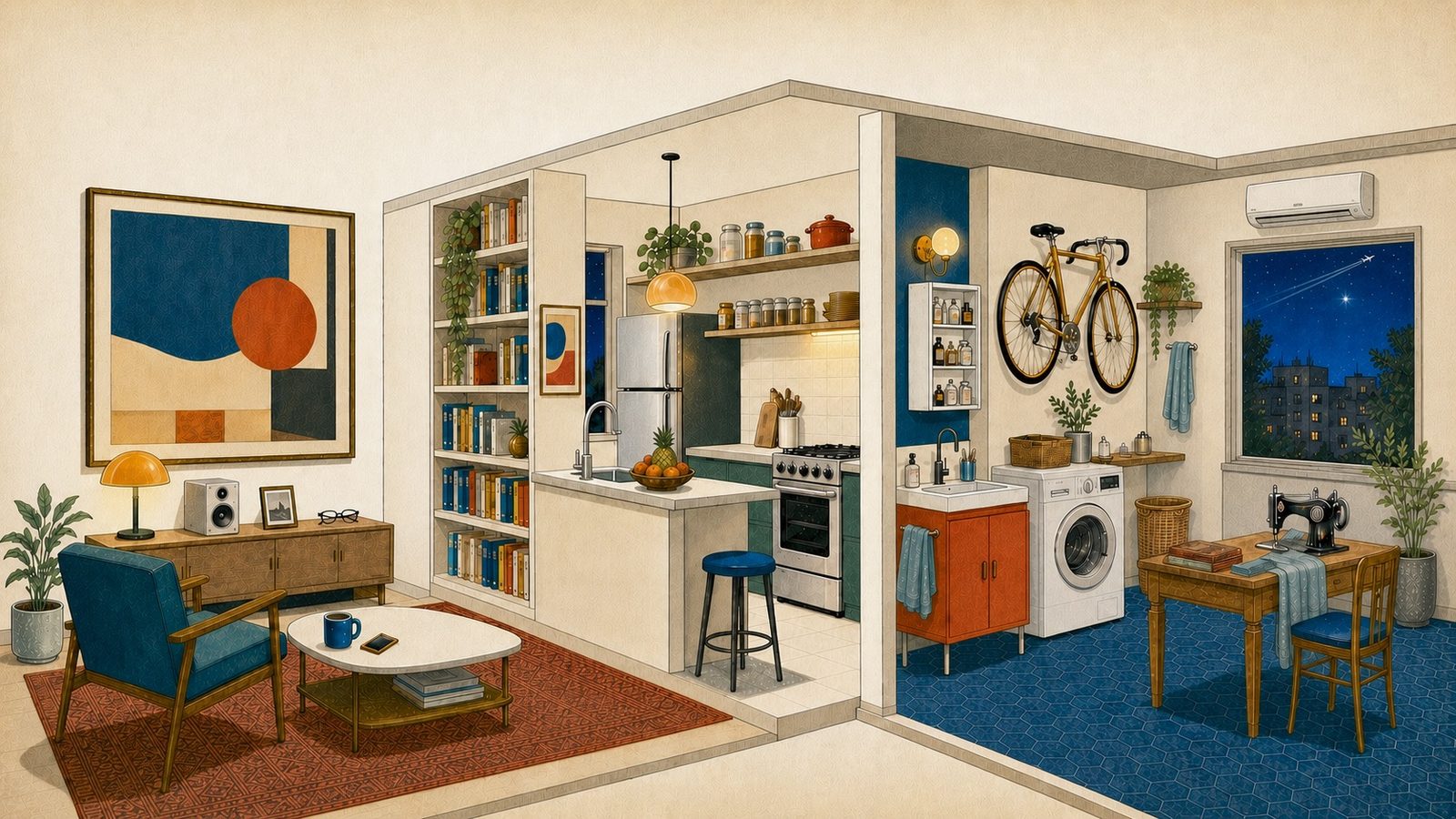
Ordinary Abundance: an interactive essay on the wonders inside a normal apartment
A scroll-driven web essay walks through one apartment over a single evening, pairing everyday comforts — running water, electric light, recorded music — with historical quotes showing how rare they once were.
A web project called Ordinary Abundance turns one ordinary evening at home into a tour of human progress. The site walks the visitor through a single flat — sitting room, kitchen, back room — as the hours pass from eight to eleven at night, and at every stop it sets a familiar convenience beside the moment in history when that convenience was still rare, costly or unimaginable.
One evening, told through objects
Ordinary Abundance is built as a scroll experience rather than a conventional essay: the reader drifts through the rooms of an apartment over the course of a night. At eight the sitting room has a playlist playing softly while someone settles into a chair with a book; at nine the kitchen stops at the fridge, a fruit bowl and water coming to the boil for tea; at ten the back room covers a pill taken with a glass of water, a toothbrush and chores left for the morning. Each object opens a short piece of history tied to a primary source.
The historical passages are the heart of the project. Edward Bellamy, writing in his 1888 utopian novel Looking Backward, imagined that music available in every home — perfect in quality, unlimited in quantity, suited to every mood — would be "the limit of human felicity". A witness at Wabash, Indiana, in 1880 described crowds standing "overwhelmed with awe" as the town became one of the first lit entirely by electric light. André Malraux, in 1947, called mass reproduction a "museum without walls".
The numbers behind the comforts
Captions convert awe into figures. New York's wells once shared soil with its privies and burial grounds; a cholera epidemic ten years before Croton water arrived in 1842 killed 3,515 residents. Smallpox killed roughly three of every ten people it infected, an estimated 400,000 Europeans a year in Jenner's century. A single new shirt required about fourteen hours of hand stitching. In medieval price lists a pound of ginger cost as much as a sheep and a pound of saffron as much as a horse. Well into the twentieth century most rural American homes had no indoor bathroom.
Why it holds attention
The writing avoids nostalgia; it is more interested in how recent the things we now treat as ordinary actually are. The closing pages argue that life today is "a gallery of past generations' heroic efforts", and that recovering the old sense of awe at these wonders honours those efforts. Every quotation is linked to its source — Project Gutenberg, archive.org, the Jefferson papers and Iowa PBS interviews among them. For a technology audience the implicit question is familiar: which of today's ordinary things will look this way in a hundred years?
SiTech — AI-powered web development
We build fast, modern websites and bring AI into real business workflows. Have a project or a question? We'd love to help.