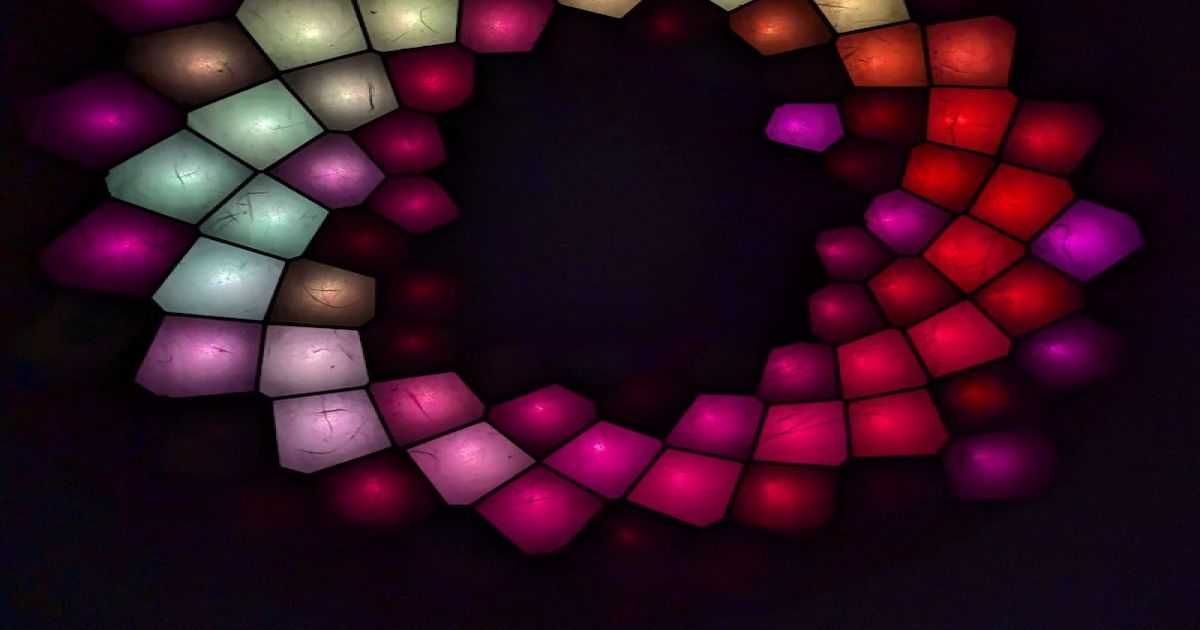
Phyllotaxis: an audio-reactive LED display in 89 cells
Software artist Jagi Natarajan documented Phyllotaxis, an audio-reactive light installation built from 89 addressable RGB LEDs arranged as a phyllotaxis spiral and driven by an STM32 board and an I2S microphone.
Software artist Jagi Natarajan has published a build log for Phyllotaxis, an audio-reactive LED display whose 89 addressable RGB LEDs sit in the cells of a phyllotaxis spiral, the double spiral seen in the centre of sunflowers and succulents.
The shape comes from a short Processing sketch: points are placed along a radial line and each is rotated by an increasing multiple of the golden ratio. Plotted, they already look close to a sunflower, and a Voronoi tessellation of the same points resembles a seed pod. His idea: give every cell its own light.
From a sketch to a 3D-printed shell
Cell edge data from Processing went into a Python script built with CadQuery, which merges the cells, adds walls and carves an LED-sized hole in each one. The geometry was finished in FreeCAD with screw holes and a thin faceplate, with translucent mulberry paper underneath to diffuse the light.
A spare STM32 blackpill board drives the 89 LEDs through a neopixel driver written over SPI. A small framework brings Processing-style shader code to the LEDs: a lookup table stores each position on the unit circle, so patterns are written in polar coordinates.
Audio reaction on the board itself
His favourite pattern, a sine wave that makes brightness pulse outward from the centre, became the heart of the audio-reactive version. The STM32 has floating point support and ARM DSP instructions, so the Fourier transform and the audio analysis run on the board itself. Sound arrives from an INMP441 digital I2S microphone, which avoids analog noise; the ARM CMSIS library handles processing, gain control and multiband splitting.
A second version, built on PCBs
The first enclosure, a microcontroller and microphone on perfboard in a 3D-printed box, was prone to noise that made the LEDs flicker. That pushed him to learn PCB design; the new board carries the blackpill, the microphone, a button and a logic-level shifter for a clean 5V signal.
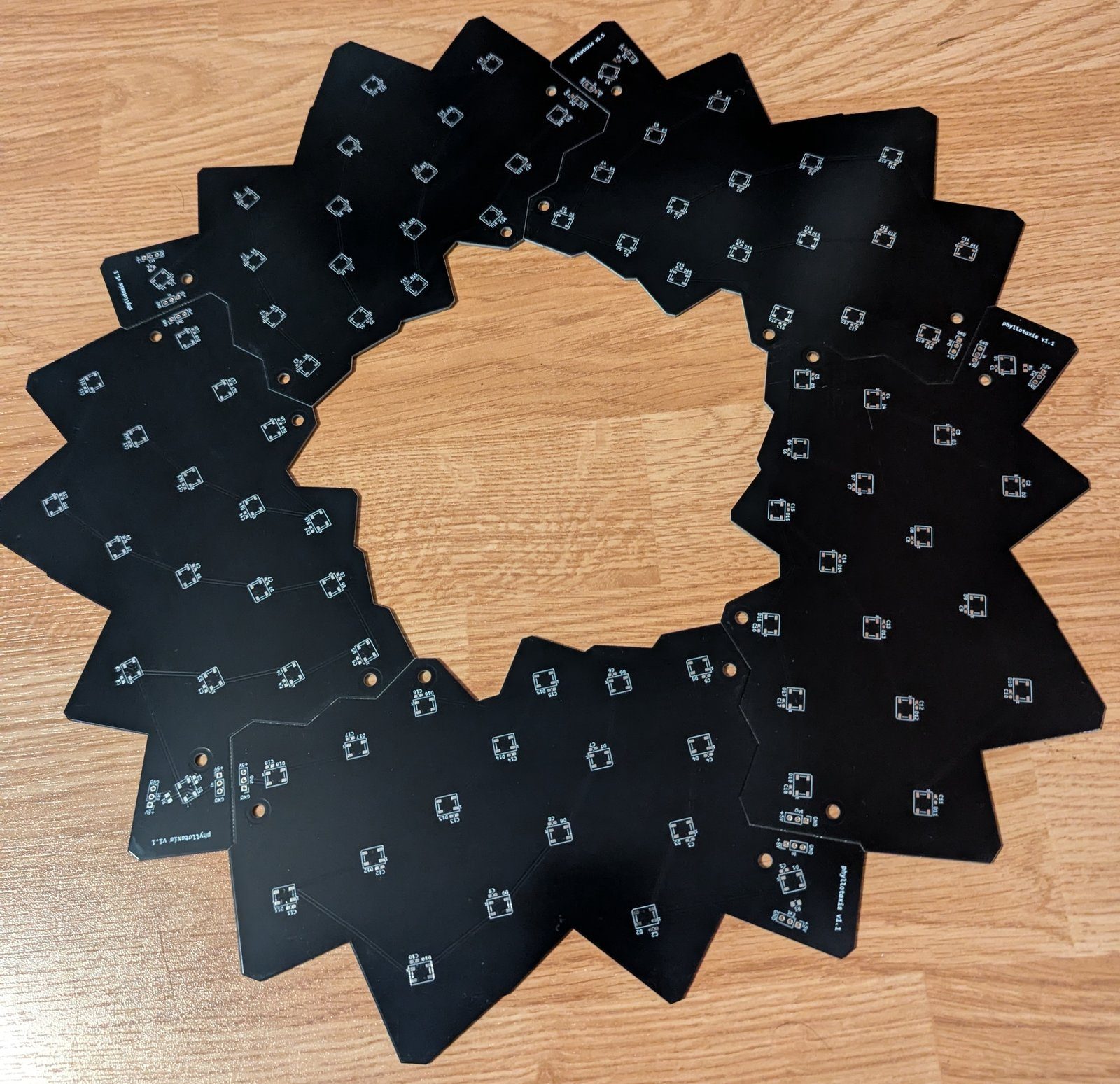
After showing the piece at a New Year's party in early 2026, he began a second version that would be easier to assemble. The 3D-printed LED plate became PCBs used as backplates, and the layout gained five-fold symmetry: boards are ordered in batches of five, so five identical PCBs form a ring. Hand soldering proved harder still, as neopixel pads sit underneath the package.
The project paused until a friend with a hot-air soldering station finished the joints at a Recurse Center retreat in summer 2026. That unit stayed there as an installation: it now runs on an ESP32, the firmware was rewritten in Rust, and the controller serves a website where attendees upload their own sketches and games. A third version is planned.
SiTech — AI-powered web development
We build fast, modern websites and bring AI into real business workflows. Have a project or a question? We'd love to help.