Study: 1841 date in the Exeter space weather account was a typo
A new study concludes that an 1871 Nature report of a geomagnetic storm delaying a train in Exeter in October 1841 contains a typo: the event happened in 1848, so a March 1847 telegraph incident remains the earliest documented case
The Carrington Event of 1859 remains the most powerful geomagnetic storm in the scientific record, but reports of magnetic storms disturbing telegraph equipment go back to the late 1840s. In 2013, scholars found an anonymous report published in Nature in 1871 describing how a "very intense magnetic disturbance" disrupted rail travel at Exeter, on the south coast of England, in October 1841. If accurate, it would have been the earliest such account. A new paper in the journal Space Weather concludes the 1841 date is most likely a typo and that the disruption happened several years later.
No record of a storm in 1841
"Space weather is often discussed as a modern challenge because of our dependence on technologies such as satellites, communications systems and electricity networks," said co-author Jim Wild of Lancaster University. What the study shows, he said, is that society has felt the effects of space weather on technology for almost as long as electrical technologies have existed. Wild and his co-authors questioned the report: the author was anonymous, and Nature published the account 30 years after the event. Archives showed that the South Devon Railway Company built the Exeter-Plymouth line in stages; construction was not approved by Parliament until July 1844, and the relevant section did not open until 30 May 1846, five years after the alleged delay. The report therefore could not be accurate. The authors could not find the original source material, but they found the publisher's copy with a handwritten annotation, "N. J. Holmes."
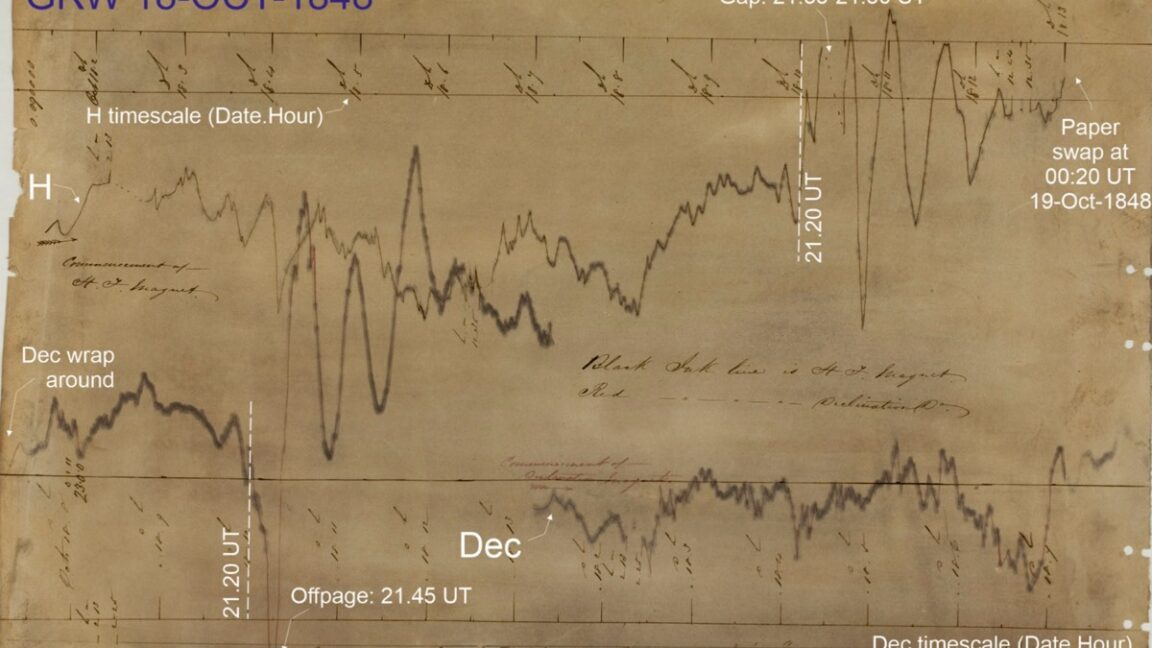
Greenwich magnetograms point to 1848
The researchers then turned to the earliest magnetograms from the Greenwich magnetic observatory in London. Records of "extraordinary" magnetic observations indicating strong geomagnetic storms go back to 1840, but no unusual activity such as aurora was reported in England on 18 October 1841. Strong geomagnetic activity did occur around 18 October 1848, confirmed by contemporary newspapers and by British astronomer Temple Chevallier's sunspot observations on 19 October 1848.
Railway timetables listed a 10:05 pm express train departing Exeter between 11 March 1848 and 26 July 1849. The authors suggest the 1841 date in the Nature account was a typographical error and the year was wrong. With 1841 ruled out, the earliest documented case of space weather affecting technology remains a March 1847 incident, when "spontaneous electrical currents" disrupted telegraph systems on the Midland Railway as a "brilliant aurora" glowed over the British Isles.
Why it matters
A storm of similar intensity today would likely damage the power grid and disrupt satellite communications. That is why researchers study past geomagnetic disturbances: understanding them should improve forecasts.
SiTech — AI-powered web development
We build fast, modern websites and bring AI into real business workflows. Have a project or a question? We'd love to help.