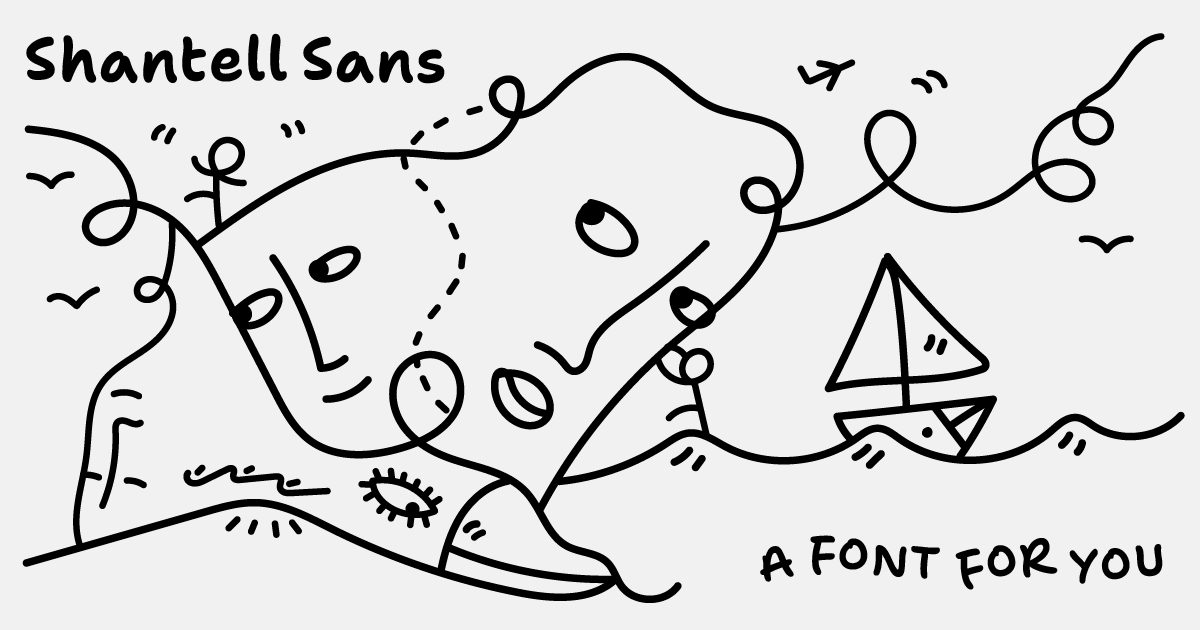
Shantell Sans: the story behind a font built from an artist's handwriting
Artist Shantell Martin and type designer Stephen Nixon explain how Shantell Sans grew out of felt-tip handwriting, four variable axes and a goal of making words feel more accessible.
Shantell Sans is a variable typeface that mixes axes for Weight, Italic, Informality and Bounce, spanning friendly everyday text faces and high-energy styles meant for animation. The project's process page, written by the people behind it, tells the story of how it was made.
A font for people who find words hard
Artist Shantell Martin describes a difficult relationship with spelling as a child: she failed weekly spelling tests, sat in detention for it, and only learned at 20 or 21 that she was dyslexic. At Central Saint Martins in London she found a creative community, but was disappointed that teachers had never spotted her reading challenges. Making her own font became a way to empower people to read and write on their own terms, inspired by Comic Sans, which she found playful and easy to read. The typeface, she says, is released under an open font license — "my gift to the world".
From felt-tip marker to variable font
Type designer Stephen Nixon of ArrowType traced Shantell's handwriting — written with a Staedtler Lumocolor M marker — into digital outlines, setting metrics close to common fonts such as Roboto with slightly wider glyph widths and spacing so it works in websites, apps and presentations. Letters that are easy to confuse are kept distinct: the uppercase I gained serifs and the numeral 1 a flag, while a and g use the single-storey forms children learn in school. Nixon also generated Bounce and Informality styles with Python: bouncy glyphs are shifted up or down, informal ones interpolate between normalised and irregular sources, and alternates rotate pseudo-randomly to mimic lively handwriting.
Spreading the font wider
Support from Google Fonts paid for a full set of italics, an experimental Spacing axis and wider language coverage, including Vietnamese characters and more currency symbols. Cyrillic was designed by Anya Danilova, who consulted other Cyrillic designers and worked through questions such as which letters should look cursive and which printed. Shantell Sans follows and slightly exceeds the Latin Plus and Cyrillic Plus glyphsets, covering more than 380 languages.
Where it is already used
Shantell has used the font on key tags for the Whitney Museum shop in New York and on a Cash App card; the collaborative drawing app tldraw uses it as its primary writing font, and the website builder univer.se turned it into a template. It is available on Google Fonts, in Google Docs and from the open repository on GitHub.
SiTech — AI-powered web development
We build fast, modern websites and bring AI into real business workflows. Have a project or a question? We'd love to help.