
Songhive: a self-hosted music platform where tracks are ActivityPub objects
Developer Fabio Manganiello has released Songhive, an AGPL-3.0 music server that combines library management, streaming and Subsonic support with full ActivityPub federation.
Developer Fabio Manganiello has introduced Songhive, a music platform meant to run on your own hardware and connect to the Fediverse through ActivityPub. It is released under the AGPL-3.0 licence, with source code published on GitHub.
The gap Songhive targets
Self-hosted music tools usually solve only half the problem. Jellyfin, Navidrome and Subsonic manage a library well, but they are isolated islands with no social layer, and sharing a track usually means sending a file or a link that may not resolve outside your own network. Funkwhale adds federation, yet its social model is library-oriented: you follow someone's library and sync their files. Services such as Spotify, Apple Music and TIDAL are widespread, but leave users owning nothing.
What the platform offers
The author describes Songhive as Funkwhale meets Mastodon: music stays on your hardware, while posts about it travel across the Fediverse. A published track appears as a playable Audio object in Mastodon or Akkoma timelines, and people can reply, boost and quote it from an existing fediverse account, without registering on your instance. Federation is bidirectional with Funkwhale and other Songhive instances, so remote libraries and albums resolve as browsable resources.
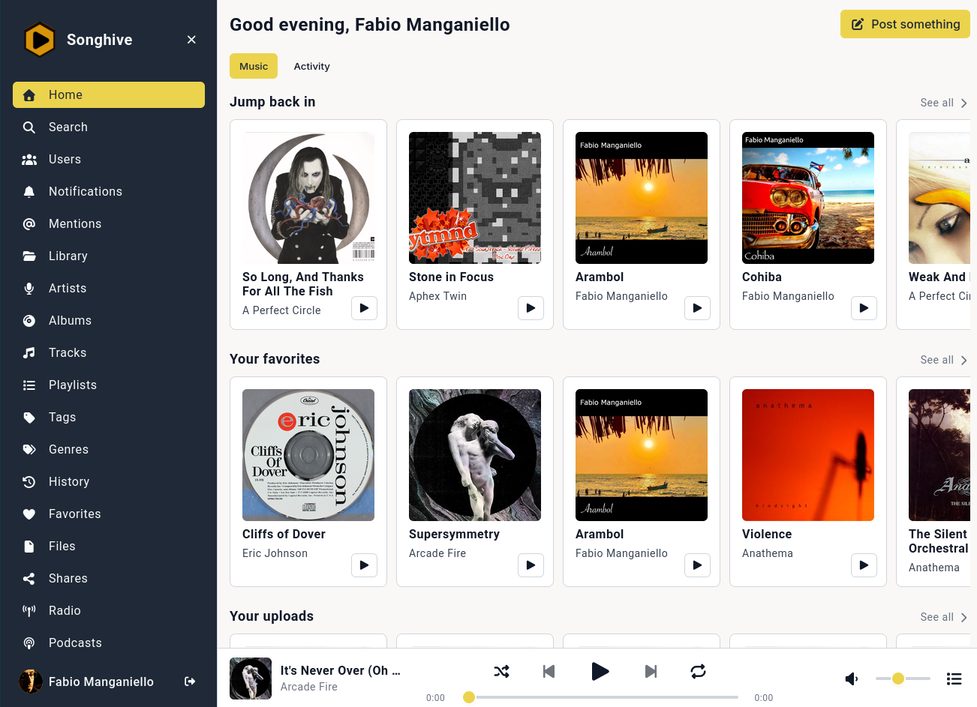
Library and stack
The library side is a full streaming server: on-the-fly transcoding to MP3, OGG, FLAC, AAC and Opus, scrobbling to Last.fm and Libre.fm, and a listening-stats dashboard. Subsonic API compatibility is on by default, so mature third-party clients such as Substreamer or Symfonium work out of the box. External storage can be attached from local folders, S3, Dropbox, Google Drive, Jellyfin and TIDAL. Stripe integration lets artists sell tracks or albums, while admins can enable paid registration and set user quotas.
Requirements and caveats
Songhive is not a single static binary: it needs PostgreSQL, Redis, a Celery worker and ffmpeg, though a Docker compose file simplifies deployment. According to the author, it can run on a Raspberry Pi 4 or 5 for personal use. Federation depends on ActivityPub's support for audio: Mastodon renders playable audio attachments but treats Audio as a converted type, so Songhive also emits Note variants when a track is shared as a post. TIDAL imports federate metadata only.
SiTech — AI-powered web development
We build fast, modern websites and bring AI into real business workflows. Have a project or a question? We'd love to help.