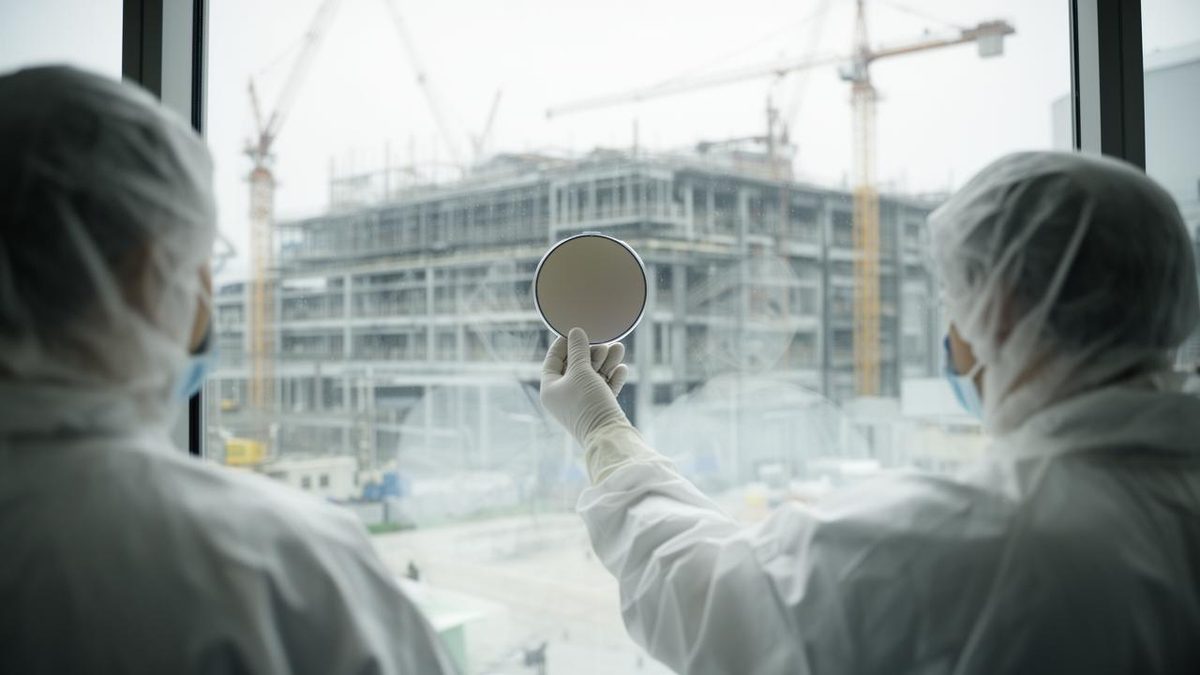
SK Hynix Races to Restart Dalian Fab 2 as U.S. License Deadline Nears
SK Hynix subsidiary Solidigm has resumed investment in Dalian NAND Fab 2, targeting November equipment move-in before U.S. licenses expire at year-end, while also evaluating a large-scale memory fab in Japan.
SK Hynix subsidiary Solidigm has resumed investment in the Dalian NAND Fab 2 in China, with production equipment move-in slated for as early as November and mass production targeted for the first half of 2027, adding roughly 40,000 to 60,000 wafer starts per month.
Locking in the Dalian line before the deadline
The timing is deliberate. The U.S. Department of Commerce revoked the validated end-user status of Samsung Electronics' and SK Hynix's China fabs last August, then issued 2026 equipment import licenses allowing certain U.S.-made equipment shipments to continue until year-end. Equipment moved into the fab before the licenses lapse locks in the production line's basic configuration.
Dalian Fab 2 is not new. SK Hynix took over Intel's Dalian NAND fab in 2021 and broke ground on Fab 2 in May 2022, then halted construction amid collapsing NAND prices and U.S. equipment restrictions. With memory demand surging over the past two years, the company resumed the project in the first half of this year.
Dalian Fab 1 currently runs at approximately 100,000 wafers per month. Once Phase 2 ramps, the Dalian base will reach total capacity of 150,000 wafers per month, close to half of SK Hynix's NAND output, and it remains the company's only overseas NAND front-end manufacturing base.
Japan fab evaluation and a three-way footprint
Ten days after news of the Dalian restart emerged, reports surfaced that SK Hynix is preparing to build a large-scale memory fab in Miyagi Prefecture, Japan, with potential investment reaching tens of trillions of won. If the project materializes, it would mark the first time a South Korean semiconductor company establishes a production base in Japan.
Japan's offer is generous. The Japanese government has already provided up to ¥476 billion (approximately $3.0 billion) in support for TSMC's Kumamoto project and ¥500 billion (approximately $3.1 billion) for Micron's fab. Japan also retains leading positions in silicon wafers, photoresists, packaging materials, and various semiconductor equipment, and SK Hynix's production lines already use materials and equipment from Japanese suppliers such as Shin-Etsu Chemical and Tokyo Ohka Kogyo.
Washington's displeasure and escalating pressure
The United States has consistently pressed the South Korean government and companies to invest in memory fabs on American soil, expressing displeasure with the Seoul-led Honam Semiconductor Cluster, a mega-project valued at 800 trillion won (approximately $517.9 billion). U.S. Commerce Secretary Howard Lutnick said last month at Micron's new fab event in Clay, New York, that he wants to bring Samsung Electronics and SK Hynix to the United States to build fabs.
A double investment bind
South Korean firms now face simultaneous capex pressure at home and abroad. Samsung Electronics has invested more than $37 billion in its Taylor, Texas foundry, while SK Hynix is advancing its Indiana advanced packaging facility at approximately $3.87 billion. In South Korea, SK Hynix has approved 54.3 trillion won to build the Yongin Y2 and Cheongju M17 fabs, with the first cleanroom at Cheongju M17 expected by end-2028 and Yongin Y2's first cleanroom not until mid-2029.
That schedule leaves a clear capacity vacuum from this year through next, forcing SK Hynix to rely on its Chinese supply chain to meet growing customer orders, since China's ready-built facilities, skilled workers, and complete supply chain remain irreplaceable in the near term.
Sources: Biggo Finance · Reuters
SiTech — AI-powered web development
We build fast, modern websites and bring AI into real business workflows. Have a project or a question? We'd love to help.