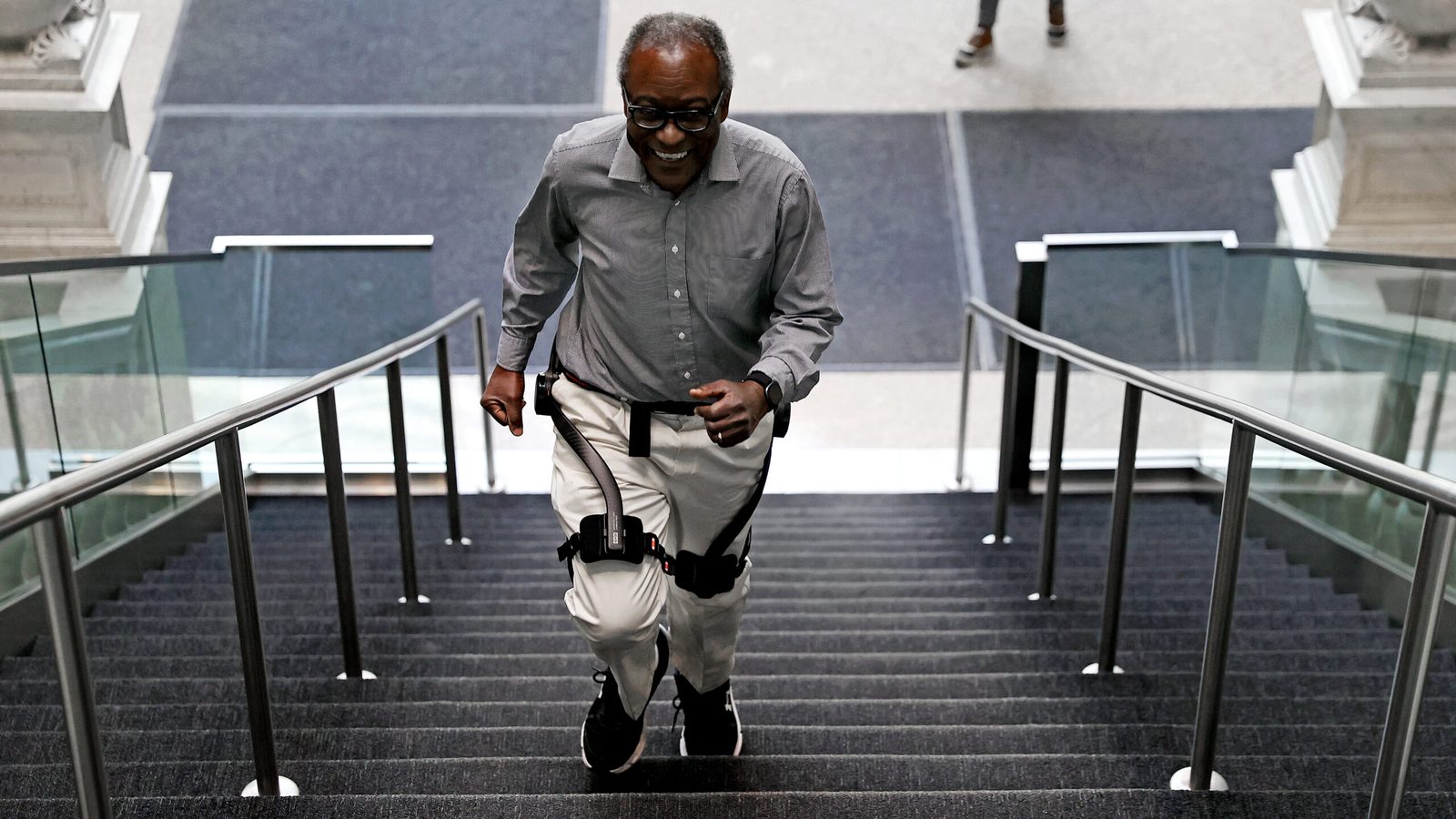
Exoskeletons edge into everyday use, from warehouses to front lines
Powered devices that attach to the body and boost human strength are increasingly used in warehouses, rescue operations, and on the front lines. Analysts value the sector at around $500 million.
Members of Seattle Mountain Rescue have spent this year hiking the US Pacific Northwest with powered assistive devices strapped to their hips and legs. Designed to add lower-body strength when climbing or carrying heavy loads, the equipment is being tested to see whether it can boost rescuers' speed and endurance during searches for stranded people.
Such devices are called human exoskeletons: they attach to the body to form an external mechanical structure whose powered frame enhances the wearer's capabilities. The technology is increasingly used in physically demanding jobs, rehabilitation, and consumer products. The analysis is by Ildar Farkhatdinov of King's College London.
From factory floors to the front line
IKEA has used SuitX exoskeletons for years, deploying 400 devices across 14 countries to help warehouse workers handle heavy materials. Ford, Boeing, and Mazda Toyota have also adopted the technology on some of their assembly lines.
In Finland, the ExoPELA project assessed whether exoskeletons could reduce muscle load and strain in rescue and firefighting work and found noticeable benefits in real-world tasks. In early 2026, the Ukrainian military revealed soldiers used Hypershell exoskeletons on the front lines to carry artillery shells. According to test results, wearers "become less fatigued, work faster, and maintain combat effectiveness for longer," Colonel Vitalii Serdiuk told Ukrainska Pravda in March.
Consumer and clinical devices for assistance, rehabilitation, and exercise are on the market; some estimates put the sector at around $500 million and expect it to double or triple by the mid-2030s.
How they work
The idea is old: a wearable exercising apparatus was patented in 1890 by Nicholas Yagn, a self-taught Russian inventor, and in 1919 Leslie C. Kelley patented a steam-powered walking aid.
A modern active exoskeleton is a lightweight frame attached at the trunk, waist, and limbs. Actuators convert battery power into movement, and embedded control units set the trajectory and force; sensors read what the user needs, speeding up support when the wearer runs or boosting power when fatigue sets in.
Assistance falls into three categories: power augmentation, seen in devices used by IKEA and in Ukraine; assist-as-needed or resist-as-needed support in rehabilitation; and full robotic control, where the exoskeleton takes over part of the body, for example letting someone with a spinal cord injury walk.
What comes next
Most exoskeletons today are wholly mechanical. Researchers are exploring control through muscle or brain signals, but that may require an invasive interface and lengthy calibration. Power is another constraint: batteries add weight and need recharging, though energy density keeps improving. Soft textile and rubber-like materials could let exoskeletons be built into clothing, footwear, or protective gear.
SiTech — AI-powered web development
We build fast, modern websites and bring AI into real business workflows. Have a project or a question? We'd love to help.