Boris Cherny's viral TLA+ tweet, and what TLA+ actually does
Boris Cherny used Opus 5.5 to model parts of the Claude Agent SDK in TLA+ and Lean, and his tweet drew about a million views. This is what TLA+ is, what it is not, and why formal models keep showing up in agentic coding.
This week Boris Cherny used Opus 5.5 to model parts of the Claude Agent SDK in TLA+ and Lean, the post drew about a million views and thousands of bookmarks, while much of the thread asked one question, what TLA+ actually is. The toolkit is over 30 years old, and it keeps appearing in practice: Datadog recently wrote about harness-first agents, and formal models are standard at AWS, MongoDB, Datadog and Kafka.
What TLA+ is
TLA+ (Temporal Logic of Actions) is a language for writing down two things: a transition system, meaning what the system can do, and temporal properties, meaning what must hold in every run. States are snapshots (who is a candidate, who voted for whom, who is the leader), and actions are single steps between them.
The classic example is leader election: three computers, a, b and c, must agree on one leader, and two leaders must never coexist. Safety properties state that nothing bad ever happens; liveness properties state that something good eventually does, for example that a leader is eventually elected. In TLA+ they are written with three simple operators: always, eventually and leads-to.
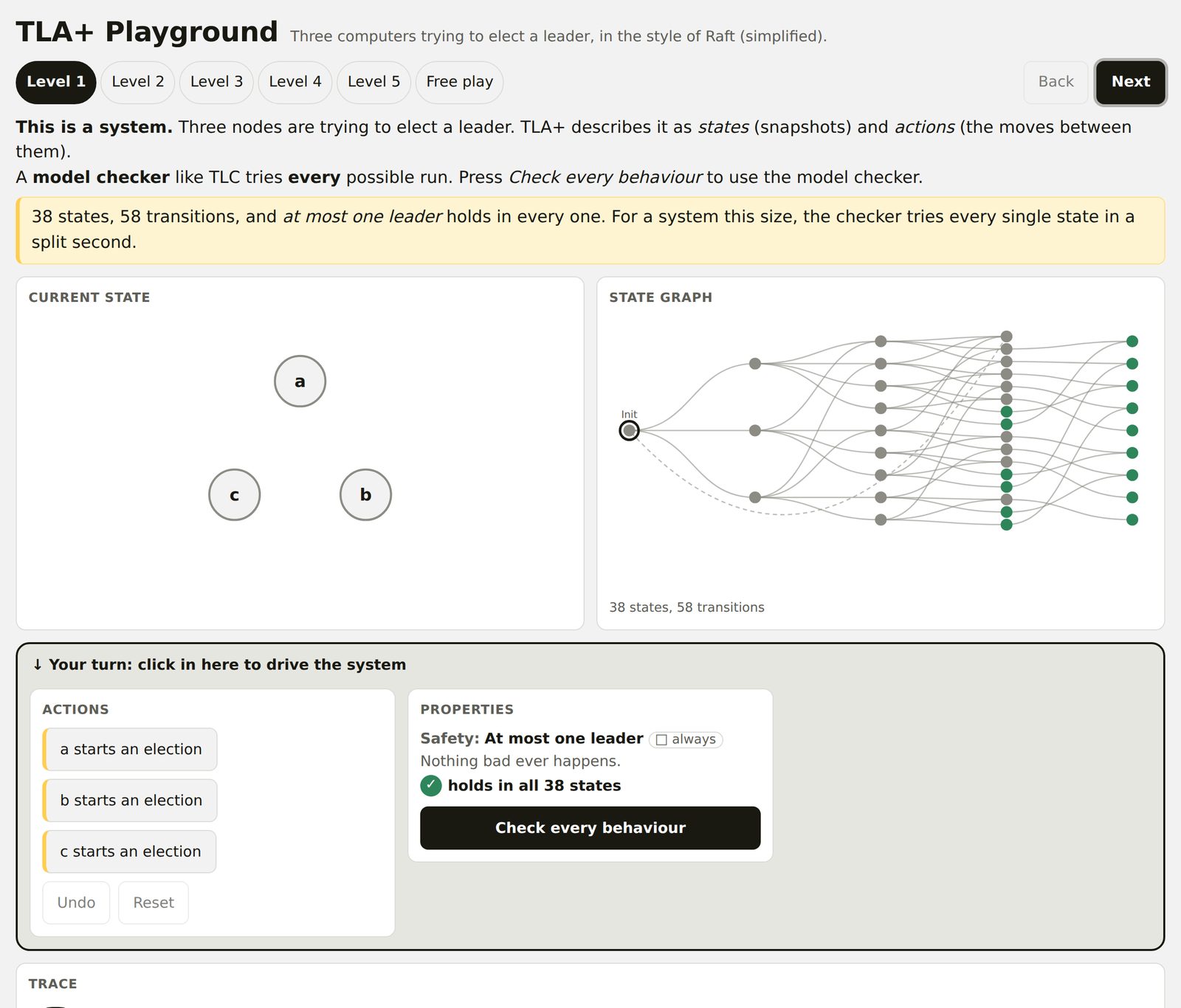
TLC, the standard model checker, explores every reachable state of a finite model and returns a counterexample whenever a property fails. For three computers the whole space is 38 states; for nine it grows past a million.
What TLA+ is not
Three caveats matter. Model checking only covers finite instances, so a general claim needs a proof, and TLA+'s own prover, TLAPS, has limited automation, especially for liveness. A specification is a separate model of the software: nothing guarantees that the implementation behaves exactly like it, and the two can drift apart as the code changes. And because TLA+ is based on linear temporal logic, properties about alternative futures or strategies, which CTL and ATL can express, remain out of reach.
From models to machine-checked proofs
Modern proof systems go further. Lean is interactive and general, and it was the prover in Boris Cherny's post; Verus is designed around Rust, so specifications and proofs can live beside the real implementation; Veil targets state-machine models and was recently used to verify a sync engine, fixing 17 bugs in the process.
The team at Reasonable is automating part of this path. Their pipeline turned 16,459 real-world TLA+ specification and property pairs into more than 3,000 machine-checked Verus proofs: one agent writes a proof, another reviews it, and a gatekeeper checks that neither modified the spec or taken shortcuts such as assume(false). The goal is software that is specified, implemented and verified in one loop.
SiTech — AI-powered web development
We build fast, modern websites and bring AI into real business workflows. Have a project or a question? We'd love to help.