TikZ Editor: a WYSIWYG editor for LaTeX figures that keeps your code intact
A new open-source tool lets researchers adjust TikZ figures visually while the underlying code updates instantly, leaving line breaks and indentation untouched and removing the need to recompile for every nudge.
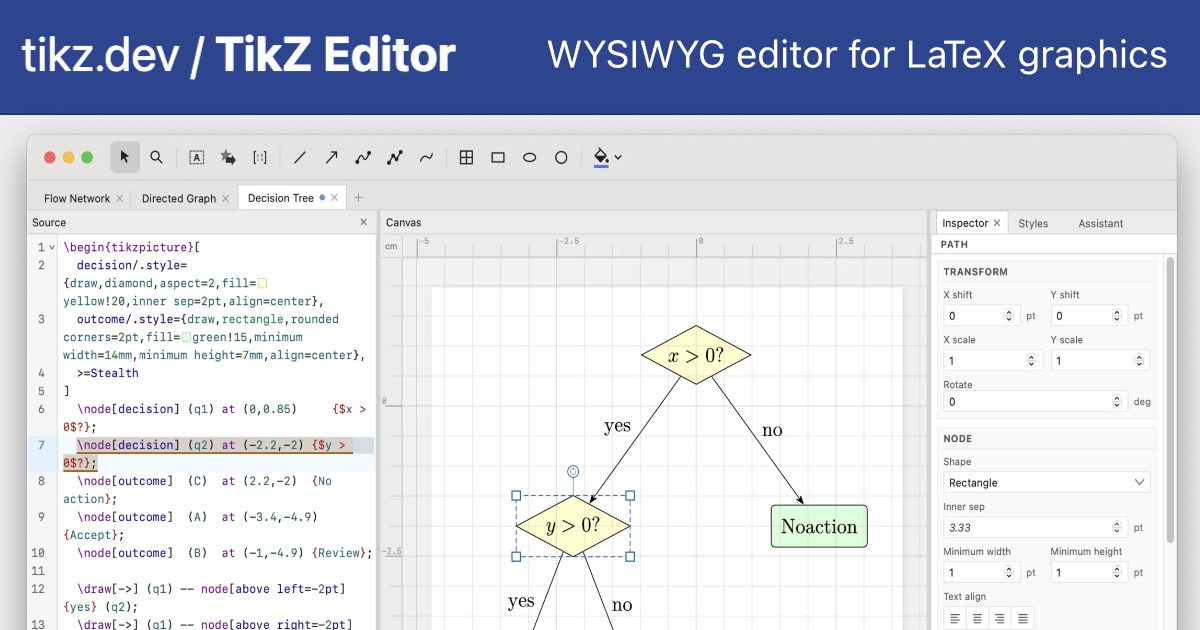
A new open-source tool aims to shorten one of the most tedious loops in academic writing: adjusting a TikZ figure, recompiling the document and checking the result again. TikZ Editor, presented as a Show HN entry on June 23, 2026, is a WYSIWYG editor for TikZ diagrams in LaTeX that updates the underlying code as elements are moved on the canvas.
How it works
The editor parses TikZ code and keeps track of where each element lives in the original source. When a shape is dragged, only the coordinates change — line breaks, indentation and spacing in the rest of the file stay as the author wrote them. The project's repository describes the result as an instant, two-way link between the canvas and the code: changes made visually appear in the source immediately, and edits in the source panel are reflected on the canvas.
Users can start from scratch, load an existing TikZ figure, or open a complete paper .tex file to edit the figures inside it. The tool supports common TikZ features, including \foreach loops; shapes such as rectangles, circles, ellipses and polygons; paths and Bézier curves with control points; trees; matrices; and styling such as colours, line styles and fill patterns.
What is in the box
The visual side offers drawing tools for shapes, paths, curves, freehand strokes and Bézier curves. The source panel adds TikZ syntax highlighting, autocompletion and number scrubbing, so numeric values can be adjusted without retyping. Figures can be exported to SVG, PDF or PNG, which makes it possible to reuse the same diagram outside a LaTeX document.
TikZ Editor is free and open source under the MIT licence. It runs in the browser at tikz.dev/editor and is also offered as a lightweight desktop application with additional features. The repository is developed by Dominik Peters and has drawn several hundred stars and hundreds of commits since work began.
Why it matters
TikZ is the standard way to produce publication-quality vector figures in LaTeX, but it behaves like a programming language: positions are set with explicit coordinates and loops, and every nudge usually means another compile. Tools that shorten that cycle matter for researchers and technical writers who keep their figures under version control.
The design decision that stands out is preservation of hand-written code. In the launch discussion, some experienced TikZ users noted that elements added from the toolbar are placed with absolute coordinates, whereas hand-written TikZ often relies on relative positioning and named anchors; the author has said that existing relative placements are preserved when edited. For figures produced by conversion tools or AI models — where formatting is often hard to read later — the editor's approach of touching only the numbers is the practical part of the pitch.
SiTech — AI-powered web development
We build fast, modern websites and bring AI into real business workflows. Have a project or a question? We'd love to help.