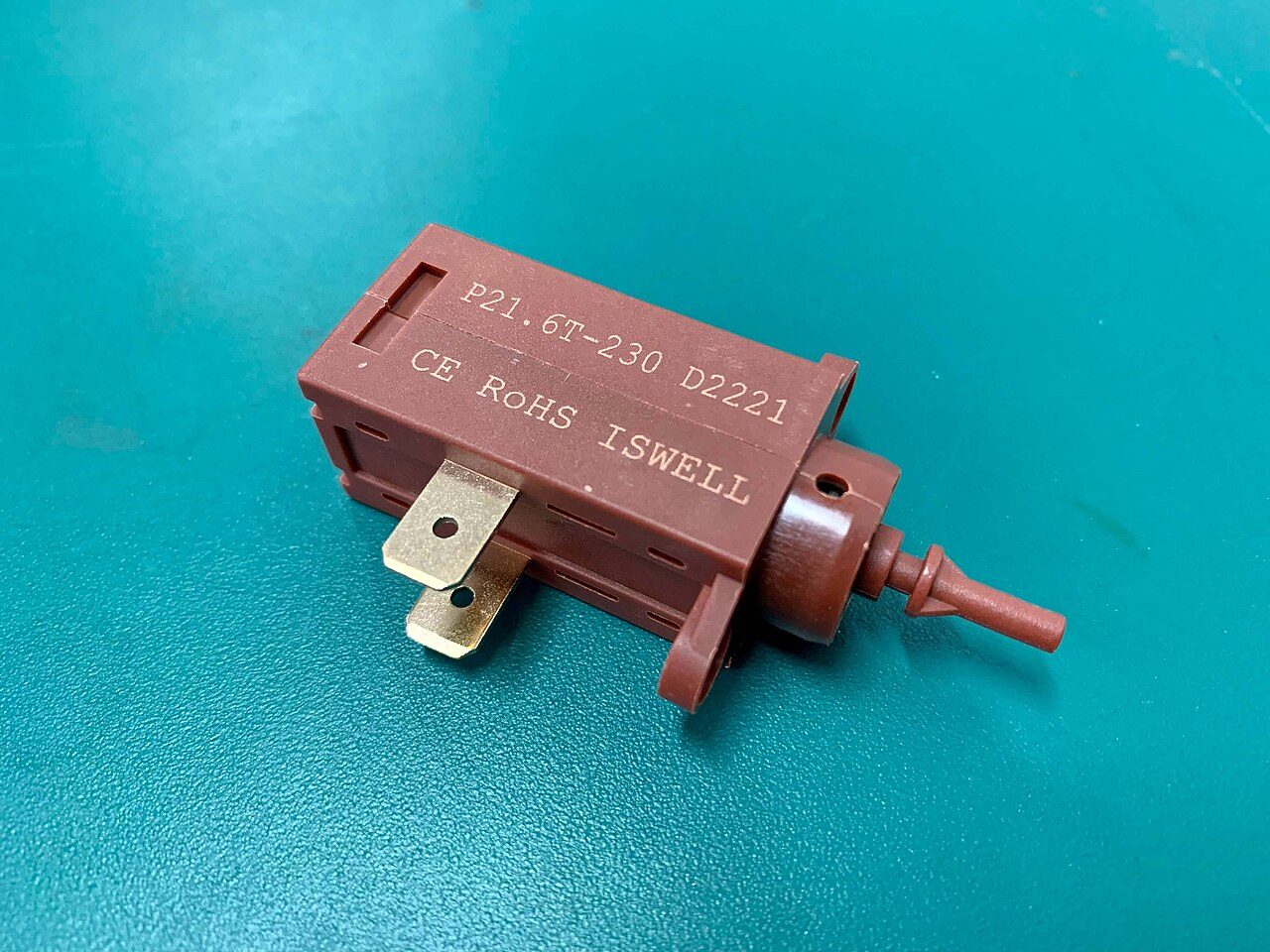
Wax motors: how melting paraffin drives locks, valves and vents
A wax motor turns heat into mechanical force using the 5-20 percent volume expansion of wax as it melts. The simple actuator quietly runs washing-machine door locks, heating valves and greenhouse vents.
A wax motor is a linear actuator that converts thermal energy into mechanical work by exploiting the phase change of waxes: as the material melts it expands in volume by roughly 5 to 20 percent, and that expansion drives a plunger outward.
Inside the device
Four elements are essential: an enclosed volume of wax, a plunger or stroke rod that converts the thermo-hydraulic force into useful mechanical output, a heat source and a heat sink. Heat can come from an electric current, typically through a PTC thermistor, from solar radiation, from combustion heat such as waste heat from an internal-combustion engine, or simply from the ambient air. Cooling is handled by convection to cooler surroundings or by a Peltier device arranged to transfer heat energy away.
The wax can range from highly refined hydrocarbons to waxes extracted from vegetable matter. Paraffin waxes in the straight-chain n-alkane series are common because they melt and solidify over a well-defined, narrow temperature range - the property that makes the actuator predictable.
Why engineers choose it over a solenoid
Wax motors deliver large hydraulic forces: the expansion can reach the order of 4,000 newtons, roughly 400 kilograms at standard gravity, according to a 1988 NASA report on high-output paraffin actuators. Both the application and the release are smooth and gentle rather than instantaneous, and because the device is a resistive rather than an inductive load, units driven by TRIACs do not need snubber circuits. The return stroke is not free: a biasing force of about 20 to 30 percent of the operating force is normally required to overcome the resistance of the seals that contain the liquid wax, supplied by a spring or a gravity-fed dead weight.
Wax motors can also run entirely passively. Because the melting point of the wax can be matched to the ambient temperature range of a given application, the element can melt and solidify on ambient heat alone, without an additional external power source.
Where they are used
Aerospace relies on wax motors to control fuel, hydraulic and other oils critical to safe flight. In buildings they sit inside self-actuating thermostatic mixing valves and drive zone valves in hydronic heating systems. Front-load washing machines use them to engage the door lock: in moist conditions a wax motor costs less for equivalent reliability than an electromagnetic solenoid and motor latch, and it has a predictable passive release delay - if power is lost the door stays briefly locked, longer than the high-speed spin coast-down, then unlocks as the wax cools.
Dishwashers use them to release the detergent dispenser latch and to control the exhaust vent during drying. Greenhouse vents work the same way, opening as the interior warms and closing again as it cools. At the smallest scale, paraffin microactuators built with microelectromechanical systems technology apply the same principle on a chip.
SiTech — AI-powered web development
We build fast, modern websites and bring AI into real business workflows. Have a project or a question? We'd love to help.