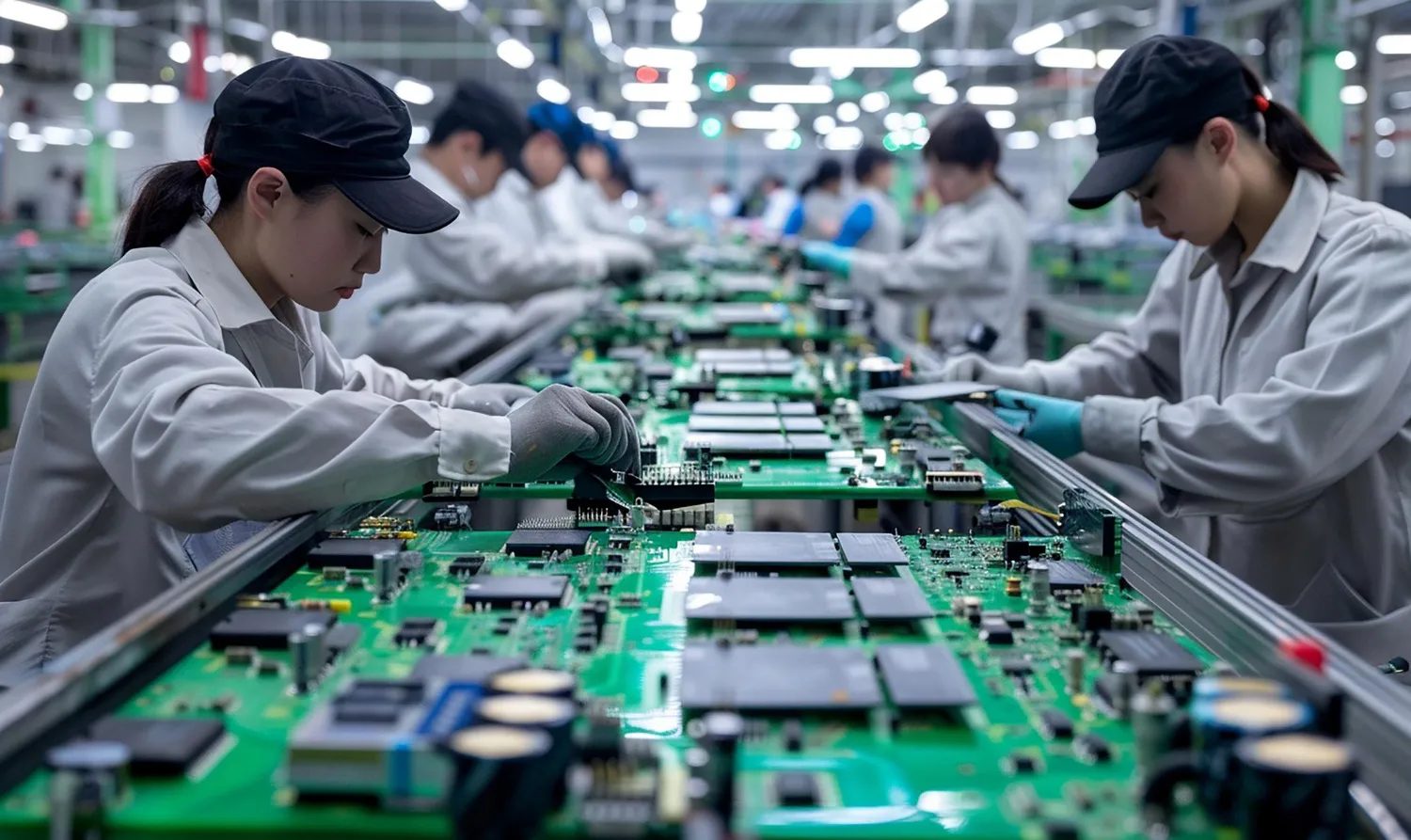
China Makes 58.8% of the World's Electronics; East Asia Holds 80.5%
Ember data for 2024-2025 show China accounting for 58.8% of global electronic device manufacturing, while four East Asian economies control 80.5% of the market.
China accounted for 58.8% of global electronic device manufacturing in 2024-2025, according to data from Ember, an energy and technology research organisation. The ranking, published by Visual Capitalist, shows that most digital hardware production is concentrated in a small group of countries.
The study covers semiconductors, monitors, boards, smartphones, laptops and personal computers, along with related electronic equipment.
China Controls More Than Half the Market
China's share is nearly six times that of second-placed Taiwan, and the country's output exceeds the combined production of every other country in the ranking. That position reflects a broad manufacturing base: finished electronics, monitors, microcircuits and other components are all made there.
Large-scale production networks link factories to major supplier clusters, turning the country into the central hub of global hardware manufacturing.
East Asia's Concentration: 80.5%
Taiwan ranks second with 10.2% of the global market, followed by South Korea at 6.7% and Japan at 4.8%. Together, the four economies hold 80.5% of the world market.
Taiwan's key strength is semiconductor production and electronics assembly, while South Korea has substantial capacity in chips and monitors. Japan remains a significant manufacturer of electronics, components and the technologies that keep the wider hardware supply chain running.
Capacity falls sharply after the top four. India ranks fifth with 3.8%, ahead of Vietnam at 3.6% and the United States at 2.9%. Only Thailand (1.3%) and Mexico (1.2%) exceed 1%.
China's Five-Year Plan
China aims to strengthen its lead through a new five-year plan focused on semiconductors, artificial intelligence and other strategic technologies. The plan prioritises the integrated circuit supply chain, including chip development, as Beijing seeks to reduce its dependence on Western technology.
By 2030, the country targets $4.5 trillion in operating revenue from these industries.
What the Concentration Means for Supply Chains
The ranking highlights the gap between where the world's largest technology companies are headquartered and where their hardware is actually built. Many leading technology and chip design firms are based in the United States, yet manufacturing capacity remains concentrated in Asia.
This leaves supply chains dependent on a handful of countries. Such concentration raises risk: logistics problems, trade restrictions or political tension affecting factories in Asia translate directly into the availability and price of electronics worldwide.
SiTech — AI-powered web development
We build fast, modern websites and bring AI into real business workflows. Have a project or a question? We'd love to help.