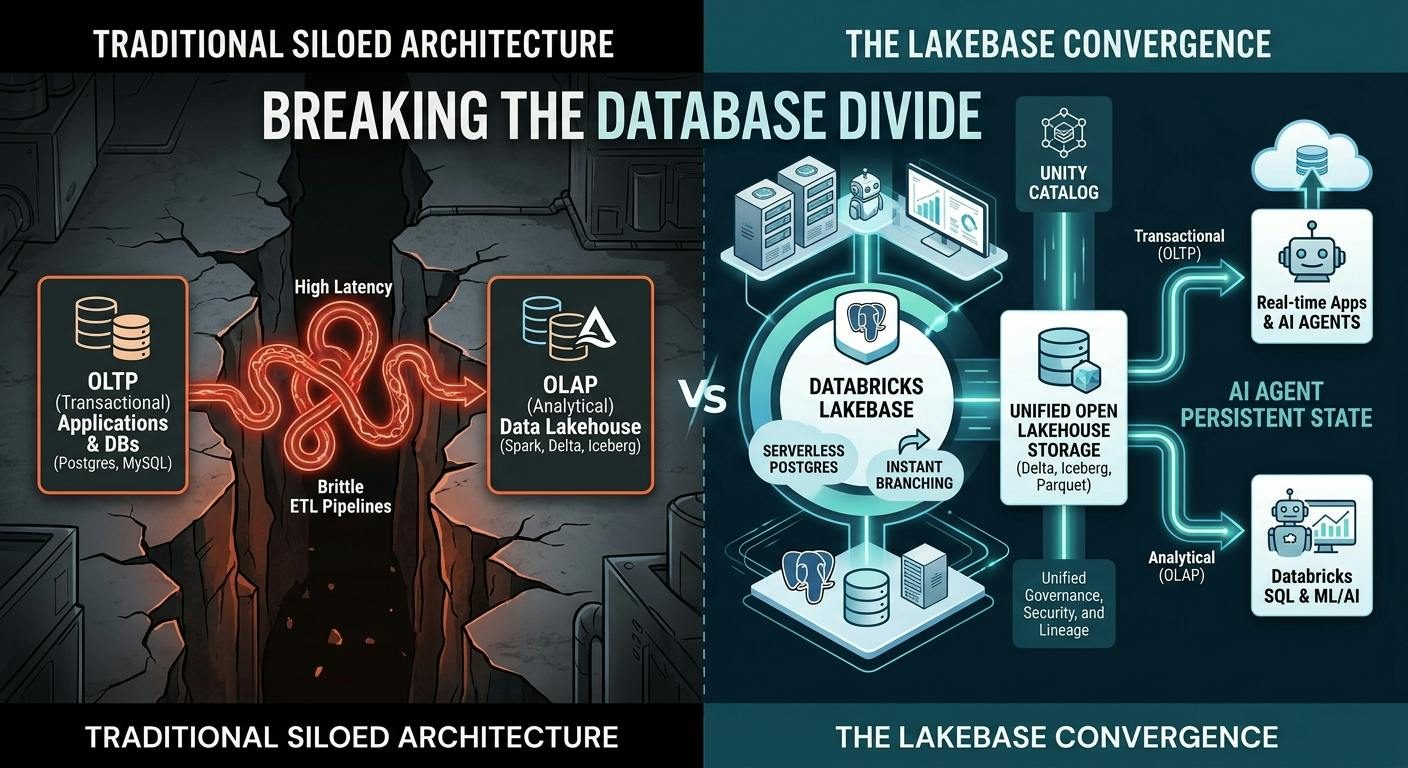
Databricks' Lakebase Blurs the Line Between Transactions and Analytics
An AI-assisted HackerNoon analysis argues that Lakebase, Databricks' serverless Postgres engine built on the open lakehouse, ends the three-decade split between OLTP and OLAP and gives AI agents a persistent state store.
For three decades, enterprise data architectures split the work in two: transactional systems like PostgreSQL, MySQL and Oracle handled real-time application state, while analytical engines such as Apache Spark, Snowflake and Delta Lake stored historical data and ran heavy transformations and ML workloads.
Between them sat brittle ETL pipelines. Companies built complex synchronisation to move operational data into the analytical lakehouse, then struggled to push feature data back into applications. In an AI-assisted community analysis published on HackerNoon, the author argues that Databricks' Lakebase — an operational serverless Postgres engine built on the open lakehouse with Neon technology — dismantles that wall.
A third generation of databases
The piece places Lakebase in a new category rather than treating it as another managed Postgres instance. Earlier databases were monoliths or cloud-native systems that kept storage proprietary; Lakebase is described as third generation — open-format storage on the lake with serverless, ephemeral Postgres compute.
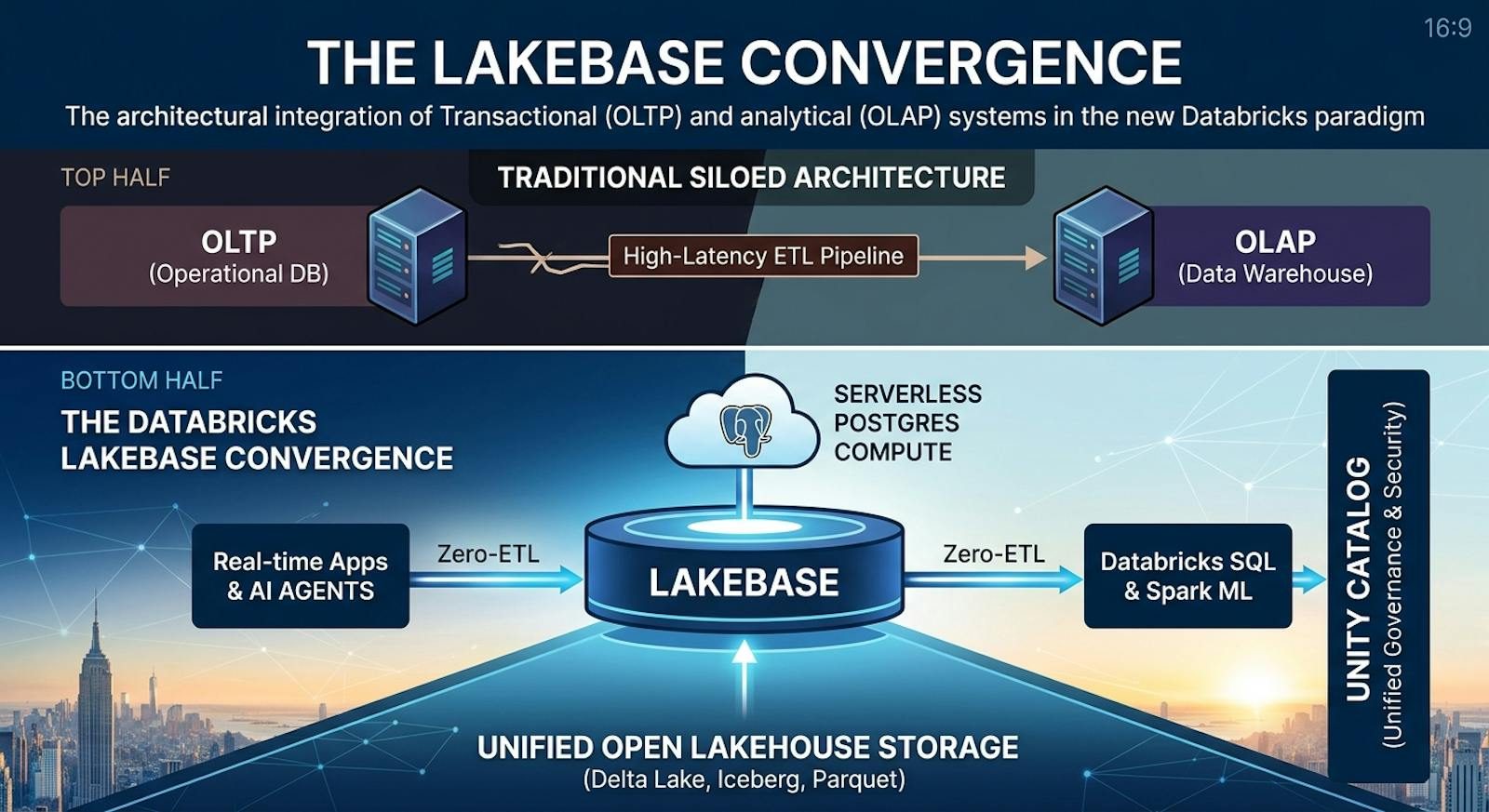
Branching, scale-to-zero and zero-ETL
Three architectural properties stand out. Copy-on-write branching creates full-fidelity, isolated clones in milliseconds instead of the hours or days traditional environments need, so developers and AI agents can test schema changes and tear environments down instantly.
Decoupled compute lets instances launch in under a second and scale to zero when idle, shifting bursty agent workloads to usage-based consumption. And because transactional data is written in formats the lakehouse can read, teams no longer need CDC or ETL pipelines to run analytics or feed LLM feature stores: Spark, Databricks SQL and Delta Lake query live data directly.
What it means for data and AI engineers
Under unified governance, transactional and analytical tables fall under one set of access controls, security policies and lineage monitoring via Unity Catalog. The author also highlights AI agent memory: agents need state management, vector search through pgvector and fast transactional lookups.
The conclusion is a direction rather than a finished product: as enterprises move from simple ML inference to autonomous agents and real-time pipelines, the database underneath has to evolve — towards platforms that are open, real-time, serverless and AI-native.
SiTech — AI-powered web development
We build fast, modern websites and bring AI into real business workflows. Have a project or a question? We'd love to help.