AST SpaceMobile plans Blacklift rocket as launch market tightens
AST SpaceMobile says it will develop the Blacklift medium-lift rocket for late 2028 commercial launches, but the plan faces skepticism given rocket development timelines and its existing launch agreements.
AST SpaceMobile has announced plans to develop a medium-lift rocket called Blacklift, saying commercial launches could begin in late 2028. The Texas-based satellite company says the rocket would carry 20 metric tons to low-Earth orbit and provide regular access to orbit. The move comes as satellite operators face a tight launch market and pressure to secure capacity years in advance.
What AST announced
AST SpaceMobile is a publicly traded Texas company building very large satellites for direct-to-cell communications on Earth. It said on Friday that Blacklift would lift 20 metric tons to low-Earth orbit and that commercial launches would start in late 2028. Abel Avellan, founder, chairman, and CEO, said in a news release that the rocket is "the springboard to significantly expand our total addressable market, providing AST SpaceMobile with regular unconstrained access to orbit and providing for most favorable owner's economics in the industry." The company also said it will continue using external providers, with agreements covering over 100 BlueBird satellites to be deployed cumulatively between 2027 and 2028.
Why the timeline is questioned
The late 2028 timeline is described as wildly, fantastically, and stupidly optimistic by rocket development standards. SpaceX became the first purely commercial startup to announce a new medium-lift rocket in 2005 and still holds the record for fastest time to orbit with Falcon 9 at 4.7 years; Falcon 9 initially lifted about 10 tons. Since 2015, U.S. companies including United Launch Alliance, Rocket Lab, Relativity Space, Firefly and Northrop Grumman, and Stoke Space have announced vehicles ranging from about 7 to 27 metric tons, while Blue Origin's New Glenn is much larger. Of those, only Vulcan has reached orbit, taking 8.7 years with an experienced team and about $2 billion in aggregate federal support. Broadly, developing a new medium- or heavy-lift rocket takes five to nine years from announcement to first orbital launch. The announcement also underscores that satellite operators planning large constellations must secure launch capacity years in advance, as Amazon did nearly half a decade ago, and may consider building their own rockets if terms are unfavorable. Investors are recognizing a worsening launch crisis, and there is capital for new medium-lift entrants. AST is not alone in ambitious claims: Cowboy Space said in October it was building Big Iron, a large rocket for orbital data centers, with a first flight also claimed for 2028.
Firefly engines and costs
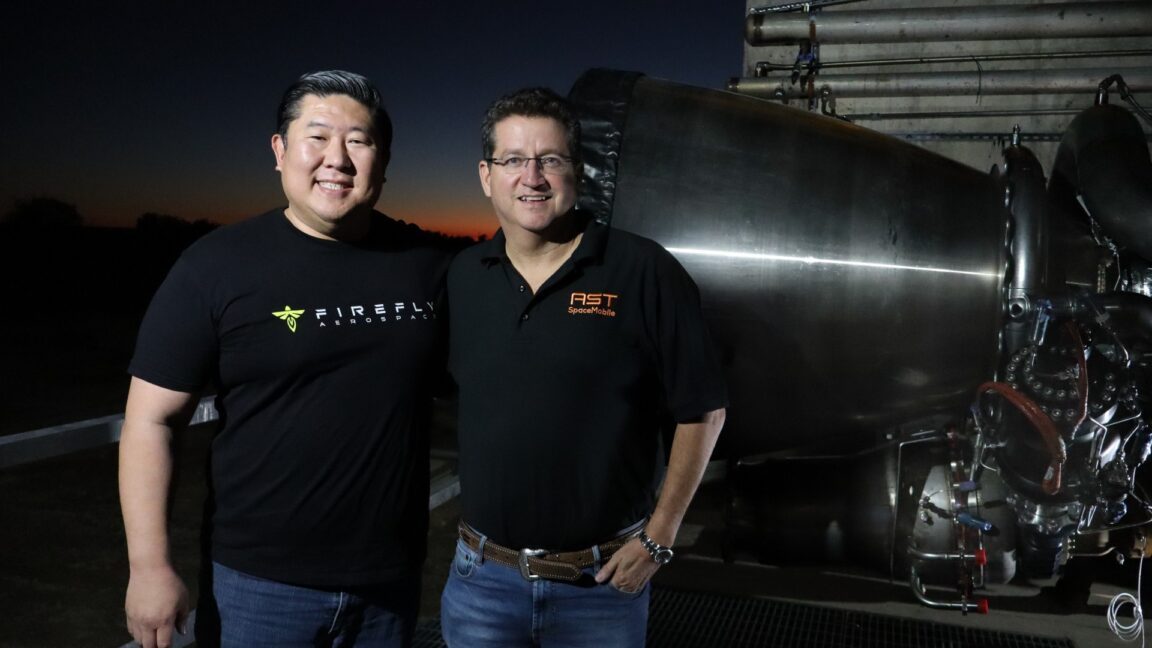
AST says it will not start from scratch. It signed an agreement with Firefly to deliver engines for the first three Blacklift rockets, provide engineering services over three years, and acquire a perpetual license to manufacture Miranda and vacuum-variant Vira engines. Nine Miranda engines will power the first stage. The engines may save a year or two, but not five, and do not remove the engineering, manufacturing, testing, and regulatory work. AST committed $1.3 billion to Firefly: $800 million for the engine license, $250 million for 27 Miranda and nine Vira engines, and $250 million for engineering support. That is $83 million per vehicle for the first three based on engine costs. AST already has agreements covering over 100 BlueBird satellites between 2027 and 2028, and the company needs to launch about 90 more massive BlueBird satellites. That raises the question of what Blacklift is supposed to accomplish and whether spending several billion dollars makes sense.
Sources: Ars Technica
SiTech — AI-powered web development
We build fast, modern websites and bring AI into real business workflows. Have a project or a question? We'd love to help.