Z.ai launches GLM-5.4 with looped 28-layer architecture and vision support
Z.ai has launched GLM-5.4, a flagship model that runs 28 layers twice instead of adding parameters. It adds vision and Generalized Coding, with API access and open weights still pending.
Z.ai has released GLM-5.4, its first flagship model built on a Loop Transformer architecture that runs 28 layers twice instead of stacking new layers. Z.ai describes the model as reaching intelligence levels comparable to 2T-3T parameter models, while adding vision support and a focus on Generalized Coding.
How the looped architecture works
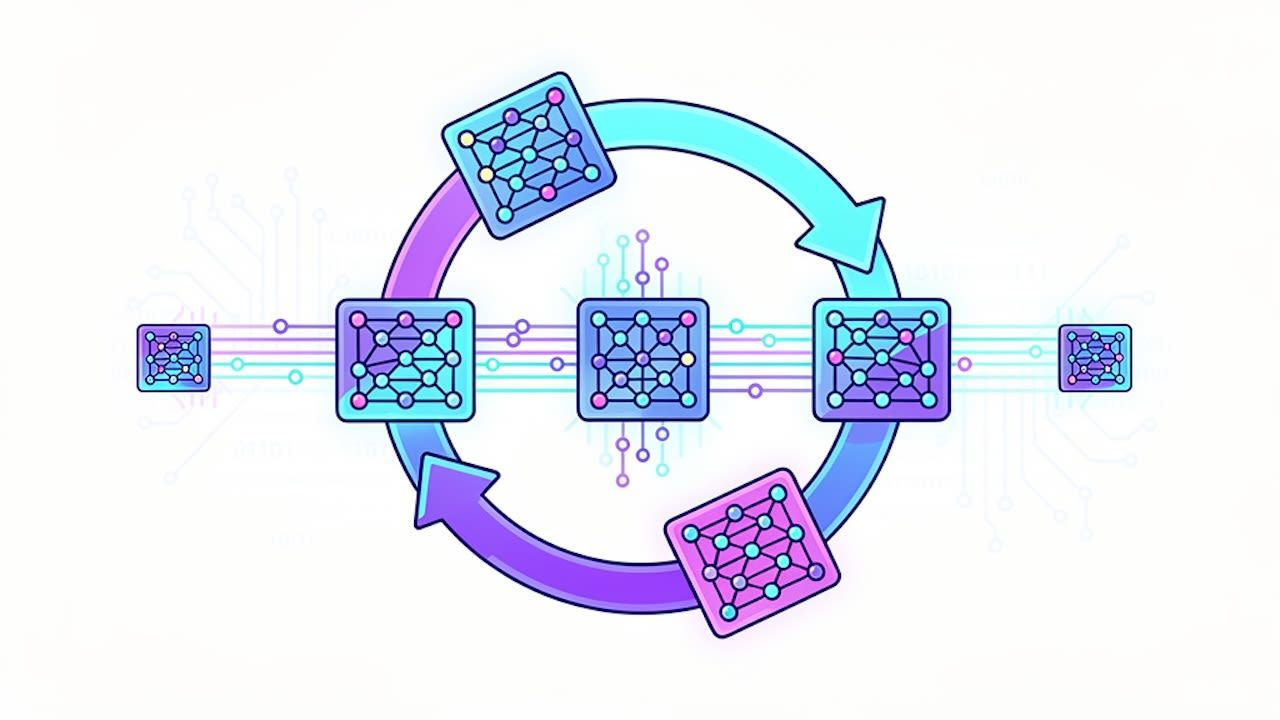
Z.ai says large-scale software engineering, cybersecurity, 3D modeling and physical control require ultra-long-chain reasoning. It argues that stacking parameters and memorizing data cannot solve these tasks. GLM-5.4 sends intermediate representations through the same group of layers twice, increasing computational depth without adding parameters. It loops 28 layers of the GLM-5 base for two iterations at the 750B scale, adapted from an already pre-trained model through continued training.
Z.ai made three architectural changes to balance performance and deployment cost. Gated progressive updates use per-token gates to control how much each iteration changes internal representations. A hybrid KV cache reuses the first pass sparse KV cache and limits extra storage to a sliding window for the second pass. Sparse attention index reuse lets the second loop reuse attention indices from the first loop indexer, which Z.ai says performs nearly identically to recomputing them.
Capabilities and availability
GLM-5.4 adds vision and targets Generalized Coding, which applies code to engineering and design work such as mechanical design and 3D modeling, not only to software. Z.ai developer documentation says the model accepts text, image, video and file inputs and returns text, with a 1M-token context window and a maximum output of 128K tokens. The launch post gives no vision benchmark scores.
GLM-5.4 is available now through the GLM Coding Plan, ZCode and Z.ai Chat. For weekly quota plans, Z.ai says the GLM-5.4 quota is 1.5 times that of GLM-5.3. API access is listed as coming soon after a security assessment, and general API pricing has not been announced. Z.ai says open weights will follow after safety hardening, with no date given.
Benchmarks and early reactions
Z.ai has published a win-rate chart comparing GLM-5.4 with three other models without explaining the evaluation methodology. Its main controlled benchmark evidence comes from a separate test using a 30B model. In that test, the looped version used about 10% more training compute than a non-looped baseline of the same size. Z.ai reports the largest improvements in math, scientific reasoning and long-context tasks, by about 15% on MMLU-Pro and 12% on GPQA-Diamond. Those results were measured on the smaller test model, not GLM-5.4 itself. Z.ai also acknowledges that GLM-5.4 can get caught in overly long reasoning loops.
Developers who tried GLM-5.4 in its first hours reported strengths in code review and security testing, and criticism over speed and rivals' lead. AICodeKing placed GLM-5.4 seventh on his KingBench 4 coding benchmark. At maximum reasoning effort, it took 431 minutes to complete the tests, compared with 109 minutes for Google Gemini 4 Neon, and required 1,128 steps versus 244 for Neon. Migel Tissera said GLM-5.4 completed a multistep remote code execution chain in a private lab environment. Loktar said GLM-5.4 is nowhere near Opus 5.5.
Sources: VentureBeat · The New Stack · Simon Willison
SiTech — AI-powered web development
We build fast, modern websites and bring AI into real business workflows. Have a project or a question? We'd love to help.