Spanish Museum Builds Cray-1 Supercomputer Replica From 30 Old Mac Minis
The Museo de Historia de la Computación in Spain has unveiled a 1:1 scale replica of the 1976 Cray-1 supercomputer, powered by 30 Mac Minis from 2012 delivering 1.3 teraflops.
A Mac Mini Cluster in a Cray-1 Body
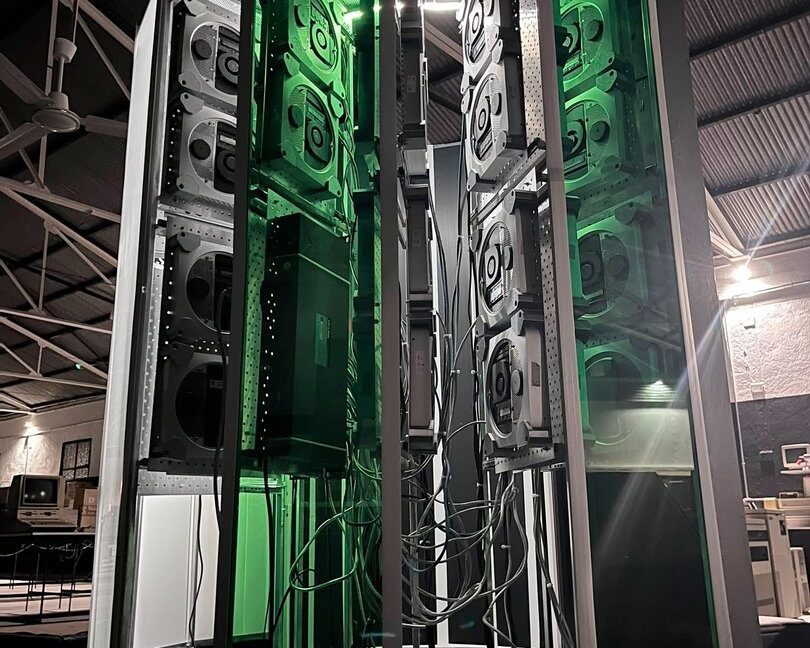
The Museo de Historia de la Computación in Spain has unveiled a 1:1 scale visual replica of the Cray-1 supercomputer from 1976. Instead of sourcing expensive modern hardware, the creative team powered the project with 30 Mac Minis from the 2012 era. Developed over 18 months, the installation serves as a 50th-anniversary tribute to both the Cray-1 and Apple's founding.
Networked together, the machines orchestrate 64 active processing cores into a combined 1.3 teraflops of performance in the team's most recent tests. The museum previously reported 1.5 teraflops using all 70 available cores, prior to one node going offline. Benchmarks were obtained using a custom matrix-multiplication Python script. Five of the PCs are quad-core i7 machines and the remaining 25 are dual-core i5 models. Except for two units from 2014, the rest of the array dates to 2012.
macOS-Powered Parallelism
The replica is designed to help museum-goers understand the shifts in computer architecture since 1976. The original Cray-1 used vector processing, applying a single instruction to multiple data elements simultaneously, whereas the replica distributes work across independent processors in a parallel cluster. For context, the peak theoretical performance of the original machine was approximately 160 megaflops.
Rather than opting for a more standard Linux distribution, the team found that macOS Mojave (10.14) met the project's needs by harnessing the operating system's built-in support for MPI (Message Passing Interface), the software layer that allows all the nodes in the cluster to pass tasks to one another. Guests can watch in real time as the system runs matrix algorithms, mapping performance from a single core to the full suite running in parallel.
A Nearly Silent Cluster
Combining 30 consumer PCs into an operational cluster was not the only engineering challenge the team faced. The museum relied on passive convection cooling through a steel rack chassis and aluminum tray mounts for each Mac Mini. The secret to the near-silence is vertical mounting: the orientation of the PCs, combined with the steel chassis and aluminum trays, allows the tower to act as a natural thermal chimney, letting hot air rise through the structure and out of the top grills without mechanical fans.
According to the museum, the only noticeable noise comes from two gigabit Ethernet switches at the base of the unit, which register between 30 and 33 decibels, though the team plans to replace them with silent models. Each individual PC is stated to produce 12 to 15 dBA of noise at idle.
Mission Control and the Road to the TOP500
To manage the system, designers built a custom terminal inspired by the DEC VT05 and the Processor Technology Sol-20 Terminal Computer from the 1970s, complete with an analog control panel and future plans to add original lamps from an IBM System/3. One master Mac Mini in the terminal directs all the other cluster nodes. The original design called for CRT monitors, but modern flat Samsung displays avoided connectivity headaches. Future additions include 3.5-inch and 5.25-inch floppy drives and a 3D-printed shell mimicking the HP 250 design over a PowerMac G4 keyboard.
The team now hopes to fill the empty second half of the tower through a crowdfunding campaign to secure 70 to 80 additional M4 Mac Minis, with the goal of creating a cluster capable of ranking on the TOP500 supercomputers list. The replica is on permanent display at the museum alongside two unused authentic Cray CX1 systems. The museum offers guided tours on Saturdays from 11:30 am to 2 pm.
Sources: Arstechnica
SiTech — AI-powered web development
We build fast, modern websites and bring AI into real business workflows. Have a project or a question? We'd love to help.