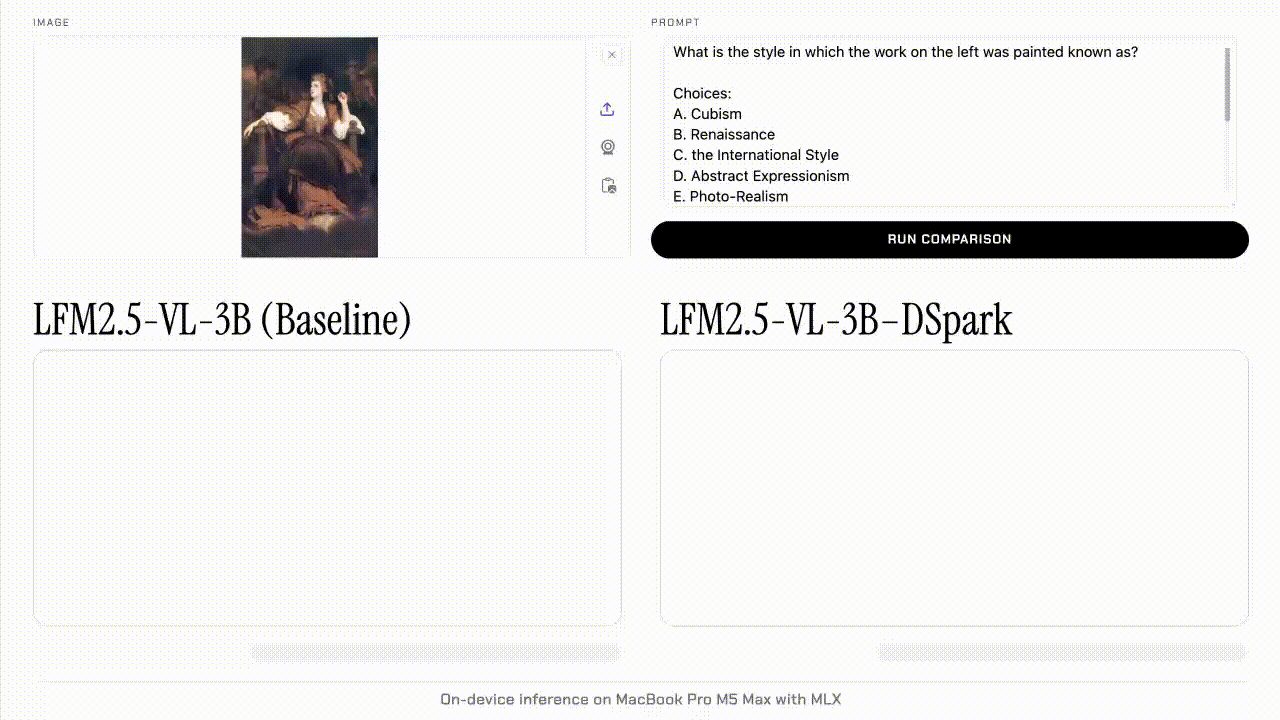
Liquid AI releases DSpark drafter to speed up vision-language models
Liquid AI has released an experimental DSpark draft model for its LFM2.5-VL-3B vision-language model: speculative decoding is up to 3.13x faster on device and 2.66x on an H100, without changing output quality.
Liquid AI released an experimental DSpark draft model for its LFM2.5-VL-3B vision-language model on September 24. The drafter adds a speculative decoding path that trades a minimal increase in memory footprint for a larger speedup, without changing output quality.
What the drafter delivers
Liquid AI reports decode speedups of up to 3.13x on device and 2.66x on an H100, with end-to-end gains of up to 2.62x and 2.27x. The drafter adds about 280 million parameters, 8.9% on top of the 3B target, and llama.cpp, MLX-VLM and SGLang support it from day one.
How speculative decoding works for VLMs
The vision drafter reuses the architecture of Liquid AI's text LFM2.5-DSpark drafters: it reads the target model's hidden states at tapped layers and drafts a block of k candidate tokens from them. Image patches and text tokens share one representation before those layers, so the drafter sees vectors of identical dimensionality whatever the input modality.
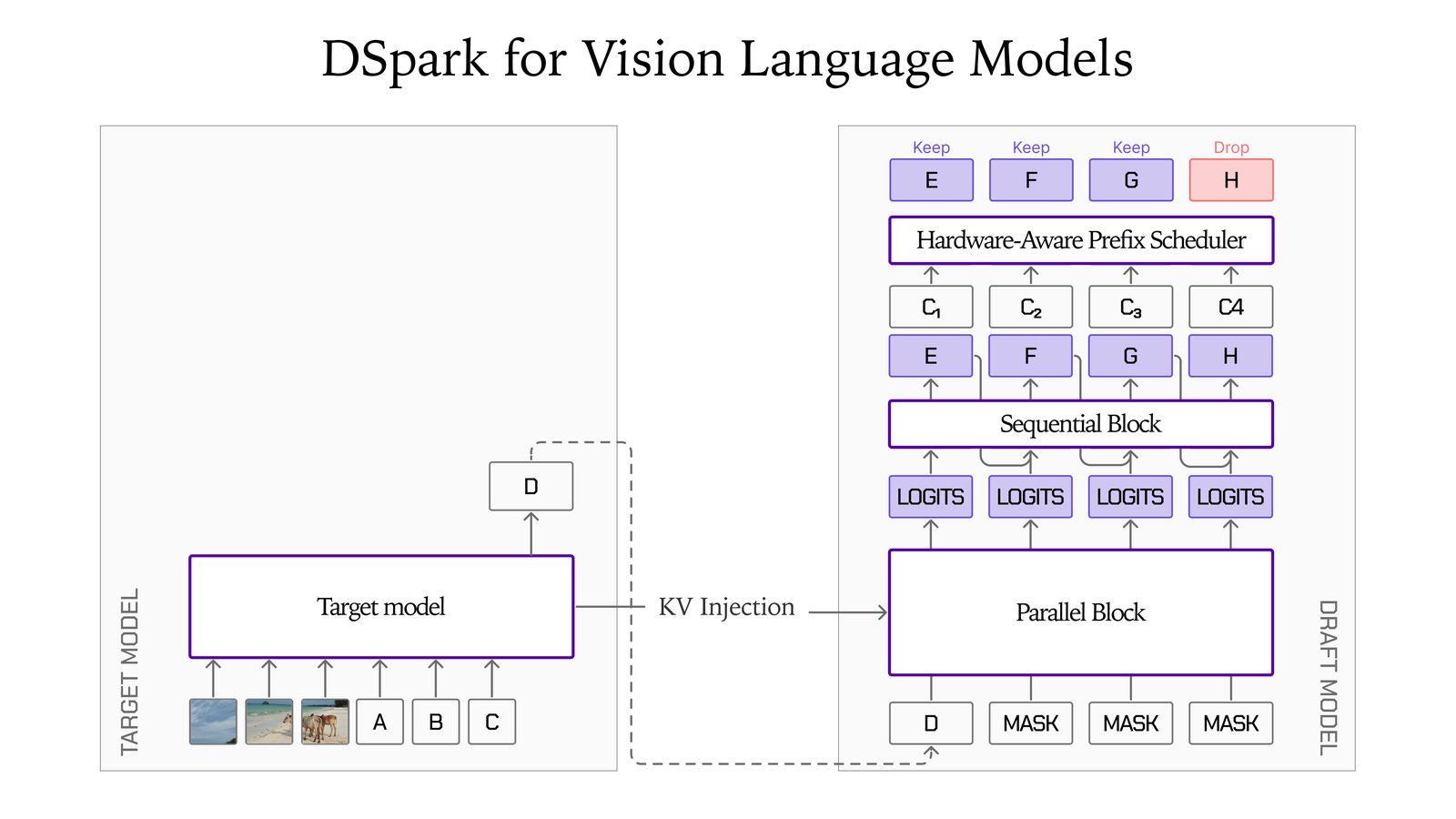
Training followed the DSpark recipe on vision-language SFT data weighted toward the expected workloads; ablations across 3, 4 and 5 layers settled on a 4-layer, attention-only drafter with a block size of 9. The drafter totals 279.5 million parameters.
Speedups on device and on GPU
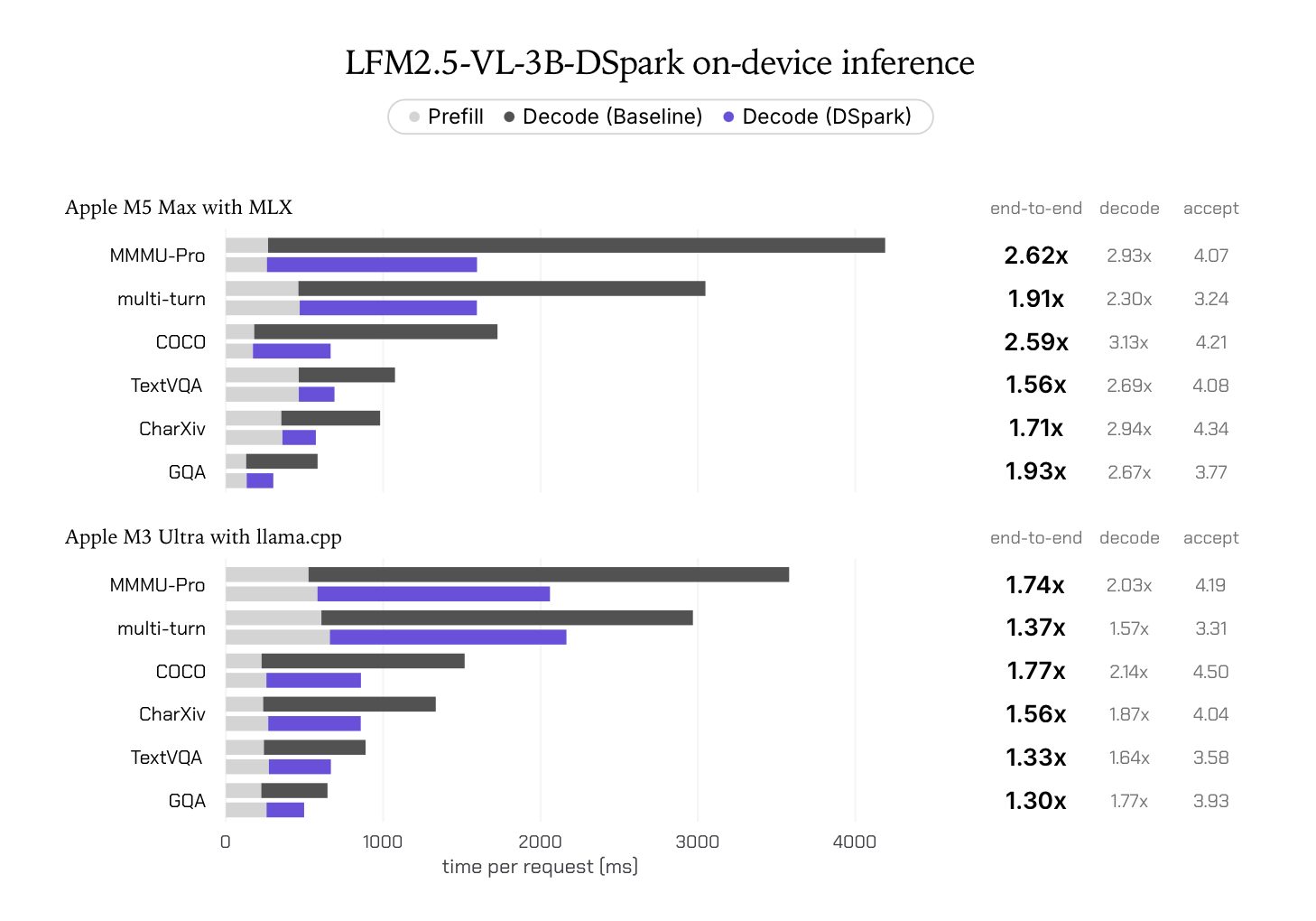
The measurements use a block size of 8 and six vision tasks following the MMSpec benchmark, from general VQA and image captioning to chart VQA and multi-turn conversation. With MLX on an M5 Max, decoding is 2.30x to 3.13x faster and end-to-end latency improves by 1.56x to 2.62x; with llama.cpp on an M3 Ultra, by 1.57x to 2.14x and 1.30x to 1.77x. On an H100, decoding speeds up by up to 2.66x, with end-to-end gains of 1.64x to 2.27x.
Where speculation stops helping
Speculative decoding speeds up only decode, not vision encoding or prefill. The image passes through a vision encoder, and the language backbone then processes hundreds of visual tokens along with the prompt; on edge devices prefill takes a larger share of end-to-end latency. When those stages consume much of the wall time, even a large decode speedup yields a modest gain, which Liquid AI describes as Amdahl's law.
The drafter is on Hugging Face in Safetensors and GGUF formats and needs builds with DSpark support for llama.cpp, MLX-VLM and SGLang. Speculative decoding is exact: the target verifies every proposed token, so greedy output matches the target model alone.
SiTech — AI-powered web development
We build fast, modern websites and bring AI into real business workflows. Have a project or a question? We'd love to help.